

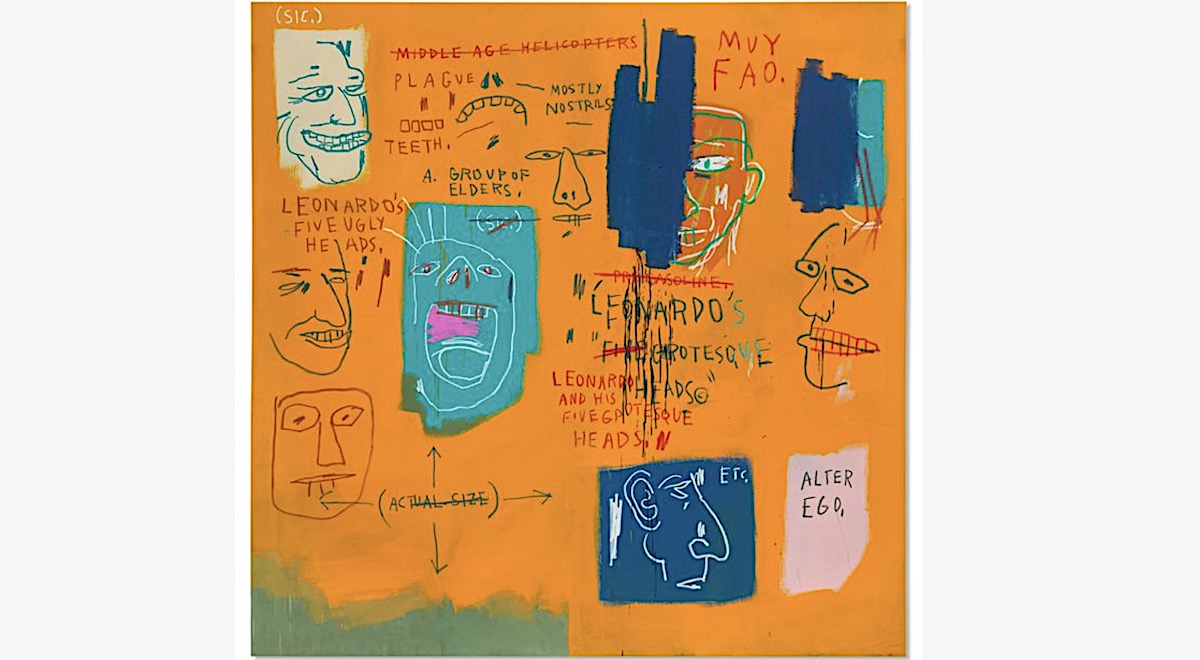
Christie’s will offer Jean-Michel Basquiat’s Untitled (Leonardo and His Five Grotesque Heads) in its 21st Century Evening Sale in New York on 19 November, part of the 20/21 Fall Marquee Week. The painting is estimated at around $30 million and is the top lot of the evening. It has been in the same private collection for more than twenty years and has not been seen in public since.
The canvas dates from 1983 and is large, a square measuring 84 by 84 inches (213.4 centimetres each way), in acrylic and oil stick. Its source is a Leonardo da Vinci drawing in the Royal Collection in the United Kingdom, made around 1493 and known as A Man Tricked by Gypsies, formerly Five Grotesque Heads. The sheet shows five male heads with twisted expressions and exaggerated features, and it is the most elaborate of Leonardo’s studies of the grotesque, the deliberate use of the distorted and misshapen as a counter to classical ideals of beauty.
Basquiat takes those five figures and puts them on a blazing orange ground, with passages of turquoise and royal blue, organised across a loose grid. Words sit beside the faces and the anatomical fragments. Among them are “TEETH.”, “MOSTLY NOSTRILS.” and “A. GROUP OF ELDERS.” In the bottom right corner, on a patch of pale pink, he wrote “ALTER EGO”, which points the whole exercise back at himself. Christie’s reads the painting as a challenge to the idea that some faces are universally unseemly, and as a question about who gets to decide what counts as grotesque.
Basquiat was a young Black artist in an overwhelmingly white 1980s art world, and the auction house argues that studying history helped him understand his own cultural situation. In a society marked by violence and racial injustice, it says, he used painting to question systems of oppression and to place himself within them. The Leonardo, then, is both a source and an opponent, a canonical figure from five hundred years earlier to be taken on directly.
Ana Maria Celis, Christie’s head of post-war and contemporary art, said few paintings show Basquiat so plainly wrestling with the weight of art history. She noted that he was drawn to Leonardo’s sketches from a young age, and that here he improvises on the older master while handling one of the canon’s most affecting themes. In her account, he reinvigorates the grotesque by setting it among the duplicities and excesses of New York in the 1980s. She called the picture a jewel in his output that has been hidden for twenty years, and the artist at his best.
A Basquiat on this level, from a long-held private collection and fresh to the public, is the kind of material that auction houses look for when they want a clear headline lot. A $30 million estimate puts it well within the range where serious competition tends to appear, though the house has not said whether the work carries a guarantee; the estimate is a guide, not a promise. The Leonardo link helps too. It gives the painting an art-historical argument that can be explained quickly, something specialists value when presenting a work to buyers who may be choosing among several expensive options in the same week.
The sale is planned at an optimal time in a busy autumn, following the London evening sales and the fairs in Paris, and Christie’s is clearly hoping that a rare, well-documented Basquiat will set the tone for November in New York. It is the sort of painting that is easy to describe and difficult to match, and that is probably the point.