
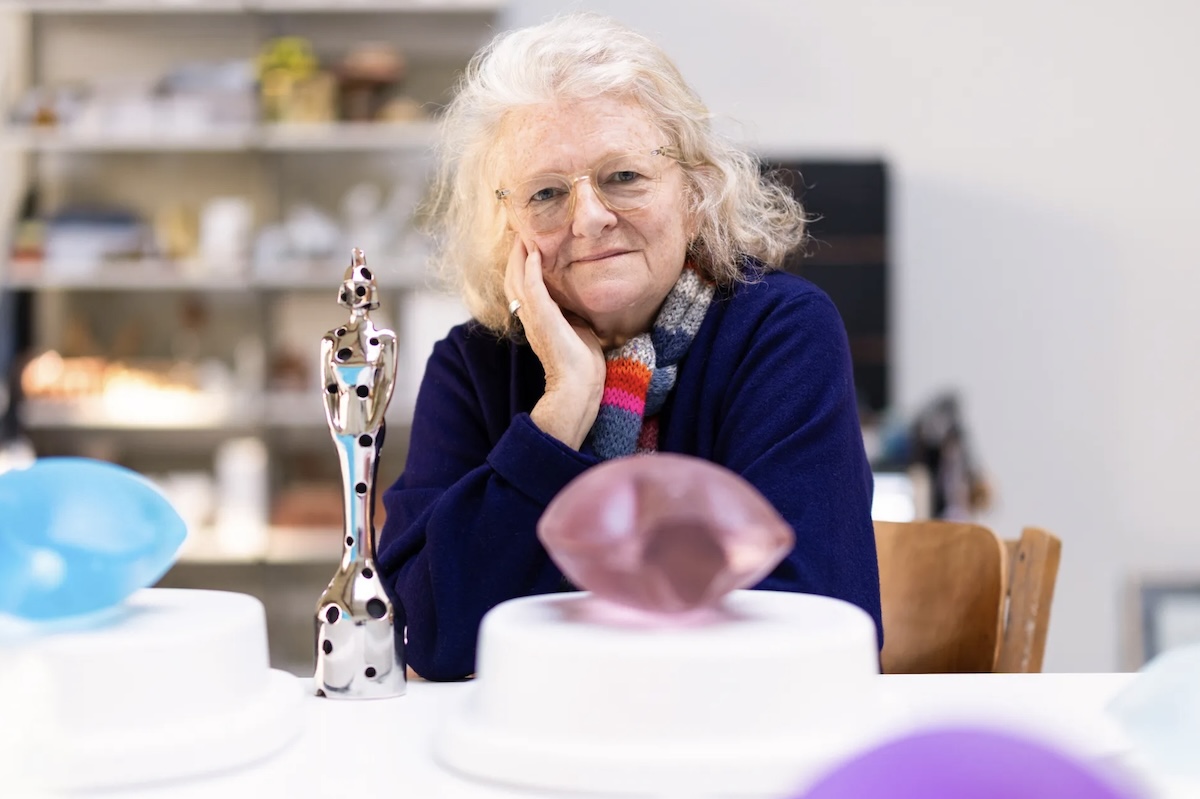
Winners in each category of the 2027 Brit Awards will be presented with a sculpture designed by Dame Rachel Whiteread. Much of her sculpture consists of negative spaces and voids; it seems very appropriate that she should be invited to produce an ‘inside out’ image of the traditional form. A stately, upright woman representing Great Britain, she has featured as the basis of all previous trophies for this award. Whiteread’s is the void inside such a figure, studded with a regular pattern of round holes all over, so all that remains of the original form is a thin layer of bright polished metal. More like an exposed outer layer of flesh than a smooth, unbroken surface.
In a statement, the artist says that, in creating music, performers and songwriters reveal something about themselves and their inner lives; in this sense, her trophy parallels this. So it was only right that she should want to mark others’ achievements and pay homage to this important aspect of British life and culture by interpreting its symbols.
However, she is also keenly aware of the need to champion the arts in general in the present-day climate, which she feels is very much under threat. She gives no further indication of what she has in mind, but plenty is going on to support her concern. Perhaps an incongruous context in which to make these points, but clearly Whiteread feels strongly about this.
As befits the occasion, much of her statement is devoted to eulogising the quality and range of music over the years represented by artists given this award, and to the ability of so many British songwriters and musicians to communicate so openly of their feelings, inspire and give optimism at times of despair, and encapsulate an experience or an emotion.
Many important artists have previously been invited to design the trophy for the occasion. In addition to Damien Hirst, Zaha Hadid, Es Devlin and Anish Kapoor, they include Peter Blake, Tracey Emin, Vivienne Westwood and Yinka Ilori. Few could surpass Whiteread’s CV in similar circumstances.
Winner of the Turner Prize in 1993, the first woman so honoured, she was the first female artist to be invited to represent this country at a Venice Biennale, in 1997, and was chosen in 2001 to make a work for the Fourth Plinth. This took the form of a resin negative of the plinth’s shape, placed on top of it. An unassuming work on the face of it, but highly impressive given its situation, and only the third work to be commissioned specifically for that position.
Producing positives from negatives, or otherwise revealing the hidden aspects of everyday forms, is clearly something that recurs frequently in her output, whether it is the outside of a house or the simple spaces under furniture. So it is a natural context in which to find this device again, albeit on a much smaller scale and to be displayed in many homes, as well as displayed proudly by the recipients.
How much thought and attention the actual award-winning artists and singers will give to its appearance and significance is hard to know. Most awards are hugged, pecked, and dangled in front of the press. However, all are, to some degree, examples of public-domain sculpture. And people’s relationship to and interaction with forms in their surroundings is very often central to her work. So perhaps it might encourage a little more contemplation than usual.
It would seem logical that the organisers of this popular event should wish to feature a link with modern artists and their work, via the changing designs of this figure. The interpretations range widely, from whimsical to minimalist. All will expect a very distinctive response from Whiteread: a pale, almost ethereal-looking woman.
Appropriate for an artist whose work evokes memories and voids, the figure is simultaneously occupied and empty. Many a musician will be leaving the building with a replica of her to look at in future.
Top Photo: Rachel Whiteread with the Brit Awards trophy she designed.Courtesy John Marshall – JM International and the Brit Awards