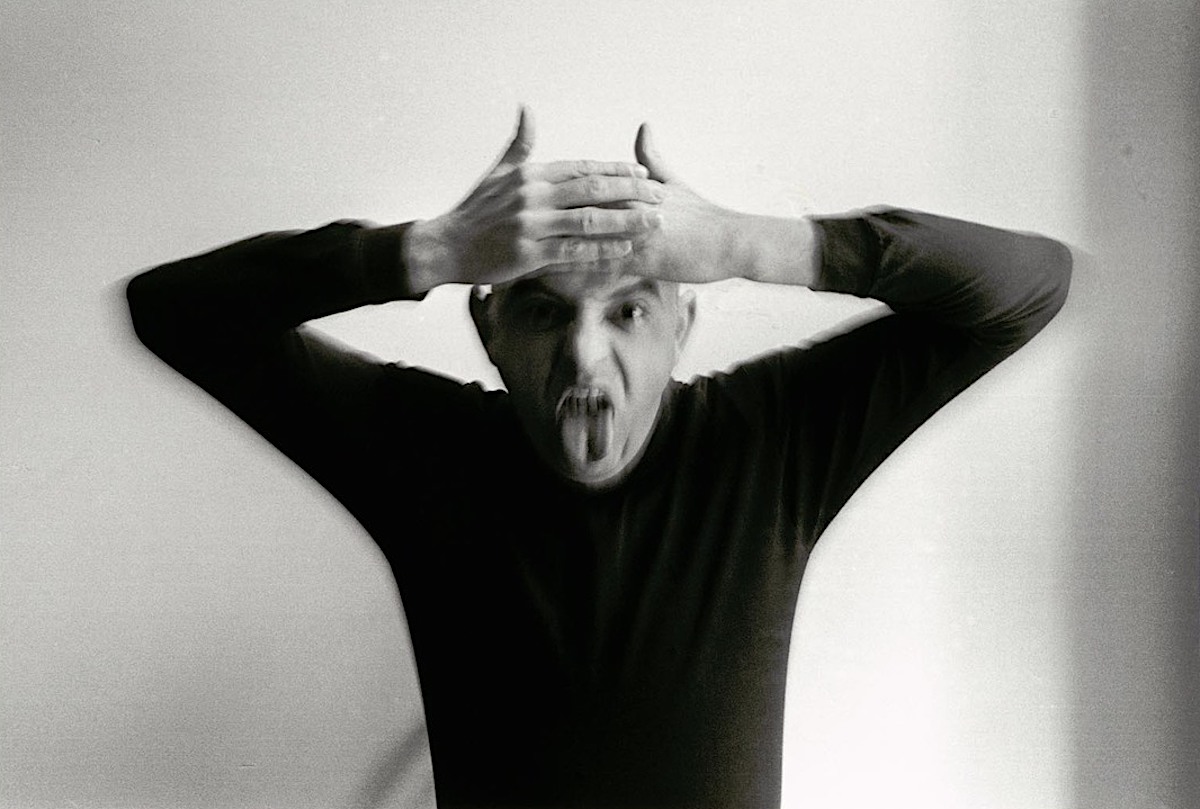
The photographer Duane Michals died on Tuesday in Manhattan. He was 94. His Death was confirmed by Bridget Moore of DC Moore Gallery, which represented him.
Michals was born in McKeesport, Pennsylvania, took art classes at the Carnegie Institute in Pittsburgh, and then got his undergraduate degree from the University of Denver in 1953. After military service, he moved to New York, studied at Parsons, and worked as a graphic designer. In 1958, he borrowed a camera from a friend and took it to the Soviet Union for three weeks. That trip is generally where his photographic life begins.
“I think photographs should be provocative and not tell you what you already know. It takes no great powers or magic to reproduce somebody’s face in a photograph. The magic is in seeing people in new ways.” —Duane Michals
His early work was documentary. Empty New York, made between 1964 and 1965, photographed the city’s deserted streets, subway cars, and lunch counters in a manner that recalled Eugène Atget’s turn-of-the-century Paris. The series was largely unknown until he published it as a book in 2018. By then, he had long since moved on. Atget led him toward Magritte, toward Cornell, toward de Chirico, and eventually he renounced documentary photography altogether. “To photograph reality,” he said, “is to photograph nothing.”
What replaced it was something more difficult to categorise. From 1966 onward, he began making multiframe compositions, sequences of black and white photographs structured like comic strips, accompanied by handwritten text in the margins. The prints were small. He might use four images to complete a piece or thirty. The writing was sometimes a caption, sometimes a title, sometimes something closer to a prose poem running beneath each panel. He started incorporating painting into the printed images in 1979. The work kept accumulating formal strategies without ever settling into a fixed method.
The subjects were mortality, sexuality, dreams, and the strangeness of ordinary and queer encounters. He drew on William Blake, Lewis Carroll, Joseph Cornell, and Magritte. Death Comes to the Old Lady from 1969 is a five-panel sequence with no text: a seated woman, then a man in a dark suit appearing at her side, blurring and dissolving into shadow except for his hand on her shoulder, and finally the woman herself rising and dissolving. He cast his grandmother as the Old Lady. His father played Death.
My Father Could Walk in the Sky, from 1989, is a double exposure of a naked man, seen from below, against a dark, starry sky, accompanied by rhyming couplets. “My father could walk in the sky / He promised to teach me how / But he left without saying goodbye / I don’t cry, I’m a grownup now.” The combination of formal simplicity and emotional directness was characteristic. “When I write,” he said in 2019, “it’s to talk about what you cannot see in the photograph. It’s to augment the photograph, to give voice to the silence of it.”
He was included in the landmark Contemporary Photographers: Towards a Social Landscape exhibition at the George Eastman House in 1966, and had a solo show at MoMA in 1970. Retrospectives were held at the Carnegie Museum of Art in 2014 and the Morgan Library in 2019. He published more than 25 books. Despite consistent recognition, his work never commanded high prices, which seemed not to trouble him particularly.
He was a self-taught photographer who belonged to no school and founded none. His influence was of the quieter sort, the kind that comes from demonstrating that it was possible to work entirely outside technical and genre conventions and still build a substantial body of work. He considered it an advantage that he had never been properly trained. “I didn’t know that you weren’t supposed to write on a photograph,” he said.