The trajectory of Eman Khalifa is as compelling as the paintings she produces. Her work – which she has recently exhibited at major contemporary platforms including The Other Art Fair, Parallax Art Fair and Untitled Art Fair – marks the steady evolution of an artist who has arrived at painting not through the conventional linear path, but through lived experience, reinvention and a sustained commitment to creative autonomy.
Khalifa’s return to art after a 30-year business career, undertaken while raising a family as a single mother, inevitably shapes the tenor of her practice. There is a sense of urgency and emotional directness and authenticity in the work that feels earned rather than constructed. Her paintings are not tentative explorations but confident assertions, grounded in a willingness to embrace risk, experiment with form, and allow intuition to guide process. What imbues her work with distinctive vitality is a refusal to separate life from art. Khalifa’s mantra for her art is
“Nature as a Language of Emotion. Art as a Totem of Identity.” – Eman Khalifa
Khalifa’s childhood and years of study were spent between Cairo and the United States, giving her a multicultural identity that influenced her artistic voice. Through her art, she seeks to reveal human nature through contemporary realism, abstraction, and immersive painterly environments. Guided by her philosophy of Artistry Without Limits, Khalifa begins with the emotions we are taught to hide and the parts of ourselves we are rarely encouraged to face. Drawing on nature, interior spaces, science, colour, and light as her visual language, she transforms memory, longing, and fracture into layered compositions. Her process is a form of excavation and emotional release, resulting in paintings that feel raw, fluid, and deeply alive.
Khalifa’s practice spans three interconnected bodies of work: Elemental Abstraction, Geometric Abstraction, and Contemporary Realism, each exploring distinct facets of human experience. Khalifa explores dualities such as control and surrender, stillness and rupture, or beauty and distortion in her art. She invites viewers into meditative spaces where feeling takes precedence over form. Ultimately, her work seeks to bring hidden emotions to the surface and reconnect us with our own humanity, reminding us that feeling is not weakness, but the clearest proof that we are alive.
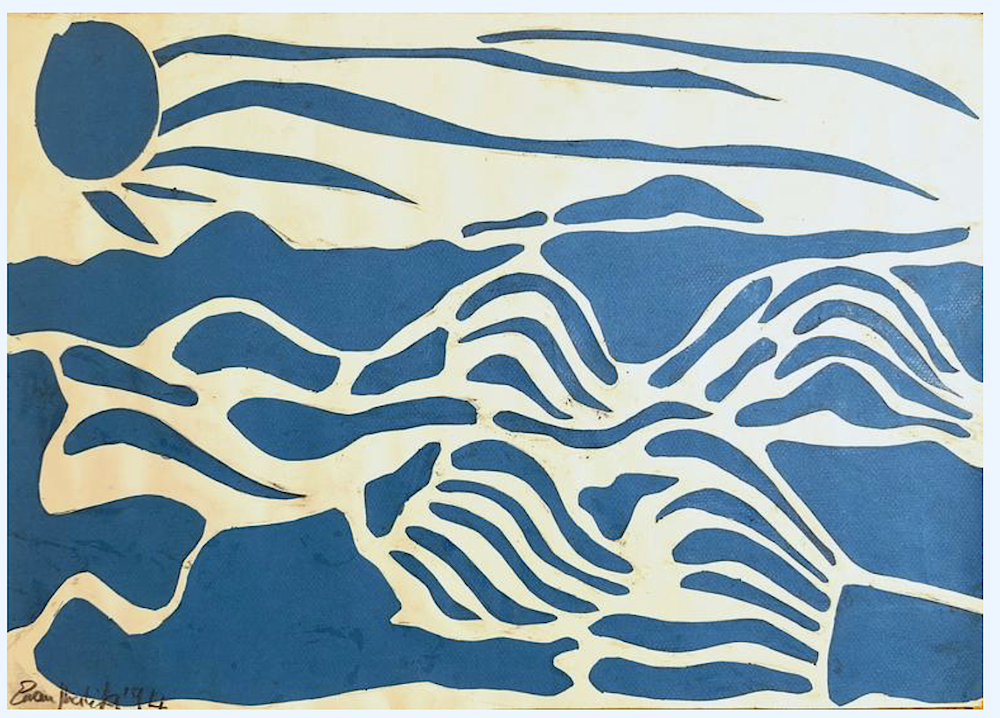
Eman Khalifa Blue Airwaves
Educated at the American University in Cairo under the guidance of Paul Rinaldi, Khalifa’s early training was rooted in observation and engagement with art historical precedents. The influence of painters such as Paul Cézanne and Johannes Vermeer is evident in her sensitivity to structure and light. At the same time, the dramatic tonal contrasts associated with Caravaggio are echoed in her more figurative and transitional works. Yet Khalifa’s practice does not rest comfortably within these traditions. Instead, it moves restlessly between figuration and abstraction, drawing also on the fractured planes and spatial reconfigurations of Cubism.
This hybridity is central to understanding the evolution of her work. Early pieces reveal a stronger attachment to form and representation, but over time, Khalifa has increasingly embraced abstraction as a primary language. Importantly, this is not an abstraction as an aesthetic endpoint, but as a means of articulating emotional and psychological states that resist literal depiction. Her paintings inhabit a space where structure dissolves into sensation, and where composition becomes a vehicle for internal transformation.
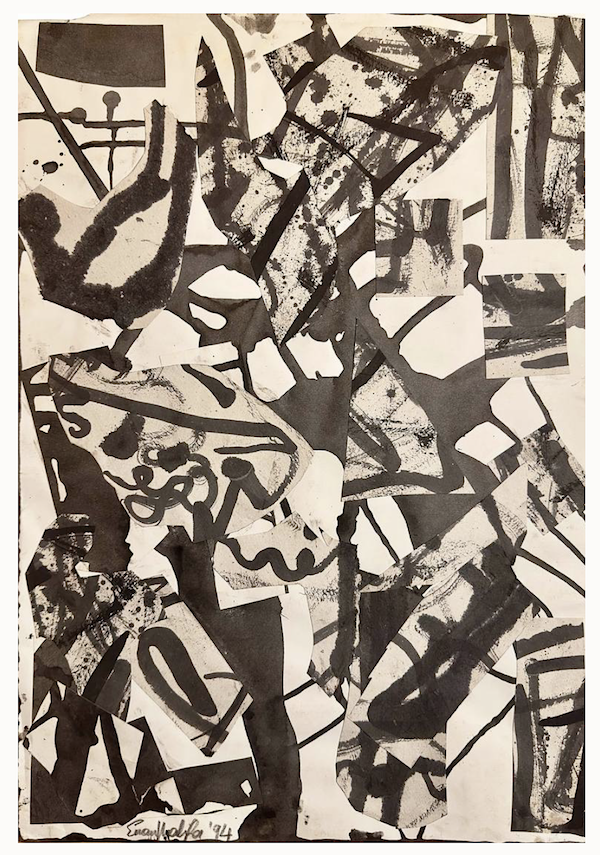
Eman Khalifa Fragments Of Memory
Khalifa’s participation in fairs such as The Other Art Fair, Parallax, and Untitled has played a crucial role in her evolution as an artist, providing a platform to test and expand her visual language in an international context. These settings, often characterised by their immediacy and diversity, seem well suited to an artist whose work thrives on engagement and dialogue. The transition from smaller, collector-focused pieces to larger, more ambitious canvases signals a growing confidence and a willingness to scale up both materially and conceptually.
The elemental framework that underpins much of her recent output, referencing water, fire, earth and light, serves as both subject matter and metaphor. Works such as Deep Wave and Good Hope demonstrate her sustained engagement with water as a symbol of depth, movement and emotional immersion. In Deep Wave, the fluidity of acrylic pour techniques creates a sense of continuous motion, pulling the viewer into a field that feels expansive yet claustrophobic.
By contrast, Good Hope captures a moment of poised stillness. Here, Khalifa exercises greater compositional restraint, allowing light to articulate form with a clarity that recalls her earlier engagement with figuration. Khalifa captures oscillations between movement and stillness in her paintings, which burst with rhythm.
Fire, as explored in Phoenix, introduces a different register altogether. The painting’s dynamic colour shifts and energetic surface suggest both destruction and renewal, aligning with the mythological symbolism of rebirth. Yet Khalifa avoids overt narrative, communicating the idea of fire through colour and a palpable energy that she captures on canvas.
Perhaps most compelling are the works that occupy an ambiguous space between abstraction and suggestion. Her painting Desire evokes floral forms emerging from darkness, yet resists settling into representation. The interplay of light and shadow, which seems to be derived from Khalifa’s love of Caravaggio, imbues the painting with a sense of drama. At the same time, the looseness of her mark-making prevents it from becoming illustrative. This tension between control and release is a recurring feature of Khalifa’s practice.
Khalifa’s use of colour is equally significant. Drawing on memories of her childhood in Egypt – in particular the luminous seascapes of Alexandria and Almaza Bay – Khalifa employs a palette that is both vibrant and deeply atmospheric. Turquoise blues, fiery reds and luminous golds recur across her work, not as decorative elements but as carriers of emotional resonance. The influence of Cairo’s chaotic, colourful markets, with their dense patterns and optical complexity, is evident in her layering techniques and her interest in visual rhythm.
Structure remains an underlying concern, even as Khaflia’s work becomes increasingly abstract. This can be traced back to her father, an engineer and poet, whose dual influence is reflected in her ability to balance precision with expressive freedom. In works like Tectonic and Glacial Drift, this manifests as a tension between order and disruption. The compositions suggest underlying systems – geological, emotional, or otherwise – that are in the process of shifting, fracturing, or reforming.
What distinguishes Khalifa’s practice is not simply its aesthetic range, but its emotional accessibility. While rooted in sophisticated painterly concerns such as composition, light and materiality, the work invites viewers to project their own experiences and interpretations. This balance between technical rigour and emotional immediacy is not easily achieved, and it is here that Khalifa’s maturity as an artist becomes most apparent.
Her journey from Cairo to London, from business to full-time artistic practice, adds a further layer of resonance. It speaks to the possibility of reinvention, and to the idea that artistic voice is not fixed but continually evolving. In Khalifa’s case, this evolution is ongoing, marked by a willingness to embrace uncertainty and to allow the work itself to dictate direction.
As her practice continues to develop and she prepares for forthcoming exhibitions, including the Sussex Art Fair at Goodwood, it seems apparent that Khalifa is an artist whose star is in the ascendant. Her work is situated at the intersection of abstraction, figuration and emotional expression, and offers a compelling contribution to contemporary painting.
In an art world often preoccupied with novelty, Khalifa’s paintings remind us of something more enduring: the power of colour, form and gesture to communicate the complexities of human experience.