
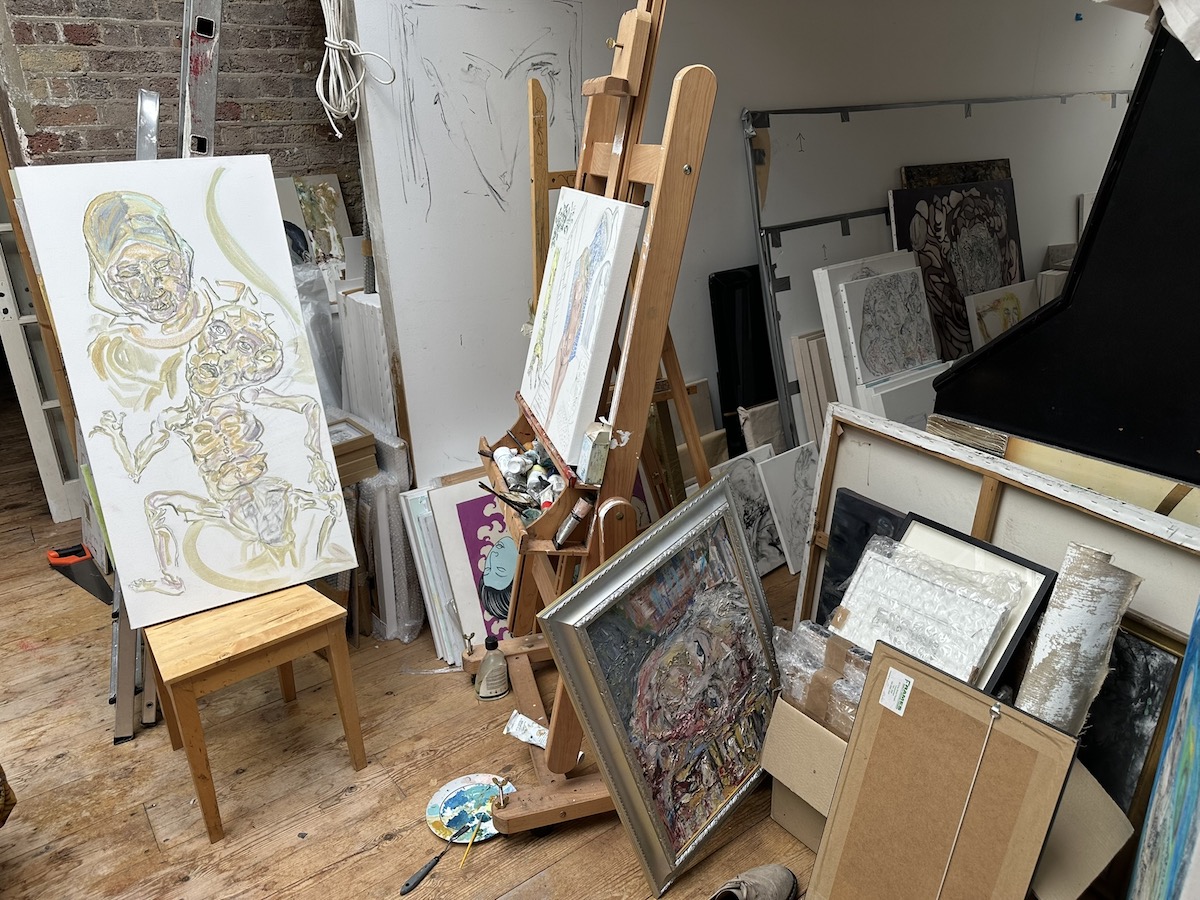
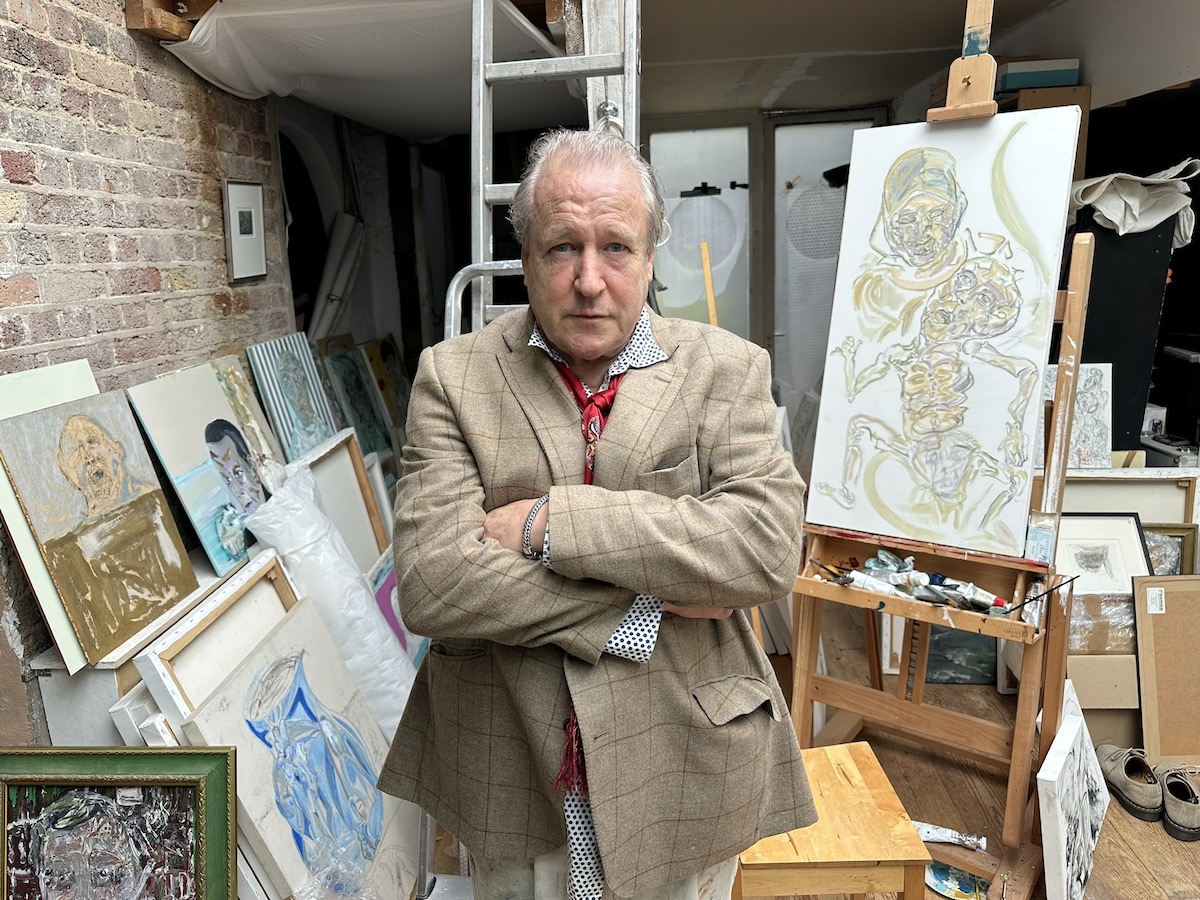
Paul Freud occupies a curious and compelling corner of British painting. Despite sharing a famous surname with his father, Lucian, he is an artist who has quietly built a language of his own.
Born in Paddington in 1959 and raised in the cultural sprawl of North London, he grew up with his mother, the dress designer Katherine Margaret McAdam, who added her own sense of visual discipline to the household.
Before he ever set foot in an art school studio, he spent the late ’80s studying sociology and psychology, disciplines that pressed him to look more closely at behaviour than appearances.
He attended Goldsmiths in the early ’90s, a battleground of ideas, home to installation and conceptual experiments. Freud’s decision to commit, almost stubbornly, to painting during those years wasn’t retrograde but radical in its own way.
His paintings, often described as psychological, aren’t weighed down by that label so much as illuminated by it. They probe, they study, they hesitate. There is sincerity here, also a quiet rigour that keeps the work from slipping into sentimentality. Freud’s drawings, too, carry the same charge: line as inquiry, gesture as diagnosis.
Across decades, he has held to the conviction that painting and drawing remain viable instruments for understanding the human condition. In doing so, he has carved out a steady, thoughtful presence within contemporary British art.
Did growing up in the Freud household shape your own relationship to art and creativity? If so, how?
My mother’s household was the Freud household, to me; my relationship with the Freudian side mainly came through regular visits by Lucie (Lucian’s mother, his father’s namesake). Editor’s note: Interestingly, Paul refers to the spelling of Lucien with an ’e’ instead of an a. I knew my father was a famous painter; however, being the son of Lucian never influenced me much in deciding whether I was going to become an artist. It was in the blood, you see, that rose early on, when I knew, by the joy of painting, that it was right for me… it gave me some security and a sense of purpose, and the promise of completion, where, eventually, choosing colours, the shade and the line, became my only truth. The inspiration and integral introspection I didn’t necessarily have access to in any other areas of my life. Lucian was myth and legend, so as a child he didn’t directly influence my art or my upbringing much, just a pat on the head requesting You go and get your mother with the Bentley S1 purring in the mist on the corner of Fernhead Road that contrasted to Norman Wisdom’s pat on the head from the open window of his Rolls Royce “One day son you can have a car like this” His parents lived on the same Road.
It was my mother’s belief in me that shaped my relationship to art and creativity. Watching my mother create patterns, cut fabric, and transform materials into beautiful, wearable pieces inspired me. Her name was Katherine; however, she was known as Kay.
Were there particular lessons or pieces of advice from your Dad that have stayed with you?
Yes, I showed him some paintings around 1990; he was very encouraging. There was one with a self-portrait in a cracked glass window, a clock on it. I remember having a lot of time, so I applied many layers of varnish over several months, and the floorboards looked exceptionally realistic and really quite exquisite.
I once heard Jeremy King, the restaurateur who knew my father, relaying the best piece of advice he’d ever heard from him. King lived a life attempting to be agreeable, as most do. And Lucian said something like, “No!” Jeremy! “Be selfish.”
To some, I’m sure it sounded harsh. But what he meant was: you can not steer your own ship if you’re trying to row everyone else’s. It’s not selfishness in the cruel sense; it’s self-direction with a resolute determination requiring an unwavering belief in your own ability and ultimate destiny. That way, you won’t be a cop on anyone else’s highway, and I suppose that is what I required for my own life. Once, after lunch with my father, we argued about his less-than-robust role as my father. Table tennis, as I denied he could do anything he wanted: “Yes, I can,” “No, you can’t,” etc. As I hinted, he had failed to protect me as a child growing up in the back streets of Paddington in the sixties. Then… He mentioned ‘A Boy Named Sue,‘ a song by Jonny Cash. I wanted to punch him. He’d just painted the Queen. I realised then that he could and did do anything he wanted, so, by implication, so could I.
He sent me a kind postcard saying that the cracking of the lobster at our dinner was enhanced by my realisation that I could indeed do anything I wanted. That education was priceless, and that lesson, so early on, was necessary for me and my beliefs, and I encouraged this in others, especially my children. This has stayed with me ever since I started to realise who I am. It took me a while. It could be said I only really realised it when presented with my father’s observation, the click of the lobster’s shell revealed my self, converting my anger into praise and pride. Lucien was self-assured in the life he wanted and was the most extraordinary man I had ever met. I was nervous to the point I could hardly eat in restaurants before that dinner at Wheelers; however, his presence calmed me somewhat. His enthusiasm, determination, and dedication to painting were much more than a passion or obsession; they were something else. One could say, some did say, the cost was too much for them. In one of his postcards to me later in life, he reminded me that I could do anything. The best gift he gave me was that Lucian never told me what to do or what not to do. He was a lousy father but quite a good painter.
How would you describe the central themes or preoccupations in your practice?
I am obsessed with transformation. Boundaries between states. Both physical and psychological. That is at the heart of it. The moment where something ceases to be one thing and becomes another, and the space between everything, even thoughts and spaces.
To get where I am, I’ve experimented with everything. Anything I could place on a canvas, I did. Getting into Goldsmiths with gold-leaf-covered dog shit was amusing; however, I was determined. It was a strange interview, although one look from Basil Beaty and I knew I was in. I started a life class at Goldsmiths involving circus performers that met a lot of opposition, but I persevered.
Recurring subjects for me have never gone away; figures that make up my body of work, like the stages of crucifixion and the Madonna and child, are not used from a religious standpoint, but as archetypes of transformation and suffering. In 2006, I became fascinated by an image of Pope John Paul II being wheeled onto the balcony of St. Peter’s Basilica during a moment I considered part of his death. He let out this cry — part agony, part transcendence, and part ecstasy of the cardinals in the background (one of whom would eventually replace him, of course), and I saw in that image the relationship between life and death.
For years after I worked through that moment, that scream, the departing, with paint, ink and charcoal. These figures are vessels through which I explore the transitions and contradictions of the human psyche. My practice, ultimately, is about that eternal passage — the shedding of skin to reveal the underbelly of the beast—the shadow side.
Can you walk us through your typical creative process from concept to finished piece?
‘Typical‘ might not quite fit the process. It’s more like a series of obsessions. It could begin with a piece of flint lying on the ground, or a torn billboard revealing the ghostly layers of unsold dreams beneath. A wood grain on a neglected floorboard that catches my eye, almost hypnotic. It could literally be the cut in a red cabbage that sets me off on a rollercoaster of creative-led obsession to capture the very secret of life itself. Do I stare at the half-cut red cabbage, or do I take the two steps to the studio to try to translate it through work? That is the real dilemma.
What materials or mediums do you find yourself returning to, and why?
Charcoal; hardwood briquettes, burnt wood, willow, barbecue remains. The simplicity and honesty of charcoal on white canvas are, in my opinion, unrivalled. It’s like language without adjectives, pure expression.
As a child, at six years old, I started with poster paints, primary-colour paint on bits of cardboard, and moved through gouache and tempera, even experimenting with tarmacadam at one point. Always returning, somehow, to the self-portrait, the line, the shading, and, let’s not forget, the frame.
I lost twenty years of work when my studio burned down — Valentine’s Day, 1999 — at the old Hartley Jam Factory off Tower Bridge Road. I was told to gather up all the charcoal remains and make an artwork from it, but I was too devastated at the time. The fact that in succession my grandmother, mother and Viennese analyst died all in the same year didn’t help. Charcoal is, in a way, rebirth through ruin. Maybe that’s part of the reason it’s now my go-to. Ashes to ashes.
How does your environment—whether a studio, city, or nature—inform your art?
Just like the weather, where I’m situated informs my emotion, and they, of course, influence whatever and however I’m trying to produce my work.
The city’s density, its constant noise and negotiation, often seeps into my canvases. This is contrasted by its opposite, when a subject is taken and stripped away, repurposed within my studio space, and just is.
My work weaves between excess and minimal line. The middle ground is of little importance to me. Sometimes the painting demands everything, all of the noise of the city and the mind, and sometimes it needs barely anything but a careless whisper. It is about finding the delicate point where gesture can communicate meaning. A mark, a defiance of reality. A brush stroke, a perfect moment in a perfect day.
Are there particular artists, movements, or cultural influences that inspire you today?
I’ve got a book of Egon Schiele, by the bed. There is and always will be Francis Bacon, although I admire Turner and Gainsborough for different reasons.
How do you balance spontaneity and structure in your work?
It balances itself. Although I do battle when I find it constantly veering on the side of spontaneity. Given a deadline, I like to perform after it’s gone. Although that being said, if you understand structure, you understand freedom.
How do you approach narrative, symbolism, or abstraction in your pieces?
In the late ’90s, I realised I needed to build narrative through structure and repetition. Maybe there was a part of me that wanted my future audience to be able to identify with me, for my work to relate to each other and be recognised as my own. My first was the Lady Di series, then the Pope series, and so on. First twenty. Then two hundred. They gave me boundaries, a kind of internal scaffolding. Within that, I could go completely off-piste, but always with a thread running through. I needed that thread, and by the time I realised it was there all along, it was gone.
I’m drawn to figures who carry deep collective and/or individual symbolism, those who can embody the extremes of human experience. The human condition is the thread that connects. I often abstract them until they become universal, from individual to myth. In that tension between the individual and the collective, I find the story I want to tell.
Looking ahead, are there new directions, techniques, or themes you’re excited to explore?
Right now, I’m trying to quantify and organise what I’ve already done. I’ve been making so much work for so many years; I want to spend some time processing it. That being said, there are always new obsessions that crop up.
There’s a huge canvas in my studio — it began in 2004, titled The Road to Damascus. It’s been evolving for years, almost like a living thing. I would like to make three more, a series of four.
What do you have planned for the near future?
It’s all about timing. I’ve kept everything close to my chest for many years now, but I am ready for my work to go out into the world in a new way. Earlier this year, I was introduced to Shahbaz Afridi of the Afridi Gallery in Royal Hospital Road, Chelsea. By chance, he had just acquired a second gallery space with plans to show works by Contemporary artists. We met, we spoke, and there is a very positive synergy. At the moment, I am collaborating with him to organise exhibitions of my works. I’d also like to mention a good friend and fellow artist Olivier Mourao who I exhibited with in Paris. I also have talks and plans to have an exhibition in China with a major Chinese curator, Xiaojuan Sun, organised by Qiongzi Zhu. I’ll be at The London Art Fair in January, represented by Cole-Levi Klimt, curated by Chelsea Chase. So all in all, for someone who doesn’t tend to plan, a lot is coming up.
Paul Freud Interviewed by Paul Carter Robinson © Artlyst 2025
Photos © Artlyst 2025