
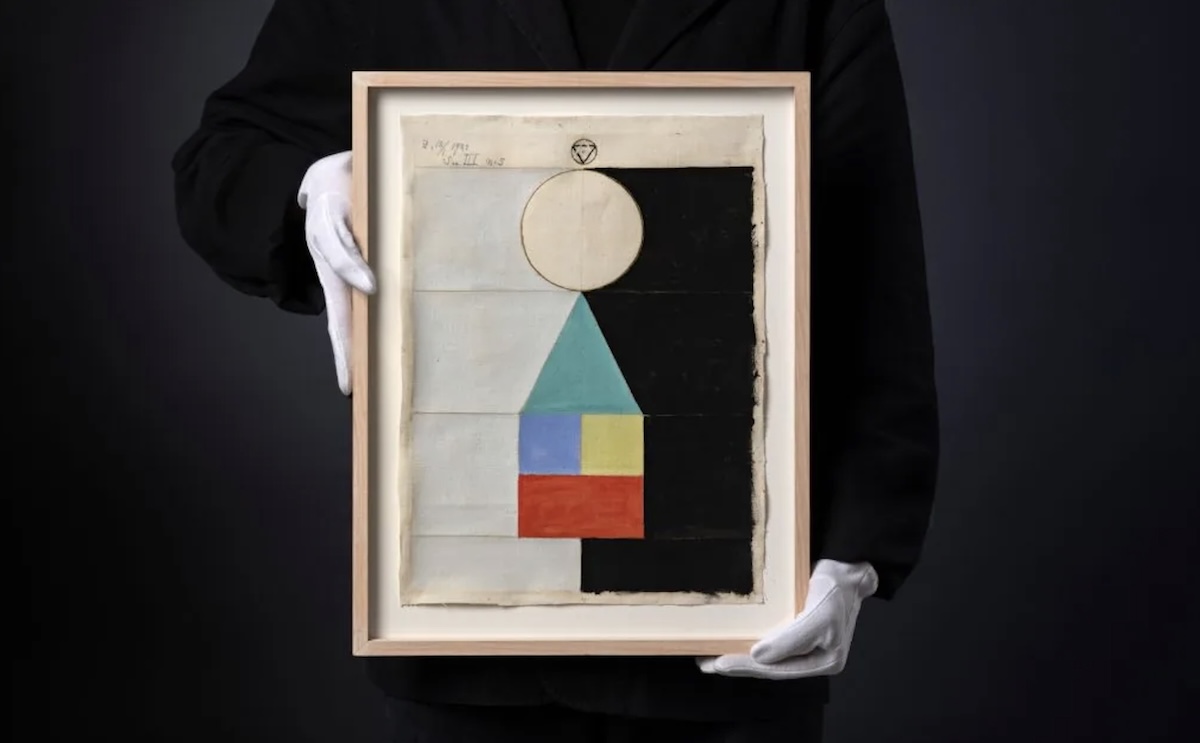
An abstract painting by Hilma af Klint is coming to auction. On 19 November, Bukowskis in Stockholm will offer Ser III No. 5, made in 1920. The estimate is SEK 6 million to 8 million, or $600,000 to $800,000. Abstractions by af Klint rarely reach the market. Her foundation holds the non-figurative work and keeps a firm hold on it. Bukowskis says only two of her abstract paintings have been sold at auction before, both more than thirty years ago. This one is rare for that reason alone.
It is small, intimate and dense with symbols. The painting belongs to a group known as Serie III—geometric forms cross and overlap, borrowed from the esoteric ideas that shaped her thinking. Number 5 is about balance: a white and a black ground set light against dark. Blue and yellow squares stand for the feminine and the masculine. A circle sits atop a green triangle, a nod to the seal of the Theosophical Society.
Louise Wrede, Bukowskis’s head of art, spoke at a preview at Bonhams in New York. These are among the last canvases af Klint made, she said. After them, she turned to watercolour on paper and a more anthroposophical manner. The painting was made in a short burst at the start of 1920. In a few intense months she produced 85 small, bold geometric works. The art historian Åke Fant has described her pace as close to a new picture each day. She was studying the atom in transformation, and the astral side of plants, and she saw forms appear on the canvas from those inner experiences. By 12 March she had finished the last abstract canvas she would ever paint. After a break of just over a year, she left geometry behind and travelled to Dornach, in Switzerland, where Rudolf Steiner had founded his Anthroposophical centre.
The painting has a good record of travel. While under the care of the Hilma af Klint Foundation, it appeared in a string of shows. One was The Spiritual in Art, the landmark exhibition at the Los Angeles County Museum of Art. That show is generally dated to 1986. Af Klint’s abstractions caused a stir there, though little was known about her. The painting was also in the first af Klint retrospective, which opened at Moderna Museet in Stockholm in 1990. It passed into a private collection in 1995.
Her story is unusual. Af Klint was among the first generation of women to study at the Royal Academy of Fine Arts in Stockholm, between 1882 and 1887. She began with portraits, landscapes and botanical studies. Then she turned towards spiritualism. In 1896 she formed a group called The Five with Anna Cassel, Sigrid Hedman, Cornelia Cederberg and Mathilda Nilsson. They held regular séances and believed they were in touch with beings they called the High Ones. Af Klint felt she had been given a huge task: The Paintings for the Temple. From 1906 to 1915 she made 193 works for it, built from colour, script and symbol. Few people saw them.
That secrecy is the heart of her market story. Kandinsky exhibited, published and taught. Af Klint did not. Her abstract work stayed out of view for decades, and it took more than forty years after her death in 1944 for it to be shown in public. When the world did notice, interest grew fast.
Two exhibitions drove it. Moderna Museet staged a blockbuster in 2013, and the Guggenheim followed in 2018 with Paintings for the Future, which drew more than 600,000 visitors. Wrede says demand has climbed since then, mostly for her earlier figurative work. That is where collectors can actually buy.
The numbers tell the story. Her auction record was set in 2019, when the abstract watercolour Mjältens kraft, from 1931, made about $165,825 at Stockholms Auktionsverk. The market then cooled. It rebounded in 2025 and 2026 as several early works came up. Last year, Bukowskis sold a figurative studio interior for $118,660, her second-highest price. This June, her portrait Girl in Folk Costume, from 1890, brought about $80,090 at Stockholms Auktionsverk, her third-best result.
Now comes the gap. If Ser III No. 5 sells within its estimate, it clears the old record by a wide margin. Even the low figure of $600,000 would more than triple it. That is a steep jump, but this is an unusual object. It is a true abstraction with a clean exhibition history, and it comes from one of her most concentrated months.
Early reaction has been positive, she says. The painting can be seen at Bukowskis in Stockholm from 12 to 17 November. Af Klint is now treated as a central figure in early abstraction, alongside Kandinsky, Malevich and Mondrian.
Top Photo: Hilma af Klint, Ser III No. 5 (1920). Photo courtesy of Bukowskis.