

When two employees from Elon Musk’s Department of Government Efficiency (DOGE) walked into the National Endowment for the Arts last March, they did not bring any knowledge of the cultural and scholarly work the agency had supported for six decades. What they had was a ChatGPT account and a mission.
According to the New York Times (1), the prompt they used was absurd: “Does the following relate at all to DEI? (Diversity, Equity, and Inclusion) Respond factually in less than 120 characters. Begin with ‘Yes’ or ‘No.'” From this exercise in algorithmic box-ticking came the justification for cancelling over 1,400 previously approved grants, stripping more than $100 million from organisations, archives, museums, and community arts projects across the United States. Musk served as head of the Department of Government Efficiency (DOGE) for about five minutes, quitting in May 2025. While he was not fired, his departure followed a public rift with President Trump and the expiration of his term as a temporary government advisor. Hummm…
Since its creation in 1965, the endowment has awarded more than $6.5 billion to support over 70,000 projects, from landmark works like keeping the Smithsonian and National Gallery running, supporting the JFK Centre, and the Library of Congress, to small local cultural efforts in every corner of the country. Grants are awarded through a rigorous competitive process involving multiple rounds of scholarly review. Cancellations for political reasons were, until now, essentially unheard of.
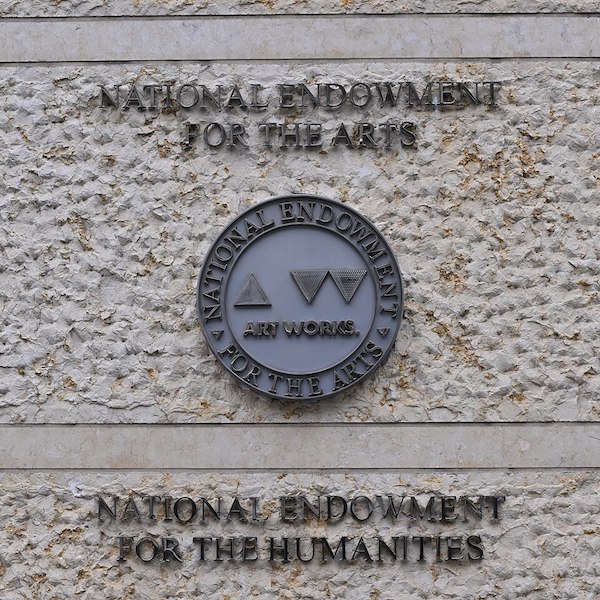
NEA and NEH sign, Washington, DC Photo: . Edward Johnson Courtesy Wikimedia Commons
What the documents filed in two lawsuits now reveal is an operation that combined political opportunism with remarkable carelessness. Justin Fox and Nate Cavanaugh, the two DOGE operatives who arrived on 12 March 2025, acknowledged in depositions that they had no background in the humanities or the arts. Using ChatGPT to scan grant summaries pulled from the internet, Fox assembled a spreadsheet flagging over 1,000 so-called problematic awards within days. By the end, only 42 grants approved during the Biden administration survived.
The results of the AI triage were, at times, genuinely difficult to comprehend. A long-running project to digitise historical Black newspapers and add them to a historical database was deemed DEI. A 40-volume scholarly series on the history of American music was marked for termination. A documentary about Jewish women used as slave labour during the Holocaust was caught in the net because, as Fox later explained in his deposition, it was “specifically focused on Jewish culture and amplifying the marginalised voices of the females in that culture.” An Alaskan archive preserving Indigenous languages was flagged because building improvements to the facility risked “promoting inclusion and diverse perspectives,” as reported in the NY Times.
Even the papers of Thomas Gage, a British general from the American Revolutionary era, did not escape. ChatGPT decided that cataloguing and digitising them amounted to “promoting inclusivity and diversity in historical research.” Meanwhile, scholarly editing of George Washington’s papers was spared, deemed acceptable under the administration’s America First priorities.
Fox later compiled a personal list of what he called the “craziest” grants, which he planned to post on DOGE’s X account. His search terms included “LGBTQ,” “BIPOC,” “tribal,” “ethnicity,” “gender,” “equality,” and “immigration.” A majority of the two dozen grants he flagged as the craziest were related to LGBTQ topics. He described the list as reflecting his “subjective” judgment, before conceding that “most incriminating” might be another way of putting it.
The plaintiffs in the two lawsuits, which include the American Historical Association, the Modern Language Association, the American Council of Learned Societies, and the Authors Guild, argue that the cancellations reflected deliberate animus toward scholarship about particular groups and that the entire exercise discriminated based on race, ethnicity, gender, and other characteristics. They are asking for the grants to be reinstated and for the public record to reflect the methods and motivations behind what they see as a fundamental betrayal of the agency’s founding purpose. That legislation, passed in 1965, described the humanities as belonging to all Americans and committed the endowment to respecting “the diverse beliefs and values” of the country it serves.
Sarah Weicksel of the American Historical Association was direct: the federal government is now signalling that only a narrow definition of the arts and humanities is worth public investment, and only a narrow set of people, cultures, and experiences are considered worth understanding in depth.
The agency has continued funding some of what it has long supported, including archival preservation, museum exhibitions, scholarly editing, and public history projects. But the direction has visibly shifted. In January, it announced $75 million in new grants, with over $40 million directed toward conservative-leaning classical humanities institutes, many of which were invited to apply rather than go through the open competitive process the endowment had long relied on.
Joy Connolly of the American Council of Learned Societies told the NY Times, “It made the stakes of that shift concrete, pointing to the extraordinary box-office success of Ryan Coogler’s film, Sinners, which has taken in nearly $280 million domestically. The film draws directly on generations of humanities research into the history of American music and slavery. It wasn’t just whipped up overnight with ChatGPT,” she said. Americans want this stuff. They pay to go see it.
The arts do not exist in isolation from the research, archival work, and cultural scholarship that feeds them. Documentaries, historical dramas, music, literature and public exhibitions all draw on the kind of patient, unglamorous institutional work that the endowment was created to support. When a chatbot eliminates that work after a 120-character prompt, the damage does not remain confined to academia. It eventually moves into all cultural spheres.
(1) When DOGE Unleashed ChatGPT on the Humanities By Jennifer Schuessler 7 March, 2026