
Nearly twenty years after her last solo exhibition with a commercial gallery, Alexandra Baraitser returns with I Just Gotta Do It at Tiderip’s new space on Percy Street. Recently relocated from Battersea, the gallery begins its next chapter by bringing Baraitser’s long-standing practice back into public view.
When asked about her artistic practice, Baraitser said, “I’ve just got to do it, and I sort of feel better after I have.” This instinctive desire has sustained her practice over three decades of painting. Born in Cape Town, South Africa, in 1971, Baraitser has followed an unusual path as a professional artist. Shortly after graduating with an MA in Painting from Chelsea College of Art, she exhibited at the Barbican Centre and in the John Moores Painting Prize in 1996, received the Abbey Scholarship in Painting at the British School at Rome in 1996 and 1997, and was named a finalist in the NatWest Art Prize in 1998.
Following The Future Past, her 2007 solo exhibition with Mark Jason Gallery, Baraitser continued painting at a distance from the commercial art world, allowing her practice to evolve alongside her everyday life. Now, she revisits a subject that once defined her work: designed objects. Bringing new perspectives and techniques to a familiar theme, she re-examines the shifting relationships between design, photography and painting.
I Just Gotta Do It opens with a room of typewriters, a subject that came to Baraitser in the past year. Though no longer household staples, typewriters remain rooted in personal and generational memory. Their practical function may have diminished, but their cultural significance remains widely recognised. By depicting objects associated with communication with the outside world, Baraitser invites audiences to understand the world through her lived experience.
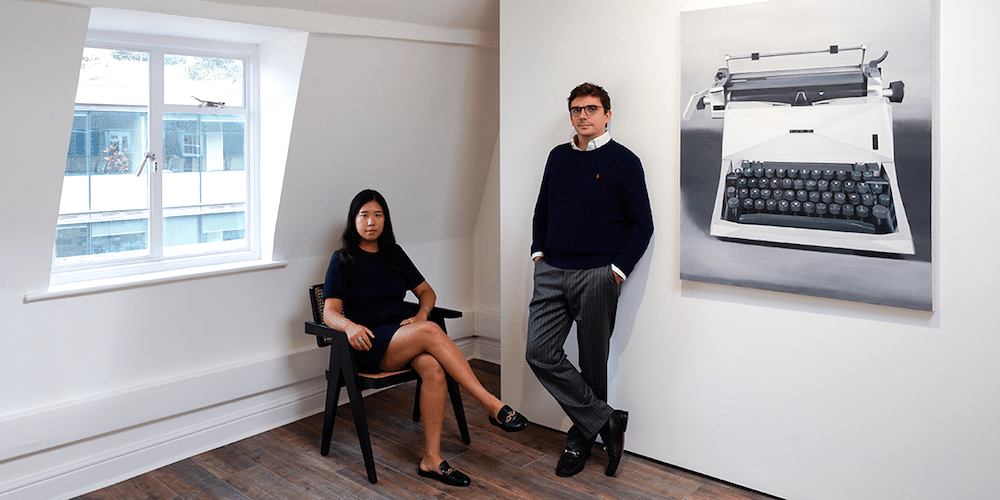
Tiderip founders Marjorier Ding and Louis Jacquier, with Typeface (2026) by Alexandra Baraitser.
Baraitser’s creative process has remained largely consistent over the past three decades. She begins with found images of designed objects, often sourced from old magazines or catalogues, and develops her paintings from them. She now uses computer software more extensively to research and alter these images, giving the works a surreal, retro-futurist quality. The typewriter paintings are based on existing models: Typeface depicts the British Olivetti 82 Vintage Manual Typewriter, while Typing Test draws on the Olivetti Studio 45 Manual Typewriter.
Compared with the precision of her earlier work, Baraitser’s brushstrokes are now looser, with parts of the paintings intentionally blurred. By subtly altering details such as the keys and labels, she shifts attention away from the typewriters’ function, transforming them into objects suspended between memory, image and painting. Her practice explores how painting can be reinvented, and how it relates to design and photography.
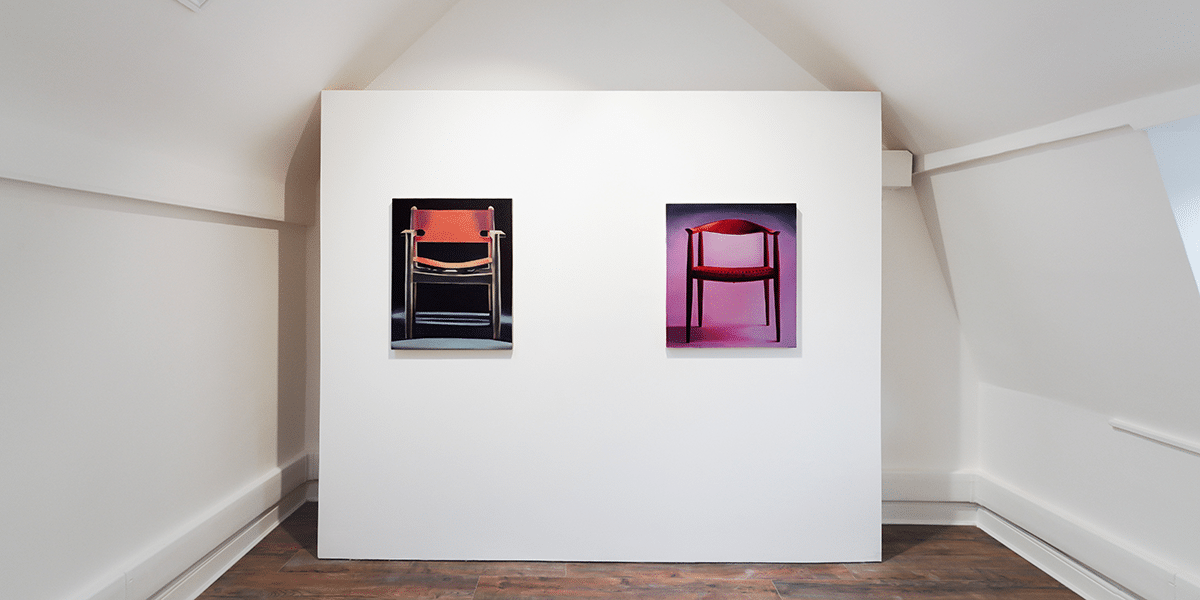
The second room returns to Baraitser’s first recurring subject: designer chairs. It brings two recent works into conversation with an earlier piece. Bellini Side Chair 1 (2006), also shown in her last solo exhibition, hangs opposite Evolution of the Chair (2026) and Vignette (2026). In all three paintings, a single chair sits at the centre of the canvas, treated with a visual language reminiscent of monumental portraiture.
The compositions reveal Baraitser’s enduring interest in design, while the palette shows how her work has changed. Like many of her earlier furniture paintings, Bellini Side Chair 1 uses a black-and-white gradient, with carefully modulated shades that create a sense of space and light. In her recent works, she uses brighter, richer colours. The arrangement of the paintings makes this shift especially visible.
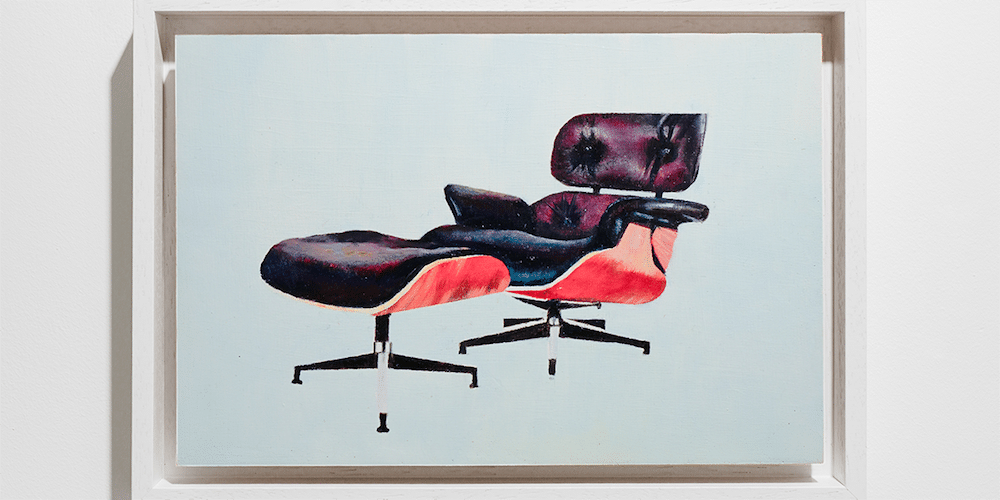
Eames and Co (2026) by Alexandra Baraitser.
The exhibition concludes with three smaller works. In Eames and Co and New Orange, radiant, semi-translucent colours create a sense of lightness and warmth. Experimenting with colour allows Baraitser to bring a more personal feeling to the images. She has also begun exploring interior design. In Upstairs, Downstairs, a more complex structure and elaborate composition create a sense of mystery.
At this stage of her life and career, Baraitser is increasingly comfortable taking risks. She experiments with the images she collects, pushing them further towards abstraction. Yet the instinct that has sustained her practice remains unchanged. Painting has continued through different periods of her life, sometimes within the commercial art world and sometimes at a distance from it. I Just Gotta Do It feels less like a return than a continuation: a practice that never really stopped, but has gathered new possibilities through time and experience.
Exhibition preview by curator Yiran Zhu.
Alexandra Baraitser I Just Gotta Do It 7th October – 7th November 2026 Tiderip 17 Percy Street, London W1T 1DU