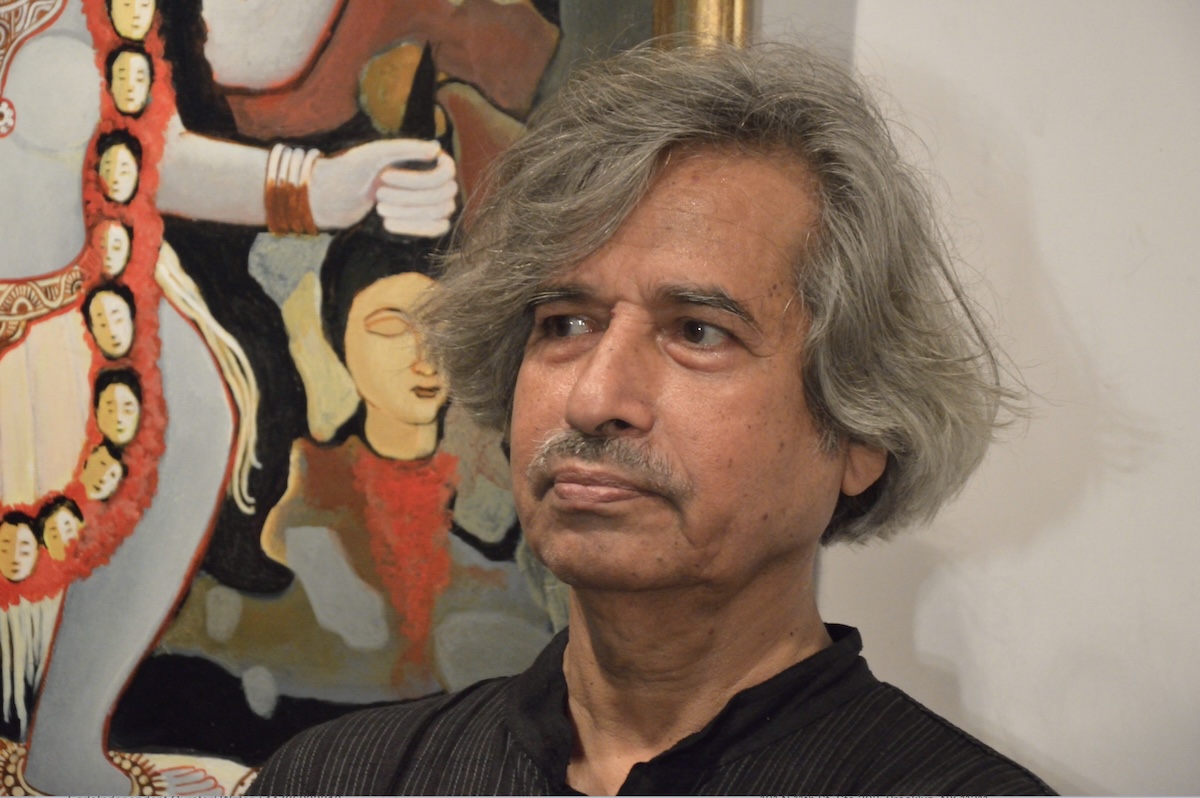
Jogen Chowdhury, one of India’s leading modern painters, died on October 25 at a hospital in Kolkata. He was 87. Indian media report that he had been fighting a rare blood cancer for more than a year.
Tributes were paid quickly. The West Bengal chief minister, Suvendu Adhikari, wrote on X that Chowdhury’s legacy would outlast the ages. He described him as a pillar of the region’s cultural life. The Kolkata painter Samir Aich called the death a personal loss. For him it also marked the closing of a chapter for the Bengal School of Art.
That school began in the early twentieth century in Kolkata (then Calcutta) and in Shantiniketan, under British rule. It pushed back against the Western realism that dominated art teaching at the time. Its painters instead looked to Mughal miniatures, pastoral subjects, and the meeting of history with myth. Hints of Cubism and Japanese modern art crept in through the lively exchange between India, Japan and Europe. The red earth around Shantiniketan, where Chowdhury kept a home, fed the work too.
Line was his gift. He drew with a tactile, expressive hand and built his figures through dense cross-hatching. Bodies bent and swelled under his pen. They drifted toward caricature, but never mockery. The distortion was a way of showing what goes on inside a person.
The critic R. Siva Kumar saw decorative wilfulness and expressive distortion working together in the figures, along with a strong current of sensuality. Chowdhury’s art, he wrote, is rich in suggestion. It resists being turned into a story without losing its sensory detail.
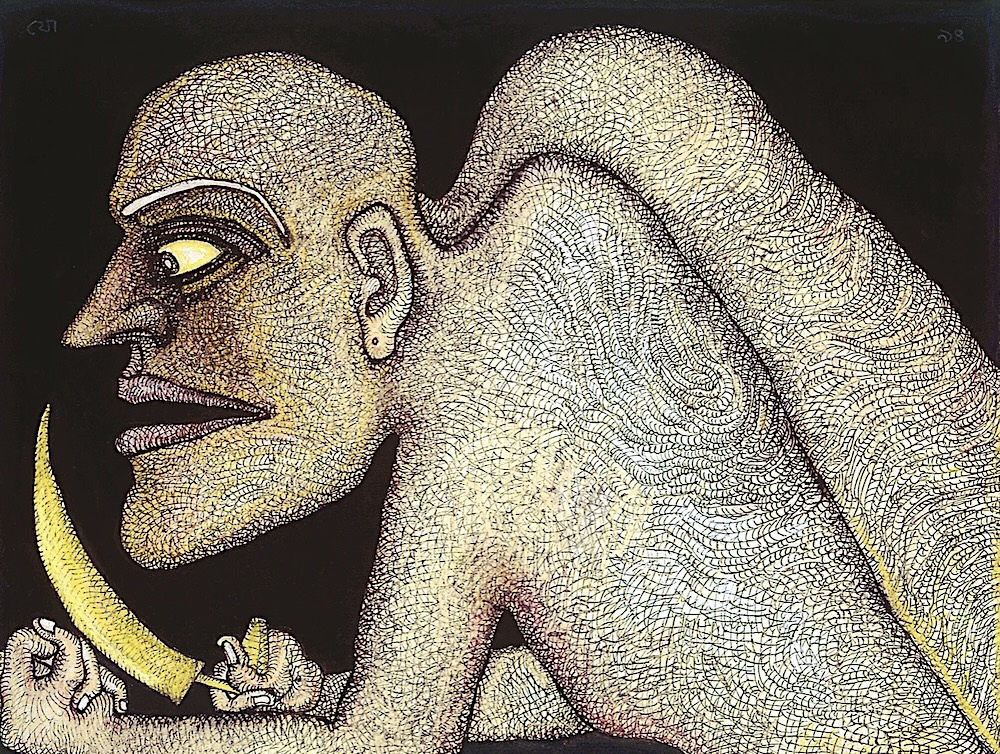
Jogen Chowdhury Yellow Knife, 1994
Chowdhury was born on February 16, 1939, in Daharpara village in Faridpur, then part of undivided Bengal. Bengal was partitioned along religious lines in 1947, after an earlier attempt in 1905. He remembered a creative, aristocratic childhood. His mother was known for her Alpana drawings. His father painted and made sculptures.
He enrolled at the Government College of Art and Craft in Kolkata in 1955 and stayed until 1960. In the 1960s, he went on to the École Nationale Supérieure des Beaux-Arts in Paris. He returned to India in 1968.
In 1972, he became a curator at the Art Gallery of Rashtrapati Bhavan, the president’s official residence. Politics came late. In April 2014, he won a seat in the Rajya Sabha, India’s upper house, for West Bengal’s Trinamool Congress. He served until April 2020.
Honours came regularly. He won the Prix de la Jeune Peinture in Paris in 1966 and was recognised at the Second Havana Biennial in 1986. Madhya Pradesh gave him the Kalidas Samman in 2001. In 2012, West Bengal awarded him the Banga Bibhushan, its highest civilian honour.
Top Photo: Wikimedia Commons Author Biswarup Ganguly