
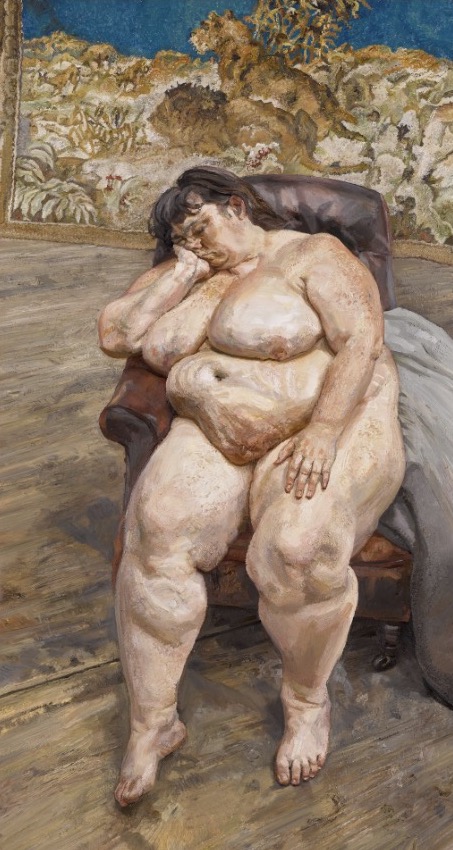
Lucian Freud’s final and most ambitious portrait of Sue Tilley (AKA’ the benefits supervisor’), completed in 1995 after nine months of sittings in his Holland Park studio, is to be offered at Sotheby’s. The painting has appeared in every major survey of his work and occupies a central place in any serious account of twentieth-century figurative painting. Yet it has never been offered for public sale. Since Joe Lewis acquired it directly from Freud’s gallerist, Bill Acquavella, in 1996, the painting has been part of the Lewis Collection, one of the great private accumulations of modern figurative art, seen by the public only in museum contexts. In June, it comes to Sotheby’s London with an estimate of £25 million to £35 million.
The work belongs to a series of four monumental canvases that Freud painted of Tilley between 1993 and 1996, works that critic Martin Gayford has described as among the most important paintings of the human figure ever made. Of the four, this is the one Gayford singles out as the most important Freud ever painted, a judgement that carries weight given how closely he followed the artist’s practice. The last time a major work from the series came to auction was 2015, when Benefits Supervisor Resting sold at Christie’s New York for $56.2 million, setting a record not only for Freud but for any living artist at that moment. The painting, now heading to Sotheby’s, has never had a market price attached to it. Whatever it achieves in June will be the first indication of where the market places what many consider the series’s definitive statement.
Lucian Freud Benefits Supervisor Sue Tilley To Be Auctioned At Sotheby’s
Sue Tilley came into Freud’s world through Leigh Bowery, the performance artist and nightclub impresario who features in several of Freud’s paintings from the early 1990s and who had a gift for introducing people to each other in ways that seemed accidental and were entirely calculated. Tilley worked days at a local job centre and nights at Bowery’s club Taboo. Bowery thought Freud should paint her, and engineered a lunch at the River Cafe to make it happen without letting Freud know it was engineered. “He knew he had to put the idea into Lucian’s head so he’d think it was his own idea,” Tilley recalls. It worked. What followed were months of sittings, conducted with the intensity he brought to all his subjects, and he insisted on Tilley’s presence even when she asked whether he might paint the floorboards without her. “I just can’t do it when you’re not here,” he told her. “I need your aura, your presence affects everything, the colour of your skin affects the floorboards. It’s all connected.”
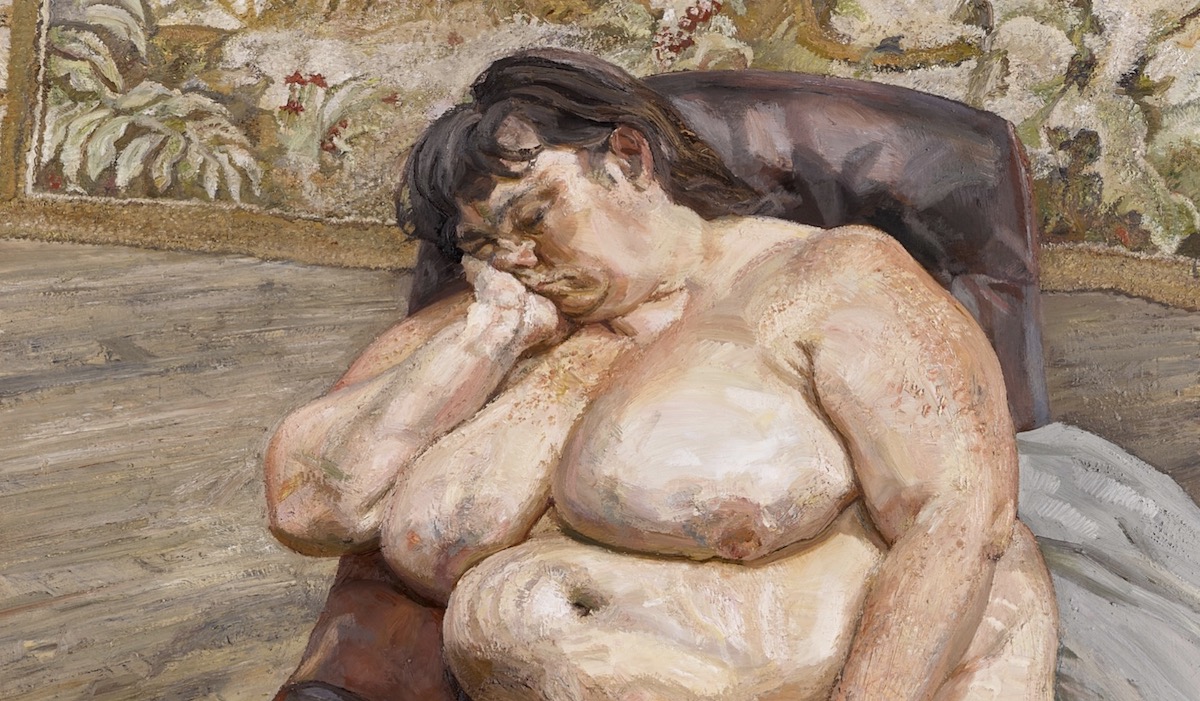
The resulting painting shows Tilley asleep in a leather armchair, her body filling the chair and the eight-foot canvas, her arm resting on the armrest, her head resting heavily on her hand. Freud works across the full surface with a technical range that moves between flecks, scumbling and broad brushstrokes, building a surface of extraordinary variety and depth. The colour spectrum runs from the purple of her heels to the red of her belly, from the rose of her tanned shoulders to the pale translucent cream of her breasts. Tilley is at once monumental and, in the oblivion of sleep, completely vulnerable, a combination that gives the painting its particular emotional charge. Above her, in the lion carpet of the title, a lioness stands guard over a sleeping lion. The symbolism is quiet and entirely apt.
The carpet itself has its own story. Knowing he needed a shock of colour to lift the painting’s warm, earthy tones, he found what he was looking for on a market stall on Portobello Road. As he handed over £20 for the carpet, he noticed several men nearby readying themselves to mug him. William Feaver recounts what happened next: old instincts from his Paddington days kicked in, Freud whipped off his belt and wrapped it around his fist as a knuckleduster, and the men backed off. The carpet made it to the studio. He waited until the rest of the painting was essentially finished before adding its startling blue, knowing from his long evenings spent studying the collection at the National Gallery, for which he held a personal set of keys, exactly what that colour would do to everything around it. “The more brown and grey-brown and pinky-brown it got,” he said, “the more I thought, God, when the carpet comes up, all these things will start singing.”
The art-historical conversation the painting enters is one that Freud had been conducting throughout his career. His engagement with Titian, Rubens, Velásquez and Manet was not academic but visceral, a sustained dialogue with the tradition of the nude that he both absorbed and fundamentally challenged. The Venetian blue of the carpet echoes Titian directly. The physical presence of Tilley’s body answers Rubens and Courbet and ultimately, in the view of art historian Bruce Bernard, places the work among those few paintings that changed what painting could be. Bernard suggested it might be the work that put the final stop to the classical tradition, not by rejecting it but by fulfilling it so completely that nothing more of that kind needed to be said.
The acquisition of the painting by Joe Lewis in 1996 was itself a good story. Acquavella had become so concerned about the pace of Lewis’s collecting that he refused to sell him any more Freuds. Lewis, undeterred, went around him, negotiating directly with the artist and, according to Feaver, flaunting inducements that included the suggestion that Freud might like a share in one of his racehorses. Freud, for his part, rather admired the persistence.
The painting will be on public view at Sotheby’s New Bond Street from 10 June, shown alongside fifty further works from the Lewis Collection ahead of the sale on 24 and 25 June. The combined estimate for the Lewis Collection exceeds £150 million, making it the most valuable single-owner collection ever offered in the United Kingdom. Within that extraordinary gathering of modern figurative painting, from Klimt and Schiele to Bacon and Caillebotte, this one work has always been the centrepiece. June will tell us what the market thinks it is worth. The art historical question is already answered.
Sleeping by the Lion Carpet is at Sotheby’s New Bond Street from 10 to 24 June, with the sale on 24 and 25 June.