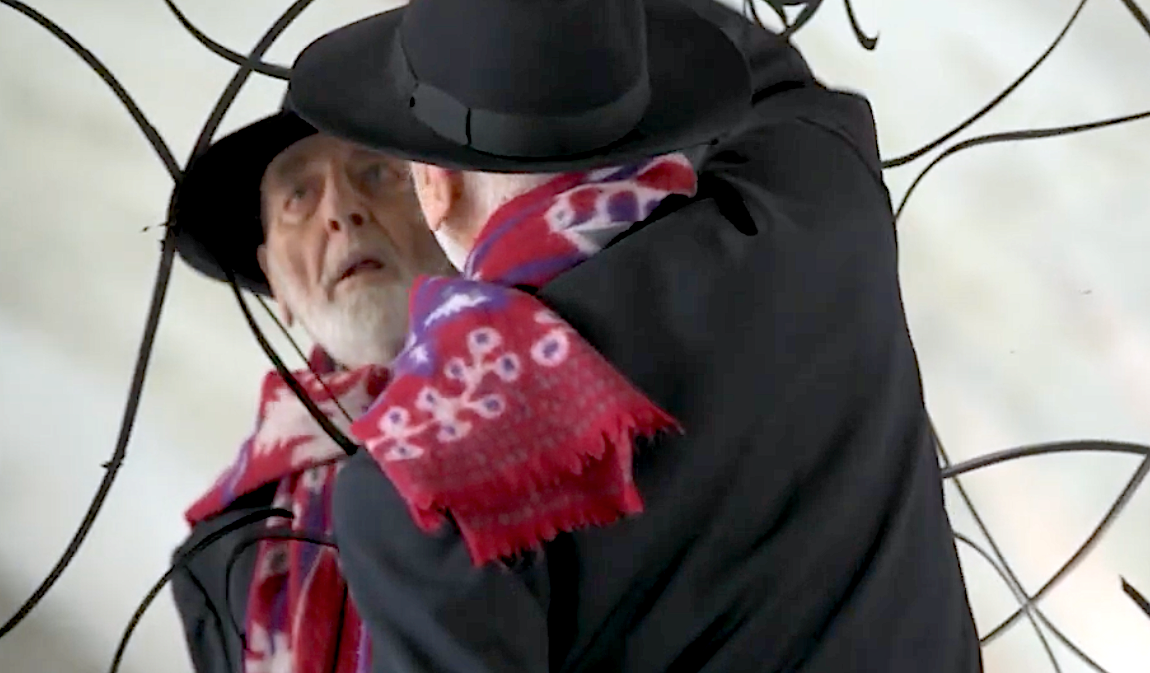
A new moving-image work by Michelangelo Pistoletto will appear daily on public screens across cities spanning four continents, part of a year-long collaboration between the 92-year-old Arte Povera pioneer, the public art platform CIRCA, and the United Nations Office for the Coordination of Humanitarian Affairs. The project, titled Three Mirrors and curated by Josef O’Connor, will broadcast every evening at 20:26 local time on screens including London’s Piccadilly Lights, and equivalents in Milan, Rome, Los Angeles, Accra, Casablanca, Hong Kong and Seoul.
The timing is not incidental. The UN’s 2026 humanitarian appeal targets 87 million people affected by crises worldwide, and the collaboration is conceived as a cultural complement to that effort. Tom Fletcher, the UN’s Relief Chief, said that art has the power to “challenge complacency and remind us of our shared responsibility,” and described the partnership as “a call to conscience” at a moment of what he characterised as brutal conflicts and shrinking resources.
Michelangelo Pistoletto Photo courtesy CIRCA 2026
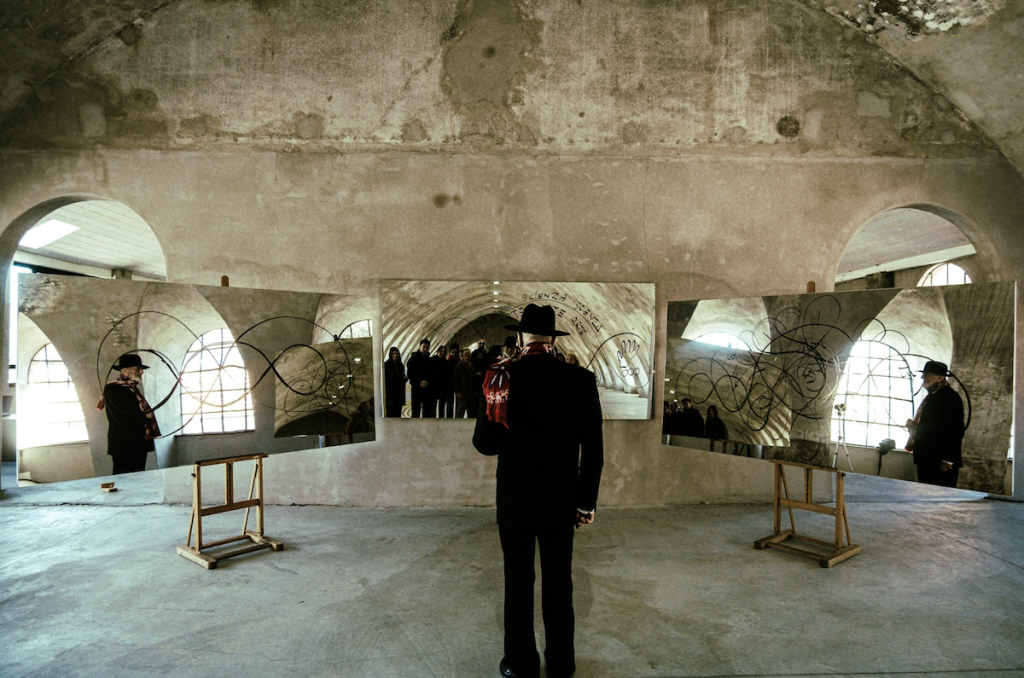
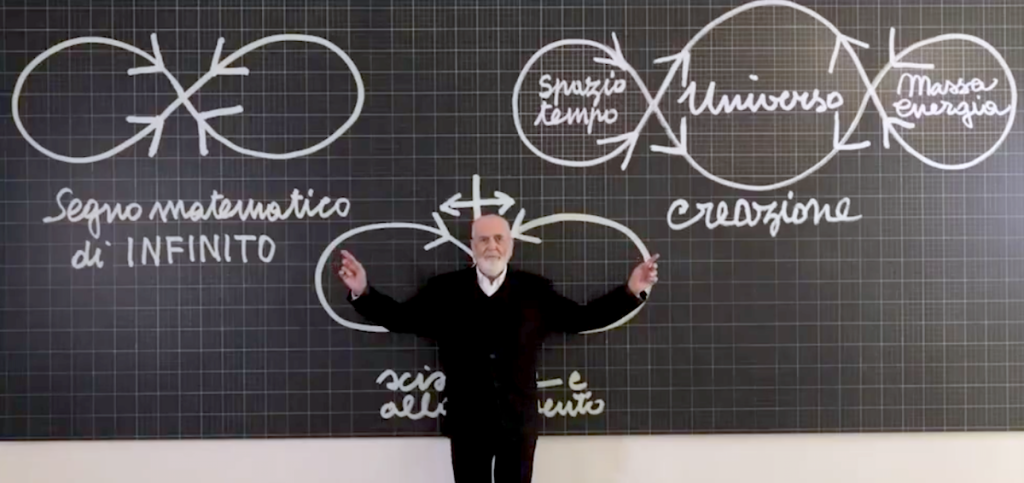
Three Mirrors was filmed at Cittadellarte, the foundation Pistoletto established in Biella in the 1990s as a laboratory for art’s engagement with social transformation. The work is structured as a triptych, each part extending his concept of the Third Paradise, an ongoing project he has developed since 2003 that proposes a form of equilibrium between nature and the artificial. The first part, also called the Third Paradise, presents the symbol he has made central to that project: two opposing circles connected by a third, symbolising balance rather than opposition. The second, Formula of Creation, develops the relational logic he describes as 1+1=3, the idea that genuine encounter produces something that neither party could generate alone. The third, Statodellarte, frames artistic practice as a civic condition rather than a private pursuit.
For Pistoletto, the mirror has been the defining instrument of his practice since the early 1960s, when he began making his Mirror Paintings, polished steel surfaces onto which he transferred photographic images of figures.
“With my Mirror Paintings, the image is no longer closed within the artwork,” Pistoletto said. “It opens itself to reality and to the present moment. Through my collaboration with CIRCA, this reflection becomes collective: the city, its inhabitants and the passing of time enter the work, transforming the mirror into a shared space of awareness and responsibility.”
Pistoletto is doing something altogether more forward-facing. He was nominated for the Nobel Peace Prize in 2025, and Three Mirrors reads less as an artwork in the conventional sense than as a proposition about what art is for. His position is disarmingly direct: peace does not happen by accident. It requires production. “The more freedom we claim, the more responsibility we carry,” he has said. “Peace does not arrive by chance. It has to be produced.”
The project extends beyond the screen. On 24 April, during Milan’s Salone del Mobile, the public will be invited to gather in Piazza del Duomo to collectively recreate the Third Paradise symbol in physical form, turning spectators into participants in what the project frames as an act of shared reflection.
A series of 12 hand-signed, editioned works titled Preventive Peace Flags accompanies the broader project. Screen-printed on polished stainless steel mirror, each flag features the Third Paradise symbol rendered in two distinct colours that meet within the central circle to generate a third, making the formula of 1+1=3 visible as colour. The reflective surface incorporates whoever is standing in front of it and whatever surrounds them, extending the logic of the Mirror Paintings into a portable, collectable object. Twenty per cent of net proceeds will be allocated to CIRCA and to the Pistoletto Cittadellarte Foundation’s public and educational programmes, including a contribution to the UN’s Central Emergency Response Fund.
Michelangelo Pistoletto Photo courtesy CIRCA 2026
O’Connor, CIRCA’s founder and artistic director, described the collaboration as the most ambitious the platform has undertaken. “Working with Michelangelo Pistoletto and Cittadellarte across an entire year, in partnership with the United Nations, allows us to articulate a single proposition,” he said. “Art as a shared responsibility. Art as a living idea. Art as an active contribution to peace.”
Pistoletto’s career spans more than six decades of sustained and restless thinking about the relationship between art and society. The Minus Objects he made between 1965 and 1966 are considered foundational to Arte Povera. His subsequent work moved steadily outward from the gallery, through performance and collaborative action, toward what became Cittadellarte and the Third Paradise. He received the Golden Lion for Lifetime Achievement at the Venice Biennale in 2003 and the Wolf Foundation Prize in Arts in 2007. His works are held in the permanent collections of major museums worldwide, and he has participated in the Venice Biennale thirteen times.
Three Mirrors is not a commemoration of any of that. It is an instruction. Pistoletto, at 92, is telling anyone willing to stop in front of a screen, in London or Seoul or Accra, that balance is not a condition we inherit but one we have to make, collectively, in the present tense.
The full broadcast schedule is available at circa.art.