
A New York judge has ruled that a painting by Amedeo Modigliani, confiscated from a Jewish antiques dealer during the Nazi occupation of Paris, must be returned to that dealer’s estate, ending a legal dispute that has run for more than twelve years and drawn in one of the most powerful families in the international art world.
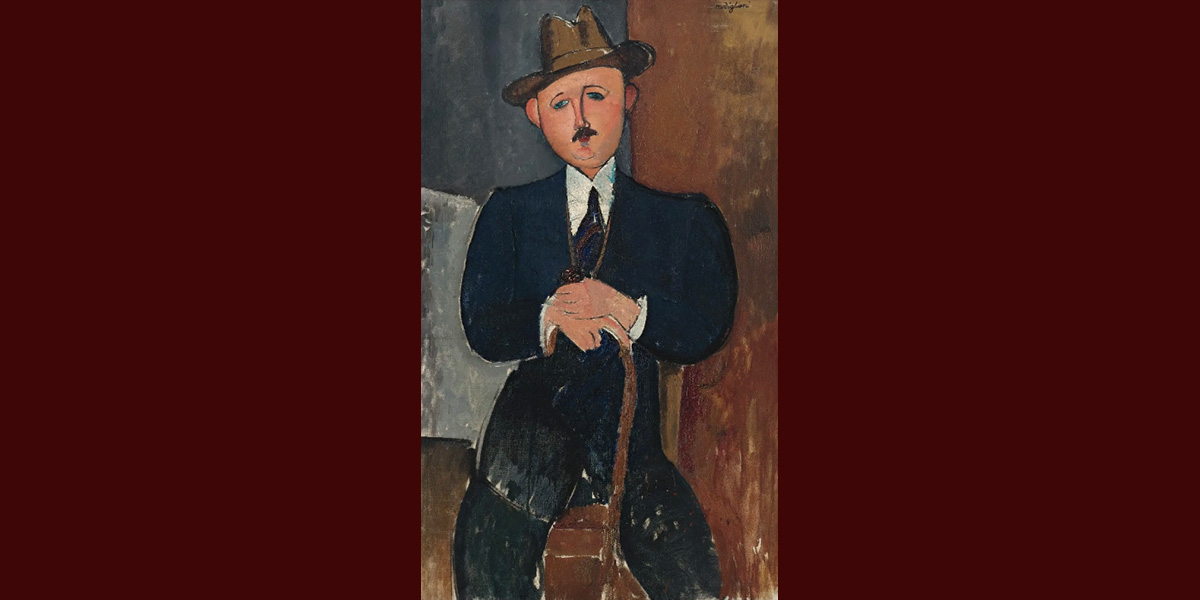
Judge Joel M. Cohen of the New York Supreme Court found that Seated Man With a Cane, an oil portrait painted by Modigliani in 1918 depicting a well-dressed man in a hat and tie seated with a cane, belonged to Oscar Stettiner, a British Jewish dealer who ran a gallery in Paris, and was taken from him unlawfully during the German occupation of France. “Oscar Stettiner owned or, at a minimum, had a superior right of possession of the painting before its unlawful seizure,” Judge Cohen wrote, adding that Stettiner “never voluntarily relinquished it.”
The ruling comes after more than a decade of litigation brought by Stettiner’s grandson, Philippe Maestracci, and the art recovery firm Mondex, which specialises in recovering looted works. The lawsuit was filed in New York in 2015, but the effort to reclaim the painting had begun years earlier. James Palmer, Mondex’s founder, said Maestracci was “overwhelmed with joy and the satisfaction that after so many years, the quest of his grandfather has finally been fulfilled.” Palmer also noted he looked forward to the defendant “abiding by his promise to return the painting upon receiving the order of the court, which today he has now received.”
The painting has been held by the Nahmad family holding company, International Art Centre, since it purchased it at auction in 1996. The Nahmads are one of the wealthiest and most influential art-dealing dynasties in the world, with operations spanning New York, Monaco, and London. For years, their representatives argued in court that there was genuine doubt whether the painting they had purchased was the same work Stettiner had once owned. Judge Cohen rejected that argument in its entirety, finding that the defendants had “failed to raise any material issues of fact, and offer no evidence that identifies anyone other than Mr Stettiner as the owner of the painting or that he voluntarily relinquished it.”
The story of how the painting left Stettiner’s possession is one shared by thousands of works looted across occupied Europe. Stettiner, who held British nationality, fled Paris in 1939 as the German threat advanced, leaving the painting behind in his gallery. A man named Marcel Philippon, appointed by the Nazi authorities to dispose of Jewish-owned property, confiscated and sold the work. After the war, Stettiner brought a claim before a French court, which in 1946 ordered the painting returned to him. By then, it had already been sold on, and the man who had acquired it claimed to have resold it and said it was no longer in his possession. Stettiner died in France in 1948.
The judge found that the 1946 French ruling was among the evidence supporting Stettiner’s ownership, along with records indicating the painting had been lent to an exhibition in Venice in 1930 under his name. The provenance listed in Christie’s 1996 auction catalogue, which described the work as passing from a Paris collector named Roger Dutilleul to a buyer between 1940 and 1945, was found by the judge to be “by design or inadvertence” erroneous and misleading. Christie’s declined to comment.
The case became considerably more complex over the years due to questions about who actually controlled the International Art Centre, where the painting was in deep storage. David Nahmad and his representatives initially maintained that he was not the owner of the painting, stating that it belonged to the holding company rather than to the Nahmad Gallery personally. That position became difficult to sustain after the 2016 Panama Papers leak, which revealed connections between Nahmad and the offshore company holding the work. Swiss prosecutors subsequently raided a Geneva storage facility and confiscated the painting. Nahmad eventually conceded that International Art Centre was his, though he maintained he had purchased the work in good faith and pointed to his 2004 loan of it to the Jewish Museum in New York as evidence of his good intentions. “If you had any doubt about looted art, would you really lend it to a Jewish museum?” he said in a 2016 interview.
Judge Cohen acknowledged that Nahmad himself had not been involved with the painting until the 1996 purchase and was not responsible for the misleading provenance information listed at the time of that auction. Nevertheless, that did not change the legal position regarding the estate’s right to the work.
Stettiner’s estate lawyer, Phillip Landrigan, was sharply critical of how the defence had conducted itself throughout the proceedings, saying the defendants had dragged out the litigation in the hope that the heir would be worn down and forced to abandon his claim, while ignoring what he described as the compelling evidence presented to the court.
Artlyst first reported on this case in 2014 when the dispute over the painting’s ownership and whereabouts first came into public view. The work has been estimated at $25 million or more, though its significance to the Stettiner family evidently cannot be reduced to its market value.
Aaron Richard Golub, the lawyer representing the Nahmad family and International Art Centre, said he had no comment on the ruling.