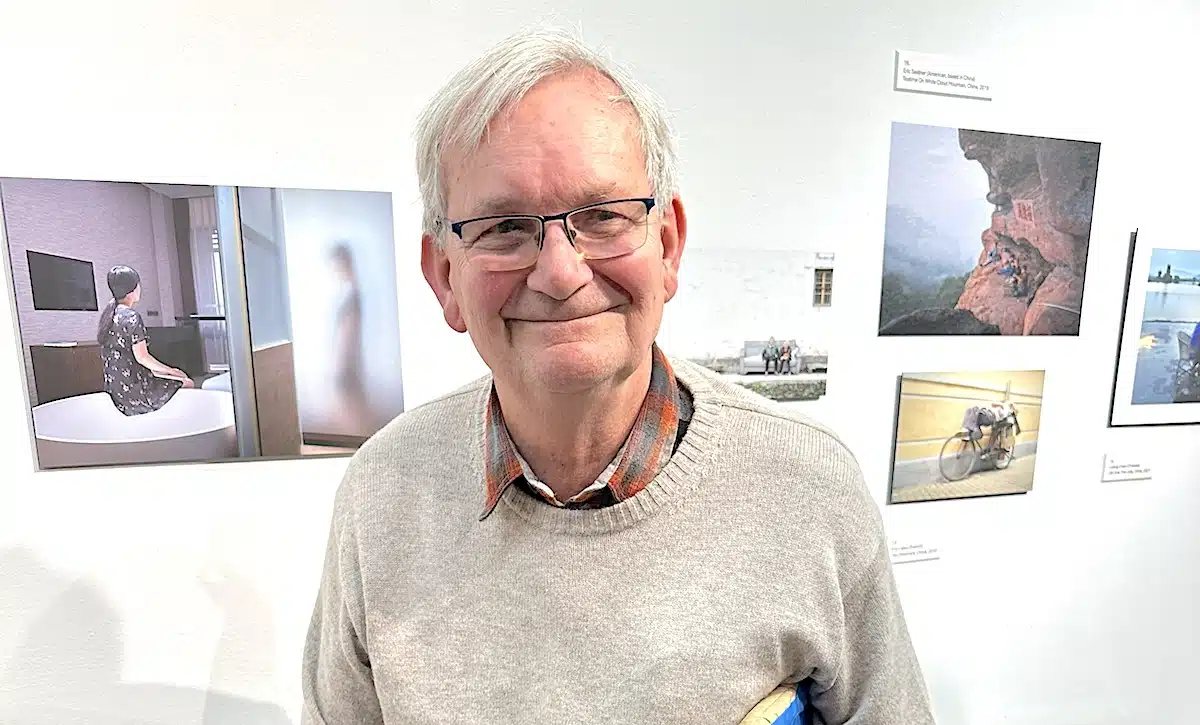
Martin Parr, the photographer who spent more than four decades pointing his lens at Britain’s sunburn, bad sandwiches, bravado, boredom and brittle optimism — often all in the same frame — has died aged 73.
His passing closes the shutter on one of the most distinctive photographic voices of the late 20th and early 21st centuries, a man who managed to turn the mundane into a national mirror, and who never apologised for any discomfort it caused.
Born in Epsom, Surrey, in 1952, Parr discovered photography early, encouraged by his grandfather, a hobbyist photographer and a Methodist minister — an odd combination that in hindsight makes sense. Parr’s moral compass was always skewed toward scrutiny, and his fascination with human behaviour began in the pews of small-town Britain.
When Parr was fourteen, his teacher wrote in a school report that he was ‘utterly lazy and inattentive’. This became the title of the photographer’s biography, who went on to produce iconic shows and to found the Martin Parr Foundation.
He studied at Manchester Polytechnic in the early 1970s, a period that honed his instinct for social documentation and cemented his interest in class, ritual, and the tiny humiliations and joys that accumulate in daily life.
Parr became notorious for showing Britain as it actually looked, not as it liked to imagine itself. He photographed the country’s social rituals with forensic curiosity: seaside holidays where children shrieked in freezing surf; tea parties with congealed food under strip lighting; political pageantry that seemed to crumble at the edges. His colours were louder than politeness allowed, his flash harsh, his eye unblinking. If Diane Arbus revealed America’s strange heart, Parr did the same for the UK — except with sand in the sandwiches and a queue forming somewhere in the background.
His early black-and-white projects, often forgotten in the shadow of his later colour explosion, show the bones of his approach: patient observation, gentle voyeurism, and a willingness to stand in the “wrong” place — the place no one thought a photographer belonged.
Then came the turn: in the early 1980s, inspired by American colour photographers such as William Eggleston and Joel Meyerowitz, Parr abandoned monochrome and embraced colour. It changed everything. Harsh flash, saturated hues, slightly slanted compositions — suddenly his work looked like Britain on a hangover weekend.
The Last Resort (1986), his now-iconic book on working-class holidaymakers at New Brighton, sealed his reputation. Children played next to overflowing bins; parents smoked with weary determination; sunbathers turned the colour of boiled lobsters. Critics were divided: was Parr sneering? Celebrating? Exploiting? Documenting? The answer, inconveniently, was all of the above. Parr’s affection for his subjects was always genuine, even when the images felt brutally honest.
By the time Think of England (2000) came out, Parr had become Britain’s accidental satirist-in-chief. His photographs were funny — painfully so — but the laughter often caught in the throat. He revealed how national identity wears itself thin at the seams.
In 1994, he joined Magnum Photos, a move that scandalised some of the agency’s old guard, who sniffed at his garish palette and irony-soaked compositions. Parr, typically, seemed amused by the fuss. He eventually became Magnum’s president (2013–17), proving that even institutions built on high-minded photojournalism could learn to tolerate a little absurdity.
Parr published more than 100 photobooks — everything from explorations of global consumerism to culinary oddities and international tourism. One year, he photographed British food with such deadpan precision that chefs tried to hide their pies. Another year, he descended upon the Frieze art fair, cataloguing the rituals of the cultural elite with the same scrutiny he once gave to Butlin’s.
He was also an obsessive collector: photo books, ephemera, political memorabilia, postcards. The Martin Parr Foundation, established in Bristol in 2017, cemented his role not just as an artist but as an archivist of British visual culture — championing overlooked photographers and a particular kind of eccentric, analogue authenticity.
Parr’s detractors frequently accused him of condescension — photographing people at their most unguarded and making them look ridiculous. Yet his pictures of wealth carried the same sting. He photographed the Queen’s Diamond Jubilee with a mischievous, almost anthropological distance. He documented Ascot, Art Basel, the Dubai elite, and Miami Beach culture with equal relish. If anything, money fared worse under his lash than the working class ever did.
His great theme, ultimately, was performance — how people present themselves when they think no one is watching.
Martin Parr leaves behind a visual archive that is as celebratory as it is critical, as funny as it is bleak. His Britain was not tidy or flattering — it was loud, anxious, colourful, contradictory, and stubbornly human, in other words: real.
He is survived by his wife, Susan, their family, his foundation, and countless photographers who learned from him that the ordinary is never just ordinary. You need to look harder — and sometimes a bit too closely for comfort.
Parr once said, “Photographing Britain is like trying to photograph your own family. You know them too well, and not at all.” With his death, Britain loses the photographer who understood that contradiction better than anyone.
Photo: P C Robinson © Artlyst 2025
Read Paul Carey Kent’s Interview With Martin Parr Here