
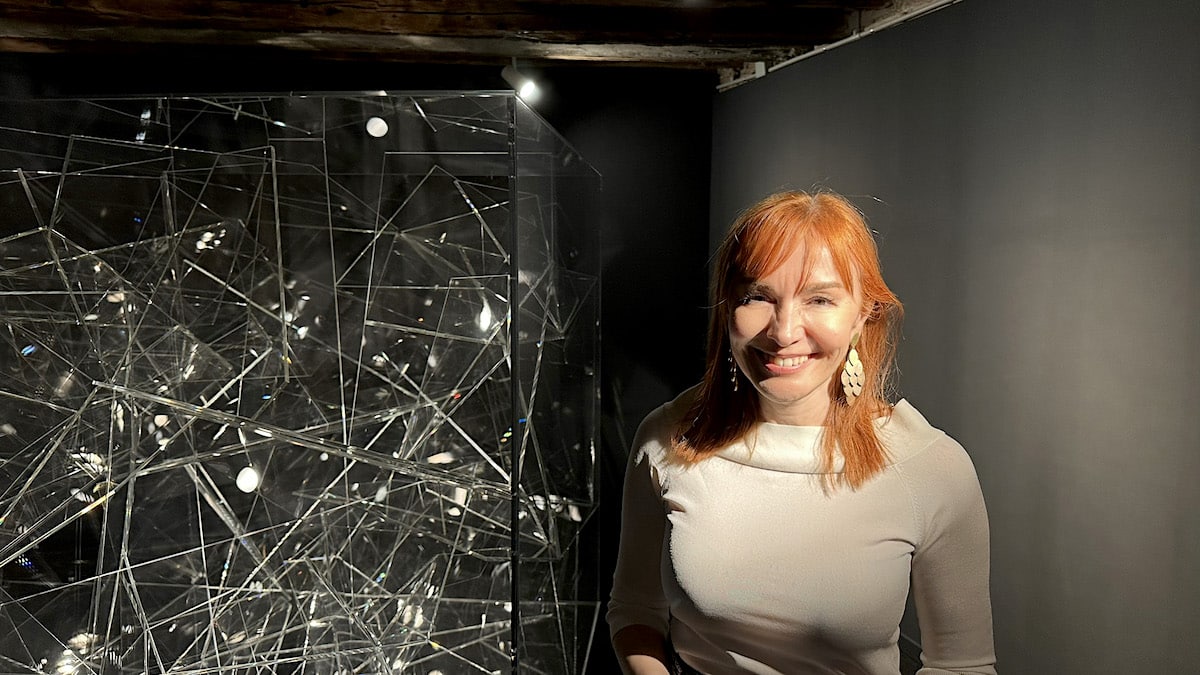
Pavlina Vagioni’s Oikeiōsis, presented by the Hellenic Diaspora Foundation, takes its title from a Stoic philosophical concept that has no precise English equivalent: a word rooted in oikos, the Greek for household, that describes the act of recognising something as belonging to oneself, of expanding the circle of care outward from the self to family to all of humanity. In the context of a Biennale already defined by political fracture, institutional crisis and the question of who belongs where and on whose terms, the choice of subject matter could hardly be more pointed.
Vagioni, born in Athens in 1975 and now based in Houston, is an interdisciplinary artist whose practice spans sculpture, painting, sound, mixed media, and digital art, always returning to the encounter between classical mythology and contemporary life. She is also a classically trained soprano soloist with over a decade of vocal training behind her, alongside studies in piano, music theory and composition, and that formation is not incidental to the work. Sound is not an accompaniment here. It is a structural element, as load-bearing as any physical material she employs.
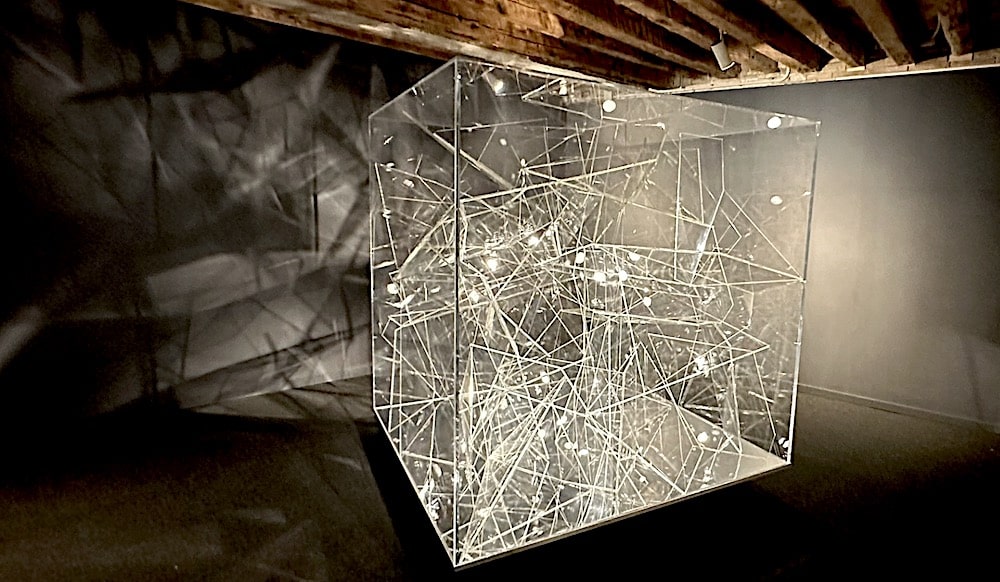
Pavlina Vagioni’s Oikeiōsis, presented by the Hellenic Diaspora Foundation
The exhibition spans two rooms, and the progression between them is deliberate. The first room is named after Neikos, the ancient Greek word for strife and divisiveness. At its centre stands a cube of polygonal plexiglass that reflects visitors to themselves in fragmented, multiplied form: the geometry of separation made literal and inescapable. You are confronted with your own image and its dispersal simultaneously, a quietly unsettling sensation that is neither aggressive nor passive. Vagioni is not interested in spectacle. She is interested in implication, in making the visitor feel the condition she is describing rather than merely seeing it.
The second room is called Philotes, the ancient Greek term for the power that brings harmony to separate elements. The architectural shift is immediate and felt in the body before the mind processes it. Six warm rock-salt seats surround a hexagonal structure embedded with mirrors, and when a visitor sits, the room responds. A layered vocal soundscape, built from the artist’s own soprano voice alongside humming, heartbeats, and other sounds, begins to emerge and build, moving from low to high in a minor extended chord that Vagioni describes as resonant with the harmonies of jazz, Ravel, and Debussy. The declaration embedded in the soundscape is Orphic: “I am a child of Earth and Starry Heaven.” The separation established in the first room gradually dissolves.
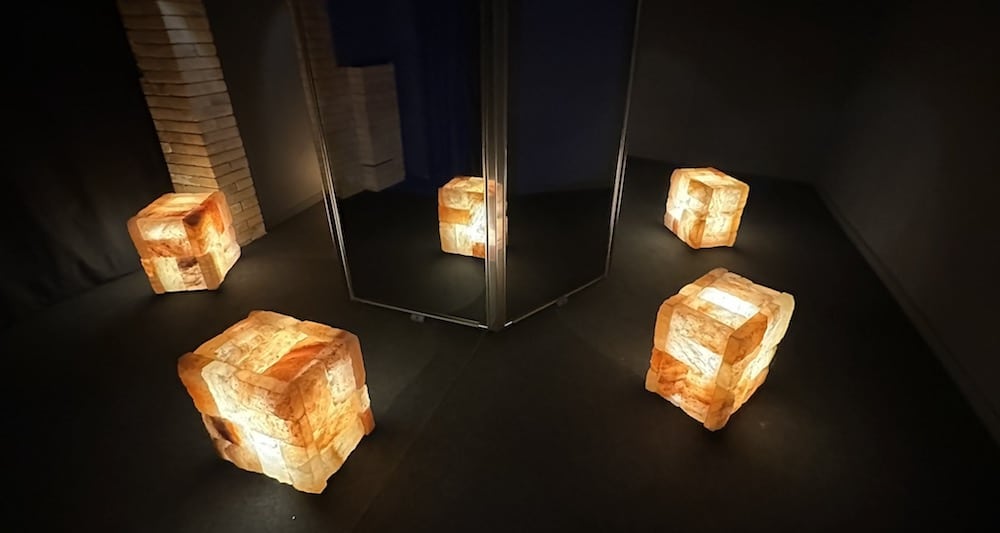
Pavlina Vagioni’s Oikeiōsis, presented by the Hellenic Diaspora Foundation
The focus of the second room is the Tartini effect, a psychoacoustic phenomenon named for the Venetian baroque violinist Giuseppe Tartini, who first described it. When two frequencies are heard simultaneously, they produce a phantom third tone that exists only as resonance, perceived but not physically present. Vagioni deliberately builds toward this effect, designing the conditions in which visitors, through their collective presence and the activation of the soundscape, produce a sound that no one could generate alone. It is an unusually elegant metaphor for kinship, and it works because it is not merely a metaphor. The resonance actually happens. You hear something that only exists because others are there with you.
The salt seats carry their own quiet conceptual weight. Curator Dr Laura Augusta, Director and Chief Curator of the Blaffer Art Museum at the University of Houston, has written about salt as the alchemical principle of memory materialised. Over the course of the exhibition, the seats will change shape, holding the physical record of every visitor who sat in them and accumulating the memory of touch over six months. The work will end the Biennale differently from how it began, altered by the bodies that passed through and rested within it.
Vagioni’s broader practice is grounded in etymological excavation, a method of returning to primary sources to understand what words conceal as much as what they reveal. The word mythology, she notes, contains within it myo, to conceal, and logos, to reveal, a tension that animates her approach to material and subject alike. Her recent series, including work addressing Medusa, Proteus and the Sirens, transforms classical archetypes into agents of healing rather than symbols of threat or danger. With Oikeiōsis, that project reaches its most ambitious and most public expression.
The exhibition is the Hellenic Diaspora Foundation’s first project outside Greece. Vagioni’s comment on the work is characteristically understated: “The world is loud with reasons to turn away from one another. I wanted to make quiet work. Not a protest, not a commentary, but a space where strangers can sit together and remember that this, too, is real.” In Venice in May 2026, that quiet feels like exactly the right register.
Words/Photos P C Robinson © Artlyst 2026
Pavlina Vagioni’s Oikeiōsis, presented by the Hellenic Diaspora Foundation, is situated opposite the main entrance of the Arsenale and running as a Collateral Event of the 61st Biennale Arte. Spazio Tana, Ramo de la Tana 2127/A, Venice, from 6 May to 25 October 2026.