
Qatar Museums has announced plans for a new permanent structure conceived by Gerhard Richter, one that will function simultaneously as architecture and artwork, sitting in the open space of MIA Park outside the Museum of Islamic Art. Doha Pavilion: Gerhard Richter will open on November 20, timed deliberately to precede the launch of Rubaiya Qatar, the country’s new contemporary art quadrennial, by a single day. Selldorf Architects has worked alongside Richter to bring the project into physical form.
Sheikha Al Mayassa bint Hamad bin Khalifa Al Thani, who chairs Qatar Museums, described the collaboration as a natural extension of the institution’s ongoing relationships with major figures in contemporary art. She called Richter one of the defining artists of his generation. She framed the Pavilion as a significant addition to both Qatar’s public art programme and the broader international cultural landscape.
Richter himself traces the project’s origins to a trip he took to Doha in 2013, arriving roughly two years into the development of his Strip paintings. The city’s architecture, along with its layered history, apparently crystallised an idea he had been circling for some time, a structure capable of pulling together the various threads running through that body of work. The Pavilion’s exterior, he explained, is built around decorative tiling derived from the same Patterns that originally led him toward the Strip paintings in the first place. Inside, those paintings hang alongside a selection of his Mirror works, with a freestanding Strip Tower installed at the centre of the space. Richter has stated plainly that Doha is not simply a fitting location for the Pavilion but the only one that made sense to him.
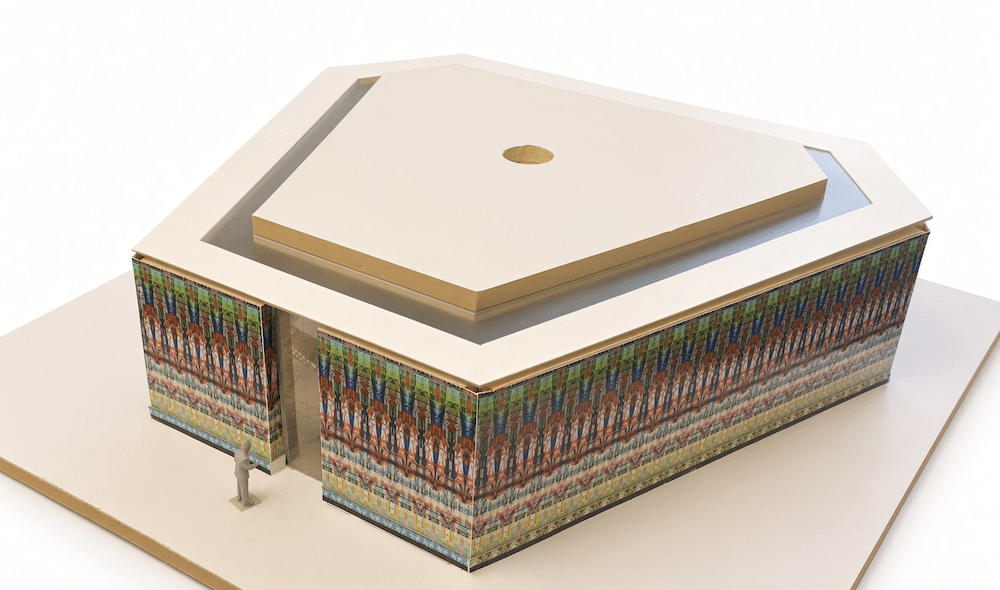
Architectural model of Doha Pavilion: Gerhard Richter. Image courtesy of Selldorf Architects
Richter’s career stretches back to the 1960s, and across six decades he has built a body of work spanning painting, sculpture, installation, works on paper, and photographic documentation that consistently interrogates how images function, how perception operates, and how memory and history bend under representation. The Doha Pavilion draws several of those long-running concerns together into a single hexagonal structure.
Each of the Pavilion’s six exterior walls carries a repeating pattern printed onto panels, directly connected to Richter’s 2011 artist’s book Patterns, which documented the process behind the Strip paintings he began that same year. What was originally a digital and conceptual exercise has now been translated into an architectural surface, extending Richter’s characteristically analytical approach to painting into three physical dimensions.
The process behind those patterns is worth pausing on. In 2010, Richter took a digital image of his own Abstract Painting (724-4) from 1990 and divided it into two vertical strips. He then kept subdividing, repeatedly doubling the strip count from four through eight, sixteen, thirty-two, and onward past a thousand, eventually reaching 8192 individual strips. Each strip was mirrored and repeated to generate a horizontal, symmetrical composition. The resulting geometry bears an obvious kinship to the interlaced patterning found throughout Islamic art, where repeating tilework and arabesque forms have long served as more than decoration, functioning instead as a kind of visual gateway to something less material.
Inside the Pavilion, three large-scale Strip paintings carry that same logic to its natural endpoint, breaking the original abstract composition down into horizontal bands each measuring just 0.08 millimetres, a slice so thin that further subdivision would become imperceptible to the eye. At the centre of the room stands the tripartite Strip Tower, a sculptural translation of the same process that Richter designed specifically for this space. Positioned between the paintings are two floor-to-ceiling mirrors, part of a series Richter began in the 1980s, mounted so that they reflect the room’s interior, including both the artworks and the people moving through it, generating a sense of space that keeps shifting as visitors do. Outside the structure sits a final piece, a stone sculpture titled Brunnen, or Well.
Annabelle Selldorf described the project as an uncommon privilege, both for assisting Richter with a major new addition to his body of work and for contributing to Doha’s growing collection of significant contemporary architecture.
The Pavilion’s unveiling leads directly into Rubaiya Qatar, running from November 21 through April 30 of next year, an international quadrennial built around themes of global ecology, water and maritime heritage, bringing together over fifty artists, a majority drawn from outside the Western Hemisphere, across venues including the newly renovated ALRIWAQ building, the Museum of Islamic Art, QM Gallery Katara and Mathaf. Together, the two projects mark a significant expansion of Qatar’s public art footprint, adding a major new permanent commission just as the country’s cultural calendar enters one of its busiest stretches yet.