
A project of the Museo Picasso Málaga in collaboration with FABA (Almine and Bernard Ruiz-Picasso Foundation) and the Junta de Andalucía that proposes to establish dialogues between Pablo Picasso and artists from different times and contexts.
This second chapter is curated by Miguel López-Remiro, Artistic Director of the Picasso Museum Malaga and Tania Fábrega, Director of the Museo de Almería. The exhibition brings together ceramic works by Pablo Picasso and Miquel Barceló, together with pieces from the museum’s archaeological collections.

Pablo Picasso (1881-1973) Plate Decorated With a Goat’s Head. Fundación Almine y Bernard Ruiz-Picasso, Madrid ©FABA Photo_ Marc Domage © Succession Pablo Picasso, VEGAP, Madrid, 2025
This playful, experimental showing of Picasso’s ceramic work in the context of archaeological finds and the artistic genius of Miquel Barceló is a little miracle in the traditional environment of an archaeological museum. It is best understood after knowing the mission of this long-term series of exhibitions. Because it is so different from other presentations, the past and the present are mixed together by a contemporary artist with the support of museum administration, conservators, and exhibition professionals many times over. Bernard Ruiz-Picasso’s stewardship of the show is fundamental to its success. His custodial ownership of the Picasso pieces and his openness to new ways of working with these pieces alongside other contemporary artists are unique, in my experience, limited though that may be.
And Almería, the region, has important archaeological holdings, with layers going back; in particular, the flowering of culture in this region during the late Neolithic and Copper Age has left exceptional artefacts.
I wonder how to bring this special show to life for those who, like myself, might find it a mysterious concept, this mixing of art and registers. Where ancient ceramics sit alongside Picasso’s pieces and Barceló’s work. Clay itself is crucial to the continuity between these producers and joins the show together. This medium has survived for millennia, giving clues to human activity and life when little else can be identified, and is used to tell stories of our far past. It comes from the earth, yet is also processed by humans into useful vessels and attractive objects. Containers are the primary functional objects, and Barceló is particularly interested in containers and buildings. The surviving abstracted representations of human figures inspired Picasso, and it is a thrill to see his figures next to those of ancient times.
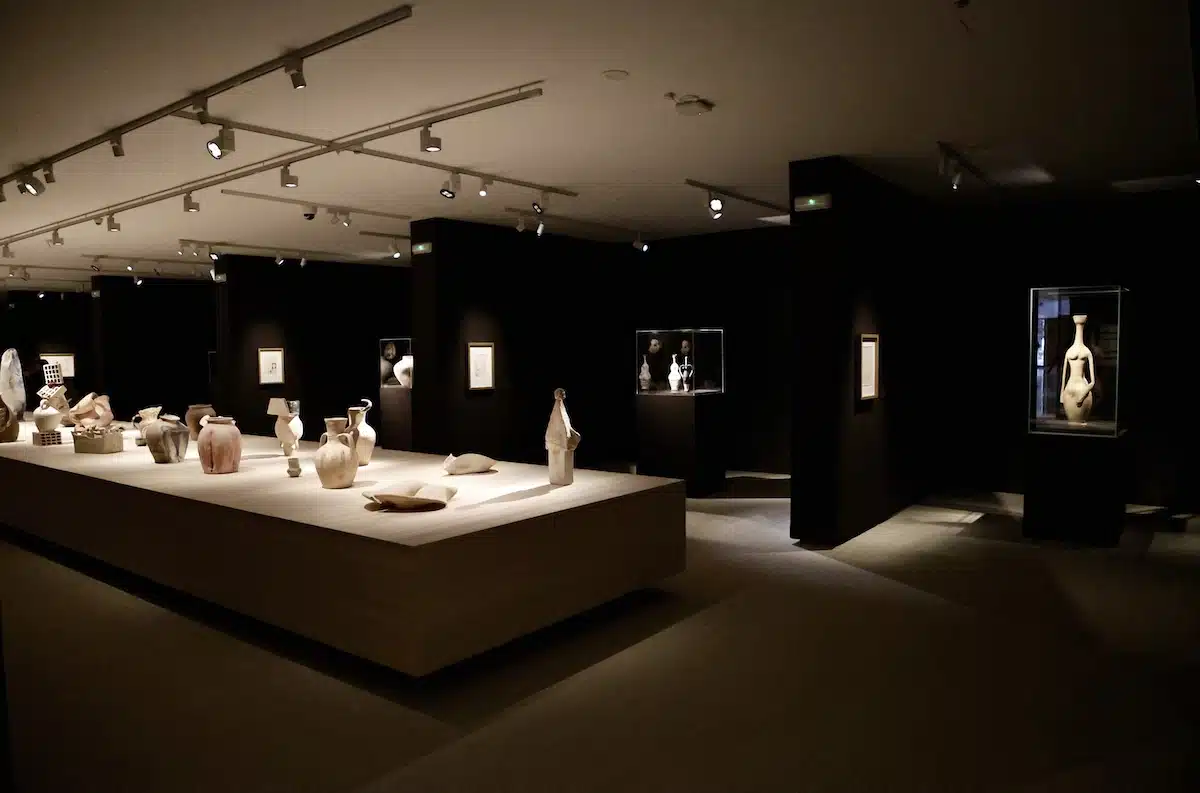
The pots and sculptures, the difference really does not exist here between craft and art, are gathered and arranged in a dark room together. A main table holds significant pieces; plinths display chosen works by Picasso, together with his charming and informative sketches; and wall-mounted plates with images of goats, men, and fish, many masks, and platters of clay.

Miquel Barceló installing Nativity Scene at Reflections. Picasso x Barceló exhibition at the Museo de Almería. Photo_ Chema Artero © Museo Picasso Málaga © Museo de Almería, 2025
At the rear is a grotto, arranged by Barceló. Inspired by the nativity tradition, this is like no other grotto. Barceló’s work uses and reimagines building materials from diverse periods – his fascination with the appearance of functional building materials is shared by many, but few use it so playfully. There is always an eye to the construction of things in his pieces and how they break down. His caves create an environment for figures to reenact the classic Christmas story. Bulls approach the crib like sheep, and the pilgrims who came to see the holy birth. And the figures surrounding the family scene approach ancient figures that could be deities, alongside Picasso’s elegantly folded and shaped clay figures. A hand of Barceló, roughly made in his brutalist aesthetic that emerges more strongly in certain works than others but which is always behind his choices, holds a lying figurine that I remember as being a Picasso piece, but to be honest the pieces work so closely here that it is hard to identify the origins of each piece, especially when the theatricality of the piece is so dominant.
In this clay theatre, the works are given extra resonance by those around them. But a few stand alone for their monumentality. A Picasso vase with multiple faces stares at me in different expressions as I walk around and admire the roughly carved date on the back and wonder how confident an artist must be to work in this beautifully straightforward manner. Barceló has also hacked well-made pots, ruthlessly, squeezing in cut slices of clay into the sharp openings, where they jut up like the fins of a shark. Having just seen the Fort Alcazaba that dominates the city, I appreciate the architectural courtyard created by Barceló, with its little minarets and decorated fortified walls. The fountain in the middle could have water added for play.
And it is this transformation of earth by fire into something that resists water that is the quality of clay, its brilliance as a storyteller. The Museo de Almería houses an outstanding collection from the Los Millares culture, a Chalcolithic culture about 3200 and 2200 BCE, with many fortified settlements and necropoli. The vessels of this period display a characteristic eyelike motif known as ‘sun eyes’ / ‘ojos-soles’. These have been interpreted as having protective qualities and representing solar divinities. It is the nature of the clay that makes it so easy for makers to mark these practical vessels with meaningful patterns, to emboss this fluid surface with marks that will harden in the fire, without interfering with the functionality of the design. This early collective art continues in the work of Picasso and Barceló, with their own understanding and expression of how to decorate, mark, and change the function of clay to charge it with symbolic and abstract value.

Reflections. Picasso x Barceló exhibition at the Museo de Almería. Photo_ Chema Artero © Museo Picasso Málaga © Museo de Almería, 2025
In this selective round-up, I have to finish with a piece by Picasso, the artist who charted the course of twentieth-century art into the modernist period. My own personal debt as a maker and appreciator of modern art, the gratitude that I feel towards his work makes this necessary. So I will finish by talking about the vessel woman in a blue dress, in which a vase is made into a female figure, with the cobalt pigment used for the plain, solid dress the vase-woman wears. The handle arms curve towards the body, and the round ball breasts sit proudly forward. ‘Mujer con vestida azul’ is simple, it’s ridiculous, it’s beautiful, just like us.
Reflections. Picasso x Barceló, Museo de Almería, Spain, 16 December 2025 – 15 March 2026
Visit Here
Lead image: Reflections. Picasso x Barceló exhibition at the Museo de Almería. Photo_ Chema Artero © Museo Picasso Málaga © Museo de Almería, 2025
A sound art piece made from the visit to the Museo de Almería, supported by Artlyst and Resonance FM is available here: The News Agents – 20 December 2025 (Picasso and Barcelo) by Resonance FM | Mixcloud