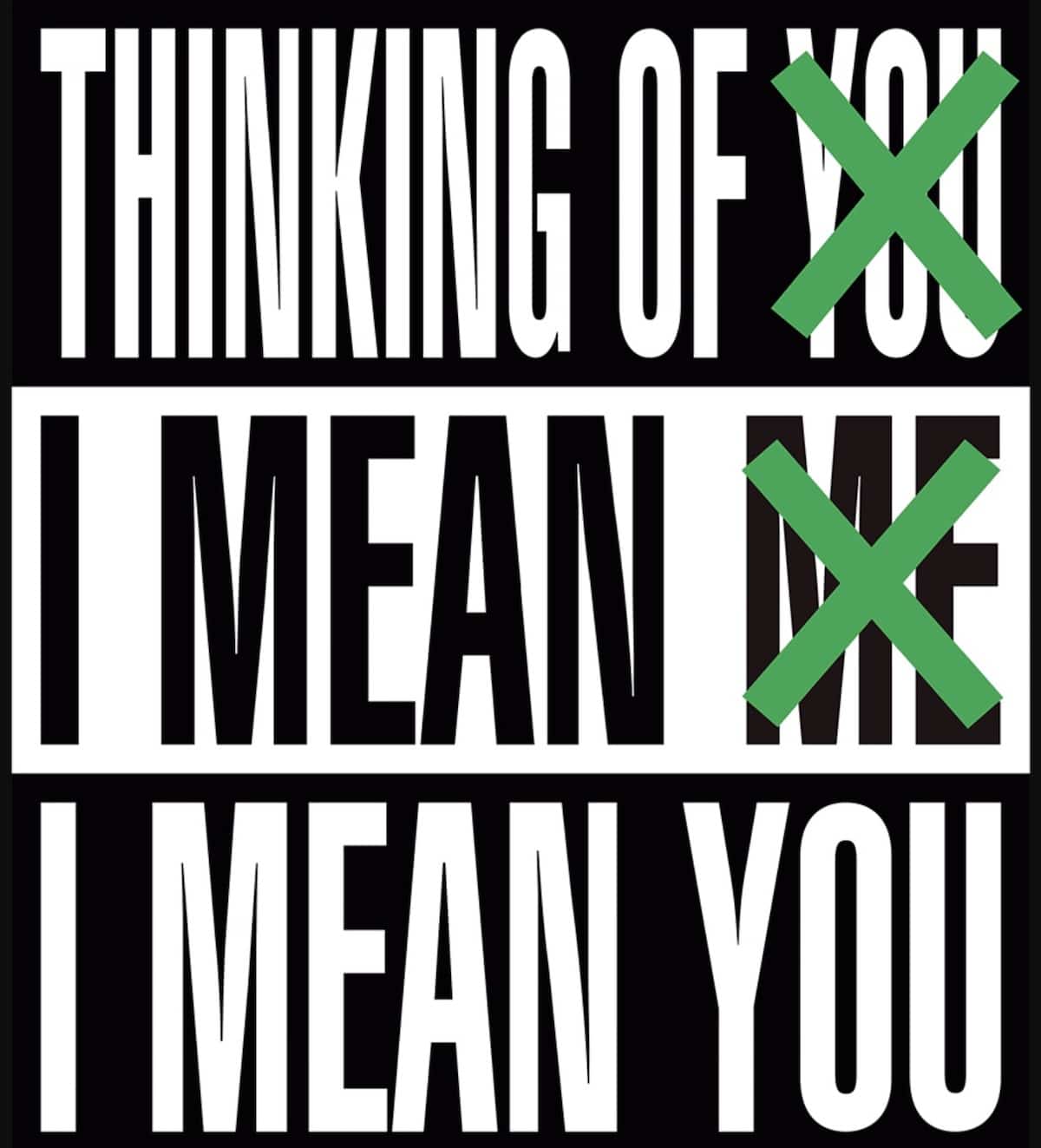
“Thinking of You. I Mean Me. I Mean You” takes the reader on a tour of the last 50 years of Barbara Kruger’s extraordinary and influential body of work. The collection has been brought together by Peter Eleey, Robyn Farrell, Michael Govan, Rebecca Morse and James Rondeau, and provides an extensive study of the artist’s sharp and thought-provoking practice, which seeks to subvert the various power and controlling forces at play.
Over the period from the 1970s to now, Kruger’s practice has consistently sought to unpick the notions of self, attraction, and materialism, employing a combination of image and typography. It is difficult to escape the powerful pull of Kruger’s imagery and type, and find oneself swept up within its narrative.
This publication spans Kruger’s varied practice throughout her career, showing how she responds to the particular time, place and circumstance of her practice. Whether via the analogic means used during the 1980s or the myriad digital methods adopted over the past 20 years (including some new commissions for the show), there are many arresting and timely visuals to be seen.
A significant portion of the publication is dedicated to Kruger’s numerous site-specific interventions, once again revealing her ability to respond precisely to each location. Reprints of key texts selected by the artist allow readers to delve deeper into Kruger’s thinking and methodology.
A master of speaking directly to the viewer and engaging head-on with the world around us, Kruger can justifiably claim to be one of the bravest artists working today. As the world changes at ever-increasing speed, her work continues to cut with equal potency. A must-have for anyone interested in the current art scene.
As such, “Thinking of You. I Mean Me. I Mean You” is a fitting tribute to Kruger’s sustained contribution to the field of contemporary art, and affords us rare access to the workings of this formidable intellect.
Barbara Kruger was born in Newark, NJ, in 1945 and has since become one of the most celebrated living artists of her generation. Her work is instantly recognisable and combines powerful photographic and typographic elements, commenting on issues of power, sex and desire and our relationship with the commercial world.
Her striking use of high-contrast sans-serif type, set against stark black-and-white imagery or vivid red, has come to define Kruger’s practice.
Originally trained as a graphic designer and art director, Kruger worked on a number of women’s magazines during the 1960s and 70s, before moving on to pursue Fine Art. Having become aware of the extent to which commercial and media images dictated our lives, Kruger started to produce her first works in the mid-1970s.
These comprised images accompanied by brief, impactful sentences, designed to question and unsettle the audience about their understanding of the ‘real’ world. Typical of Kruger’s work, they prompt the viewer to reflect on the relationship between ourselves, others and the world we inhabit.
By the 1980s, Kruger’s work was being exhibited widely throughout the US and abroad. Many of these continued to be installed in open-air locations, including large-scale billboard commissions.
Since then, Kruger has maintained a fervent interest in harnessing her work towards a cause, taking stances on topics ranging from feminist concerns to the commercialisation and concentration of wealth and power in modern society.
More recently, she has produced a series of films, adding another dimension to her already impressive oeuvre.
It is clear that Kruger shows no signs of slowing down and will undoubtedly continue to produce compelling and challenging work for years to come, utilising her characteristic wit and style.