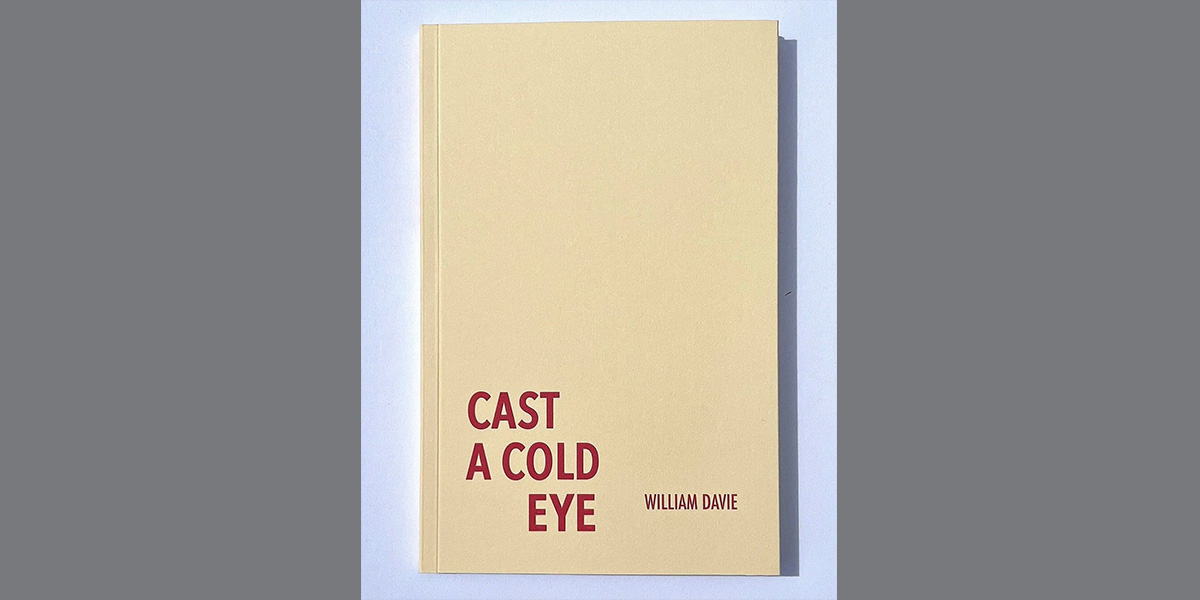
Doris Press has launched its first publication with Cast A Cold Eye, a collection of eight essays and revised reviews by London-based writer William Davie. The book moves through art history with a questioning eye, probing the margins of accepted narratives and revisiting artists and ideas that have slipped from view.
Davie circles back to a handful of artists whose reputations, he suggests, have settled a little too comfortably. Helen Frankenthaler’s woodcuts come in for close attention, their technical nerve still striking decades later. Paula Rego appears here from a slightly different angle. Davie insists that printmaking sits much closer to the centre of her practice than many accounts allow. Then there is Frans Hals. The late paintings, often treated as an afterthought, are given their due, and Davie argues with some force that they belong far nearer the heart of the story than the footnotes where they have sometimes been left.
One essay revisits the nineteenth-century rediscovery of Johannes Vermeer by the critic Théophile Thoré-Bürger. Davie treats the episode not simply as a historical curiosity but as an instructive moment in the shifting fortunes of art history itself. The story reveals how easily artists can vanish from view and how much persistence it can take for scholars and curators to restore them to the broader narrative.
Elsewhere, the book drifts further afield. Davie lingers over the photographs of Gordon Parks, drawn again to the quiet steadiness with which Parks recorded the struggles of African American life. The atmosphere changes when he turns to Lorelei Guillory. Her response to the murder of her young son carries a compassion difficult to take in, harder still to write about.
Then there is Jan Ariens, the founder of Lifelines, an organisation that facilitates epistolary relationships with inmates on death. His work begins in personal crisis but doesn’t stay there; it moves outward, gathering others into its orbit.
These passages loosen the book’s frame a little. Art is still the point of departure, but the argument begins to open outwards, edging towards something more uncertain. Resilience, perhaps. Or just the stubborn human instinct to carry on.
Art historical essays sit alongside reflections on figures such as Francisco de Zurbarán and the Japanese artist Toko Shinoda. Davie traces Zurbarán’s powerful use of light in seventeenth-century Spain and follows Shinoda’s remarkable journey from postwar Japan to the United States and back again. Her search for artistic independence, pursued across more than a century of life, becomes one of the book’s quiet anchors.
Throughout, Davie writes with an assured confidence in the power of description. Images are not necessary. His ekphrastic approach allows paintings and prints to emerge through language alone, supported by careful research and a clear critical voice.
The book has been edited by Rachel Howard and Hugo Lau, with design by Billie Temple and printing by TJ Books.
William Davie is a London-based writer whose essays and criticism have appeared in publications including Frieze, The Brooklyn Rail, Gagosian Quarterly, The Catholic Herald, and Art in America.
Doris Press, founded in 2020 by the British painter Rachel Howard, is an independent UK publisher devoted to thoughtful writing on art and culture.


