
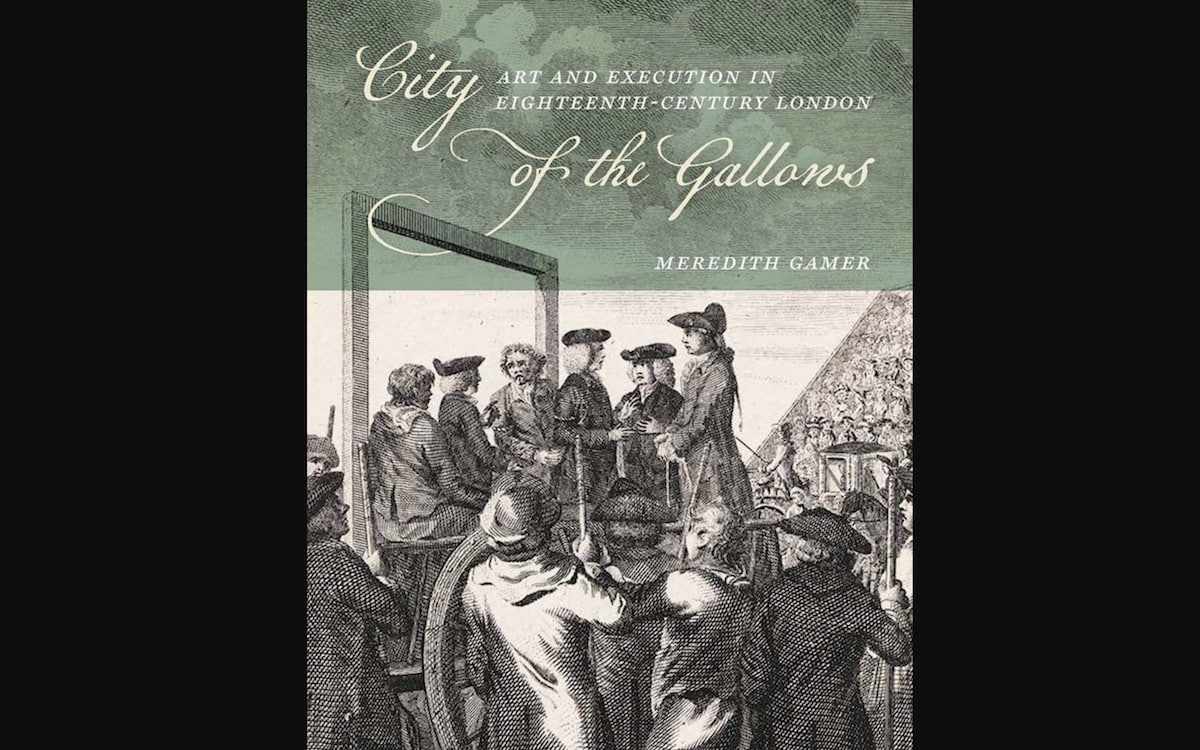
This well-illustrated book, as its title indicates, is about the influence of public hangings on art during the 18th century. Drawing on her recent articles, Gamer covers the history and purpose of public executions. Over the span of the 18th century, offences punishable by capital punishment increased fourfold, to over 200. This was Britain’s “Bloody Code”. The death sentence was widened to cover crimes against property, not just murder or treason.
Tyburn, present-day Marble Arch, was London’s principal site for hangings and the 18th century saw over 3000 carried out there. Its gallows, the Tyburn Tree, was a permanent structure with three legs supporting beams forming a triangle. This allowed up to 24 people to be executed at once. So distinctive was this structure that, when depicted, there is no doubt where the artist locates his subject. Thus, even if its location was not in the title of his print “The Idle ‘pentice Executed at Tyburn” from Industry and Idleness, 1747, Hogarth was clearly depicting Tyburn. Similarly, Marcellus Laroon’s delicate pencil, ink and wash drawings of c. 1680 of an execution clearly show Tyburn. Owned by Samuel Pepys, they reveal that the fascination with public hangings dates to before the 18th century.
The purpose of public hangings was as a deterrent. As William Paley, the moral philosopher, put it, “The proper end of human punishment is not the satisfaction of justice, but the prevention of crimes.” Yet it was not as deterrents that they drew huge crowds. Public hangings were massively popular entertainment among the lower classes. To facilitate viewing of these spectacles, stands were erected as at a race course; lamplighters rented out their ladders so people could get a better view. They were likened to the bloody gladiatorial fights of Ancient Rome.
News of the hanging was disseminated through cheap printed matter, ballads, broadsides, and chapbooks, the publication of which had increased alongside literacy over the previous century. “For a peny” wrote Henry Peacham in 1641, “you may have all the Newes in England, of Murders, Flouds, Witches, Fires, tempests and what not.” Many of these publications were illustrated with woodcut scenes of executions that, in turn, decorated the interiors of homes, inns, taverns, and alehouses, thus diminishing their shock value. By the first quarter of the 18th century, far from deterring crime, public hangings seemed to increase it.
The rise in crime and hangings, Gamer said, is mirrored in the rise in the availability of art. No longer the province of the Court and palaces, it began appearing more accessibly in various venues: coffee houses, galleries and concert halls. A range of dealers, buyers, collectors and connoisseurs also arose. Art exhibitions were hugely popular with the upper classes, although crowds were smaller than at Tyburn. Most prominent was the Royal Academy of Arts, established in 1768. In line with the teachings of its first Director, Sir Joshua Reynolds, they promoted the noble art of history painting. It uplifted thoughts, brought moral refinement and cultural improvement. Although Gamer’s argument seems lost in much detail, she points to the depiction of death being understated and presented coyly.
Pietro Antonio Martini’s etching after Johann Heinrich Ramberg, The Exhibition of the Royal Academy, 1787, is used to indicate the dominance of history painting. There is the Prince of Wales, standing beneath his own portrait by Reynolds. Reynolds himself gestures towards William Orpie’s large painting of The Murder of Rizzio. (Both the Prince and Reynolds stand classically contrapposto.) Gamer does not point out that despite Orpie’s painting being a scene of murder, there is no blood.
Angelica Kaufman, in her 1771 Andromache Weeping over the Ashes of Hector, changes the scene described by Homer. Andromache, famed for her fidelity and wife of Hector, was described by Homer as “weeping over [Hector’s] mangled corpse”, not his ashes. To depict this as Homer described it would have been to show “an object of horror, and objects of horror should never be represented in any of the fine arts.”
Joseph Wright of Derby deals with death differently. His painting An Experiment on a Bird in the Air Pump, 1768, centres on the man overseeing the experiment, his hand poised on the valve. It is the work of a second for him to let in air, allowing the bird to live or die. His painted audience displays both fascinated rapt attention and fearful sympathy. Wright is addressing the process of dying, but of a bird, not a man. The experimenter gazes directly out at us, the viewer seemingly asking us to decide.
There is, however, an aspect in which public hangings undoubtedly invade the Academy, the study of anatomy being core to its arts education. With the rise in crime in 1751, the Murder Act allowed Judges to sentence convicts to hanging and dissection. Most corpses went to hospitals, but some went to arts academies. Before the Royal Academy opened, the leading London art school was St. Martin’s Lane Academy. There William Hunter lectured on anatomy with the aid of fresh corpses straight from the gallows, so fresh rigor mortis had not set in. Gamer describes the cadavers being given heroic poses, then letting rigour mortis hold them in position. Flayed to expose their muscle structure, casts were then taken. Thus they became écorché figures for didactic use. When Hunter became the first Professor of Anatomy at the Royal Academy, several of his écorchés moved with him. One with one arm raised and legs positioned contrapposto is polychromed and Gamer believes was taken from the body of the thief and murderer, Solomon Porter, convicted for the Chelsea Murder Case of 1771, sensational as the perpetrators were Jewish. This figure can be viewed today in the Royal Academy’s long vaulted cast corridor.
Gamer goes on to refer to lynchings in America and the executioner Albert Pierpoint being sent to Germany to execute Nazi War Criminals. The last execution at Tyburn was in November 1783. The last public hanging in the UK was in 1868.
Meredith Gamer, City of Gallows, Art and Execution in Eighteenth Century London, Paul Mellon Centre for Studies in British Art, New Haven and London, 2026