
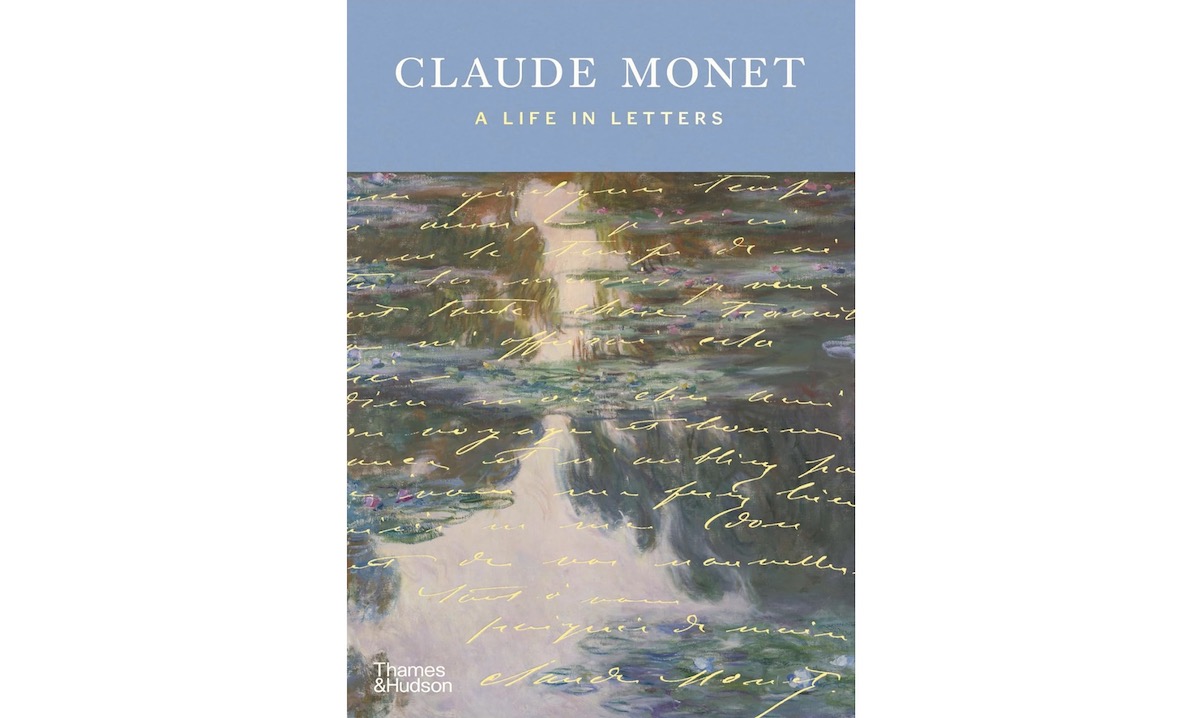
Published to mark the centenary of the artist’s death, the man himself still feels like one of the least documented parts of his own legacy. Everyone knows the water lilies, the haystacks, the Rouen cathedral facades painted over and over in shifting light. Far fewer people know what Monet actually sounded like when he wasn’t painting, when he was simply worried about money or grieving a friend’s death or complaining, as artists tend to, about how badly the work was going. Claude Monet: A Life in Letters, published this week, marks the centenary of his death, sets out to close that gap, and largely succeeds.
The book is the first major English-language collection devoted entirely to Monet’s correspondence, drawing on around 420 letters written throughout his adult life, from his uncertain early years through to his death at eighty-six. The recipients form a fairly remarkable list on their own: Manet, Renoir, Courbet, Morisot, Pissarro, Whistler, Mallarmé, Zola- a who’s who of the artistic and literary world Monet moved through. However, the importance here lies not only in the famous names receiving the letters but also in what Monet actually has to say to them.
Take the letter to Gustave Geffroy from August 1908, reproduced in the book, in which Monet describes his late water paintings as something close to an obsession, admitting the effort felt beyond his strength as an older man even as he kept pushing forward, destroying canvases and starting again, hoping, almost desperately, that something would eventually come of all the effort. It is a small passage, but it says more about Monet’s actual working process, the doubt baked into even his most celebrated late period, than most formal biographies manage across entire chapters.
What is really the book’s strength throughout is its organising chronologically, each section that opens with a short introduction situating Monet’s circumstances at that point in his life, followed by the letters themselves, annotated with enough context to make sense of references that would otherwise mean nothing to a modern reader: a gallerist’s name, a half-forgotten dispute, a painting since lost or retitled. The editing team, Teresa Krasny, Frances Fowle, Flavie Durand-Ruel, Karen Serres and Sylvie Patry, bring an unusually well-matched set of credentials to the task, spanning museum curatorship, academic art history, and in Durand-Ruel’s case, direct family lineage back to Monet’s own dealer, Paul Durand-Ruel, which gives certain sections an added layer of inherited insight rather than purely archival distance.
What comes through in the letters is a far more anxious man than the popular image allows, and a far more generous one too. The serene painter pottering about his garden at Giverny is not really who shows up on the page. Money worries stretch across decades of correspondence, especially in the early years, before recognition and sales finally caught up with his ambition.
The book is published amid a busy centenary calendar, with major exhibitions including Monet: Painting Time opening at the Musée de l’Orangerie this September before travelling to Tate Modern in February, alongside further shows in Tokyo, San Francisco, Giverny and Le Havre. Against that backdrop of paintings being rehung and reexamined worldwide, A Life in Letters offers something the exhibitions, by their nature, cannot: Monet’s own voice, unfiltered by canvas, describing exactly what it felt like to spend a lifetime chasing light that kept refusing to hold still. – PCR
Claude Monet: A Life in Letters – Teresa Krasny, Frances Fowle, Flavie Durand-Ruel, Karen Serres and Sylvie Patry
Publication: 8 October 2026