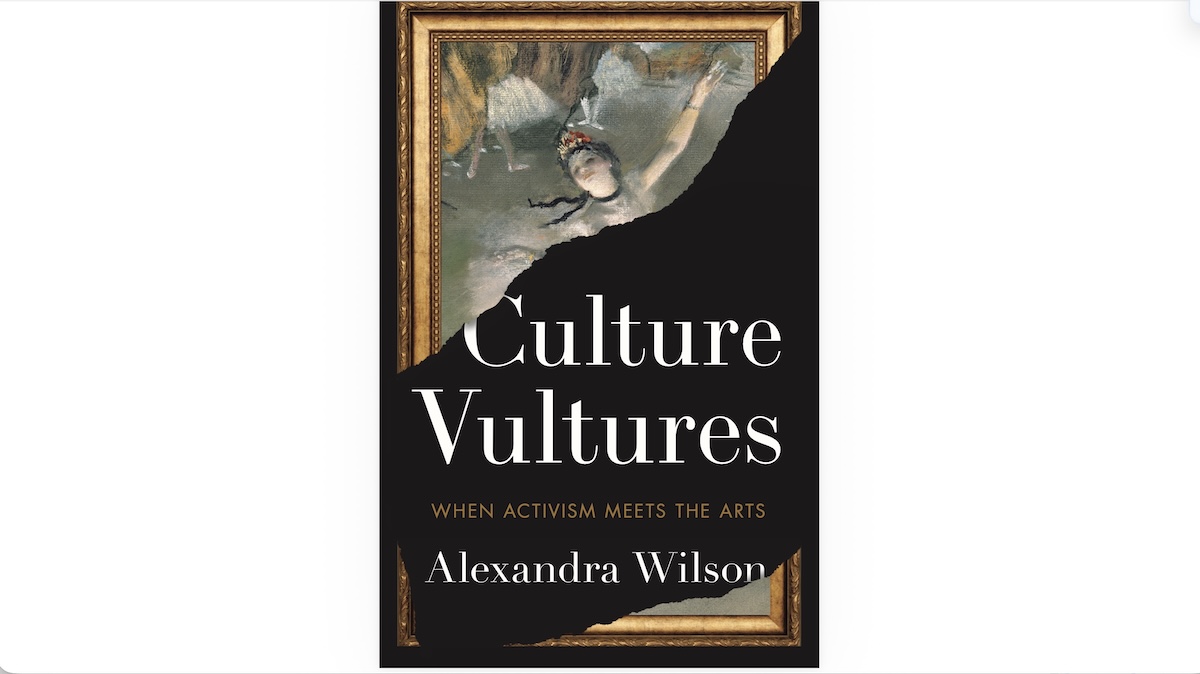
Utter a work of truth, and it is Doubleplusungood in the words of George Orwell. In musicologist, cultural historian and arts writer Alexandra Wilson’s own words, “We have (…), reached a ludicrous point where only certain attitudes and ways of speaking about the arts, all centred upon power dynamics, are acceptable.” Culture Vultures: When Activism Meets the Arts is Wilson’s response to the state of the arts, and it’s as comprehensive as a LIDAR scan of political correctness in the culture sector, and not just the visual arts. And as many have argued for decades now, political correctness, government funding, the stranglehold academics have on the arts, never favours non-conformist viewpoints though they claim they do. A certain rubber-stamp conformity weakens the political and ideologically driven, making it unquestionably status quo. It doesn’t have to be like that, Wilson argues, in Culture Vultures.
The loss of a general public in the contemporary art world tends towards ever more propagandistic efforts to draw people in. And while a model of culture never works, there are good examples of artists’ works whatever point of view you take. Some of the confusion may be due to the intervention of AI and technology into what had been physical material arts rooted in the physical world we live in. Does a photo of a tsunami stop the tsunami? Does jiggling and pasting images on a screen ever have the same resonance as a collage by John Heartfield (1891-1968)? Of course, all interpretations are valid as art, but the ways we interpret and create are increasingly diluted by the simplicity of the terms of discourse.
The political lens, using the arts as a prod, results in actions like the defacing of Velasquez’s Rokeby Venus at the National Gallery by Just Stop Oil in 1973… but as Wilson notes, earlier examples of such actions. In 1914, the same Rokeby Venus was slashed by Mary Richardson in protest of Suffragette Emiline Pankhurst‘s incarceration, and Tony Shafrazi’s spray-painted graffiti on Picasso’s Guernica at MOMA, New York in 1974 is another example. Wilson makes clear all these interventions have virtually no effect on the causes they are addressing. But there is equally a kind of violence in the appropriation of tribal artefacts,… totems, masks, sculpture that are part of the colonial legacy… Will the Elgin Marbles ever go back to Greece?
Some of the rigour of Alexandra Wilson’s overview can be tedious, but it’s all in the mix. She is simply saying political correctness has gone too far, and unseats our own collective cultural and global history. As she comments, “The arts, in other words, are sometimes reduced to being merely a tool of ideological indoctrination. (…) It is time to stop shoehorning the arts into pre-packaged, fashionable political narratives that are fundamentally pessimistic: often they do more harm than good, deterring rather than attracting new audiences.” Not everything has to be political!
Polity Books, 256 pages illustrated, published October 2026. Hardback £20
Visit Here
https://en.m.wikipedia.org/wiki/John_K._Grande
Brief bio + publications for John K. Grande…
https://www.amazon.com/author/johngrande
Art Space Ecology; Two Views Twenty Interviews
Black Rose Books / U. of Chicago, 2018)
http://press.uchicago.edu/ucp/books/book/distributed/A/bo34137373.html