

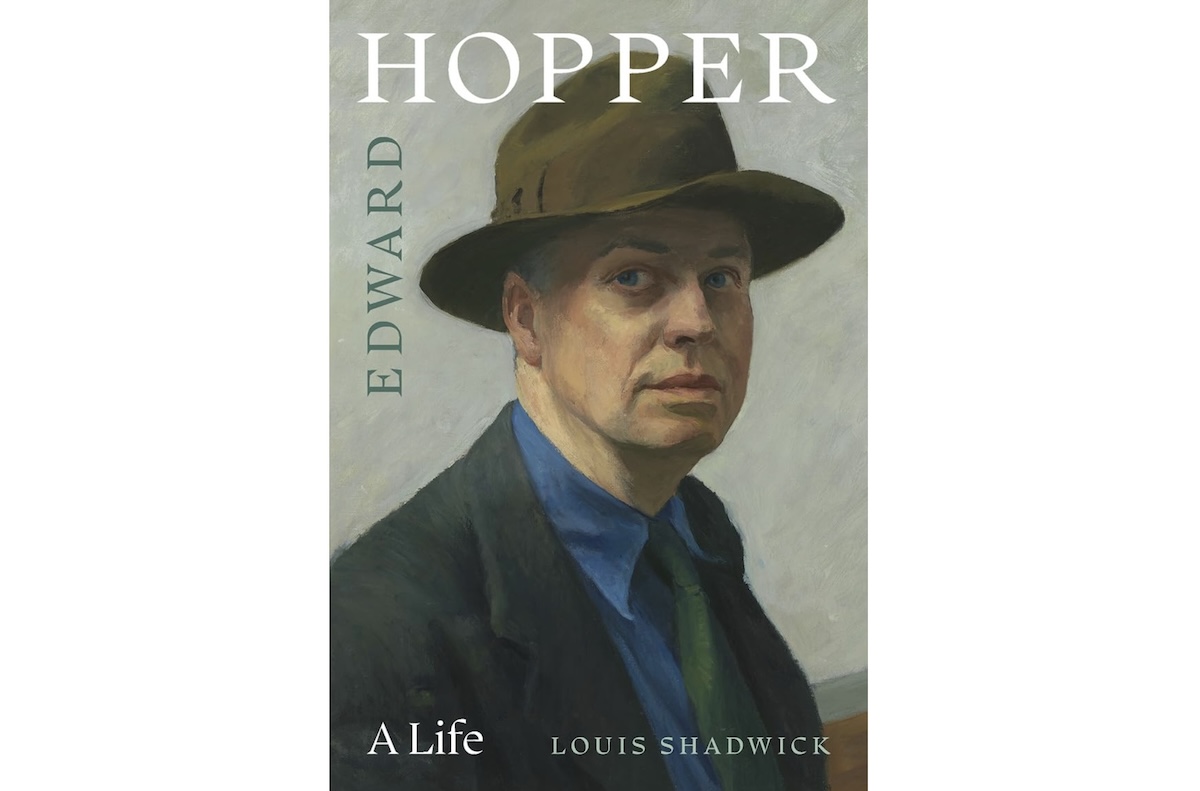
Edward Hopper is easy to recognise and hard to know. Everyone can picture the all-night diner, the couple who have run out of things to say, the lone figure squinting out a window into hard sunlight. These images have settled into the American ethos like comfortable furniture. The man who made them has remained discreetly out of focus, wrapped in a myth he helped build. Louis Shadwick’s Edward Hopper: A Life sets out to change that.
The book’s argument is clear. Shadwick wants to weave the life and the work together, and to rebuild the personal, cultural, historical and political ground they grew from. He draws on major new archives and a pile of recently found sources by Hopper and his wife, Josephine Nivison. The book contains a fuller account than we have had in the past, and a loosening of the carefully made identity of Americana that Hopper presented to the world. There are more than one hundred illustrations, in colour and black and white.
The story moves through three stages: youth, obscurity and fame. That structure is useful because Hopper’s career was a slow burner. He was born in Nyack, New York, on the west bank of the Hudson, into a middle-class family that supported his early talent. After school came a brief spell at the Correspondence School of Illustrating, then the New York School of Art from 1900 to 1906. His teachers there included William Merritt Chase, an American Impressionist, and Robert Henri, who told students to paint the world in front of them without softening it. Hopper then made three trips to Europe, in 1906 and 1907, in 1909 and in 1910. Paris drew him each time. He showed little interest in Fauvism or Cubism. Degas and Manet instead garnered his attention, with their methods of building a picture and their eye for modern city life.
The 1910s were hard. He showed in group exhibitions, including the Armoury Show of 1913, where his painting Sailing was on display. Etching paid better than oil, and he got good at it. He took a studio in Greenwich Village, which he kept for the rest of his life, and fell into the habit of spending summers in New England, including Gloucester, Massachusetts, a place where I spent many summers. Hopper painted light interacting with architecture better than almost anyone else; his work is an homage to these great Victorian and Edwardian buildings, which play a leading role in the compositions. His first solo show came in 1920, when he was thirty-seven. The Whitney Studio Club hung sixteen paintings and sold none. It still counted as a marker.
Then things turned quickly. His second solo show at the Rehn Galleries sold out, and Rehn represented him thereafter. In 1930, House by the Railroad became the first work to enter the collection of the new Museum of Modern Art. It has the whole manner in one frame: firm outlines, sharp light, a cropped view that feels like a film still, and an eerie stillness. A retrospective at MoMA followed in 1933.
Shadwick’s strongest material concerns his marriage. Hopper wed Josephine Nivison, a former fellow student in Henri’s class, in 1923. Jo posed for almost all of his women. She helped set up props and scenes in the studio, urged him towards watercolour, and kept careful records of his finished works, shows and sales. She also wrote a great deal about their life together, and much of it appears here for the first time. What emerges is a marriage marked by resentment and rivalry, yet held together by a stubborn devotion. It is an uncomfortable picture. It also makes the paintings harder to take as simple studies of loneliness, since the loneliest figures were often modelled by someone standing a few feet away.
The book is exemplary on the mature style as well. Hopper’s places are often empty. Gas stations, railroad tracks, and bridges make travel feel lonely and uncertain. When figures do appear, they tend to be single, or in pairs who do not speak. They are seldom at home. They kill time in movie theatres, hotel rooms and restaurants. Nighthawks, from 1942, is the best known case: four customers and a waiter in a lit diner at night, each lost in private weariness. Shadwick, like many before him, sees wartime anxiety in it. The suggestion is reasonable, though it is one reading among several.
Place matters too. From 1930 into the 1950s the Hoppers spent nearly every summer on Cape Cod, mostly in Truro, where they built their own house. He kept returning to the same nearby spots. He also travelled for new subjects, to Vermont and Charleston, by car through the Southwest to California, and on four trips to Mexico. The themes held steady wherever he went: tension between individuals, especially men and women, the clash of tradition and progress in town and country, and the moods of different hours of the day.
The final part of the book covers a complicated reputation. Further retrospectives came, many at the Whitney, and in 1952 he represented the United States at the Venice Biennale. Yet as Abstract Expressionism took the art world by storm, critics cooled towards him. His paintings proved that a person could feel cut off even in a prosperous, optimistic postwar nation, and that was not fashionable. Public affection never faded. By the time of his death in 1967, a new generation of realist painters had claimed him as a forebear.
Still, the approach is the right one. Hopper has been read as a painter of mood and loneliness for so long that the history behind that mood has been lost. Putting it back is overdue. – PCR
Edward Hopper: A Life by Louis Shadwick
Published in hardback on 24 November 2026, priced £30
isbn: 9780300263787, 544 pages 229 x 152mm 40 colour +106 b/w illustrations
