
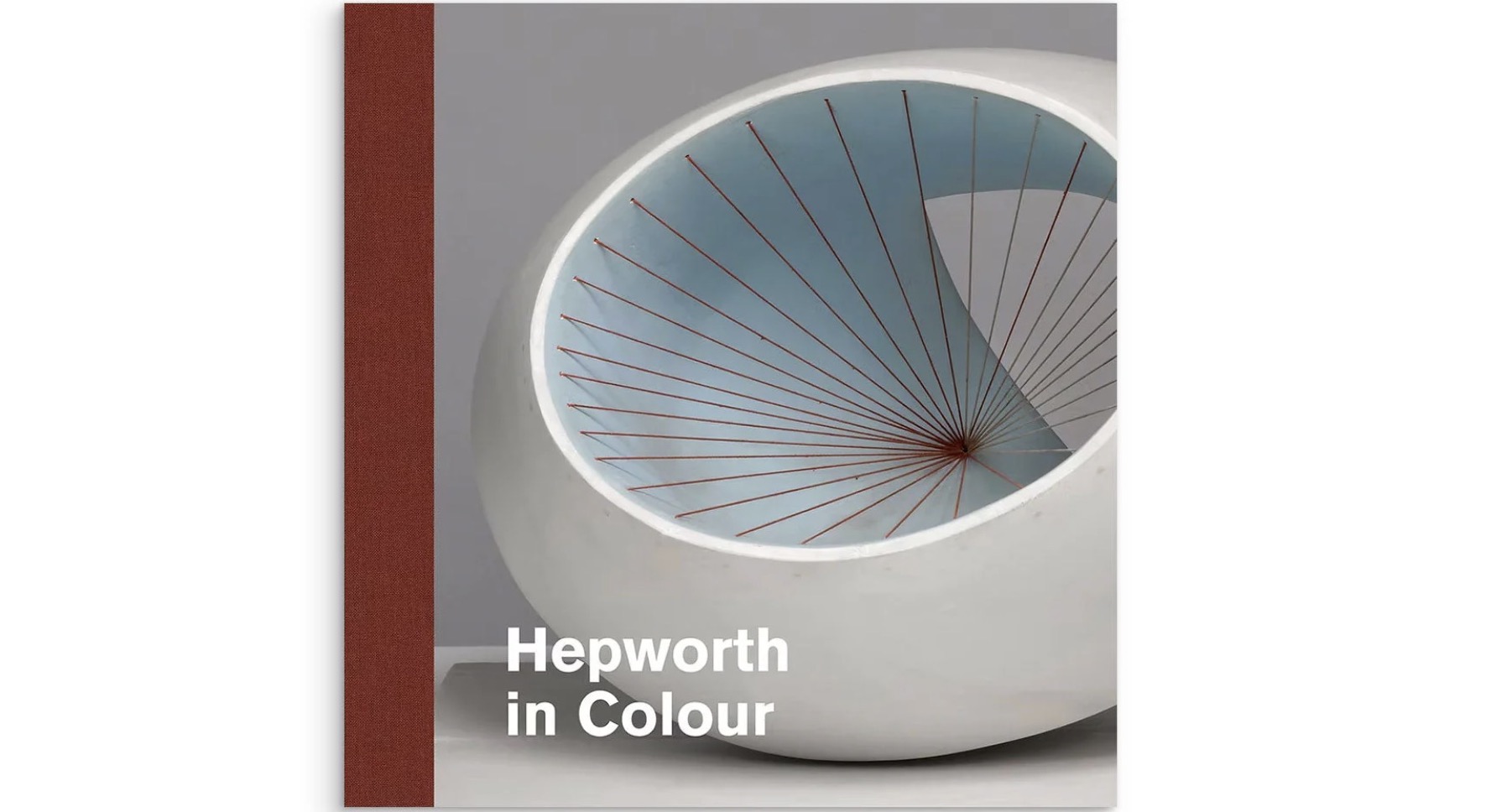
Barbara Hepworth said it herself, in conversation with her son-in-law, the art historian Alan Bowness: “In a way my colour has been accepted, but never understood.” That line sits near the centre of this catalogue, and it earns its place there. Because for all the decades of critical attention Hepworth’s work has received, the colour has been consistently underplayed, treated as incidental or decorative rather than structural to how the work thinks.
This book, accompanying the Courtauld Gallery exhibition running from 12 June to 6 September 2026, is the first to address that gap directly. It is a research-driven publication that reads like one, which is not a criticism. Around twenty sculptures and thirty drawings are reproduced and discussed, the selection weighted toward the 1940s, when Hepworth was painting vivid blues and yellows directly into the hollows and onto the curves of her wood-and-stone carvings. These are not well-known works, at least not in this context, and seeing them gathered and examined together changes something in how the broader body of work registers.
The catalogue’s argument is that colour was never peripheral to Hepworth. It extended across her entire career, from those early painted carvings through the painterly bronze surfaces of the 1950s and into the 1960s, where her use of coloured marbles opened the question of what colour could do in three dimensions in ways that hadn’t been seriously attempted before. The drawings are included not as supporting material but as evidence of a parallel practice, a more expressive graphic work that was in genuine dialogue with the sculpture rather than simply documenting it.
Hepworth is, of course, best known for her abstract forms, the references to Cornish landscape and coastline, and the quality of her engagement with natural materials. That reputation is secure. What this catalogue proposes is that understanding the colour means understanding the work differently, not correcting the existing account so much as expanding it. The Bowness quotation suggests Hepworth herself felt the dimension had been missed. Whether you arrive at this book as a Hepworth specialist or as someone with a more general interest in mid-century British art, the case it builds is a compelling one.
The hardback is well produced at 260 x 250mm, reasonably priced at £25, and the reproduction quality does what it needs to do for a subject this dependent on surface and pigment. It is a focused book rather than a comprehensive survey, and it is better for that focus.
Buy this book Here