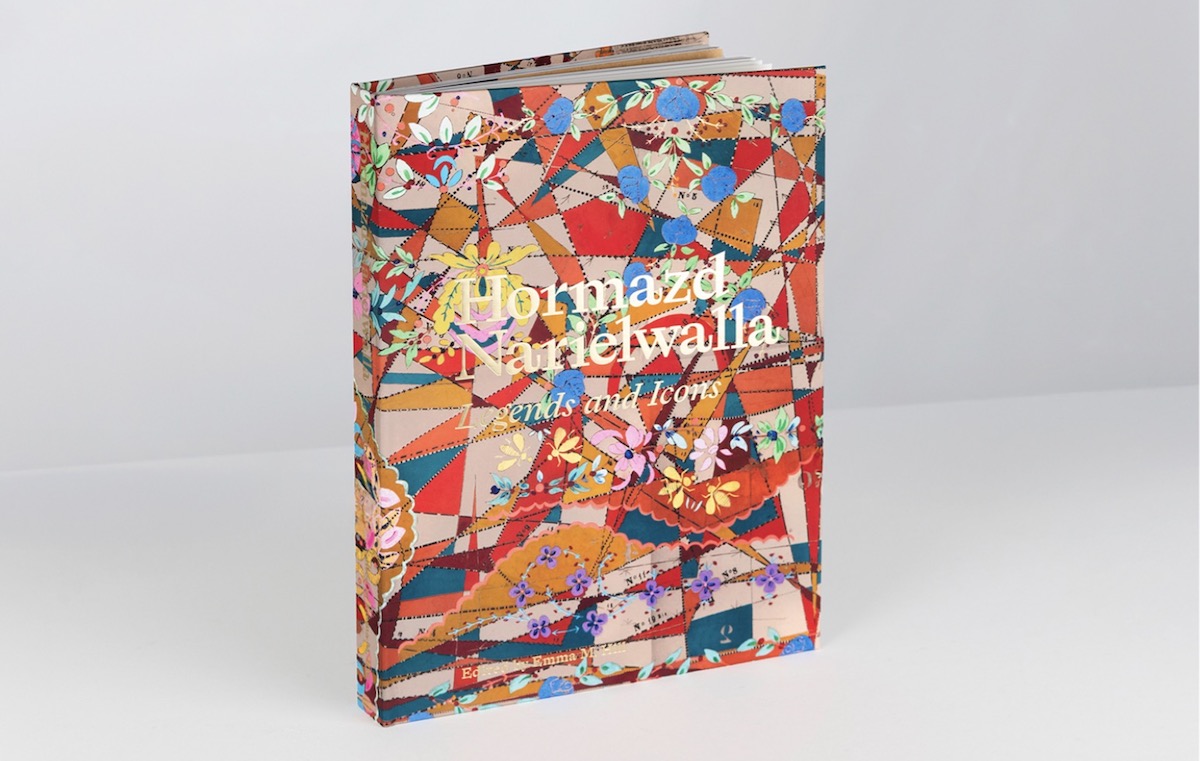
Legends & Icons (ed. Emma M. Hill) evokes the atmosphere of stumbling upon an unoccupied artist’s workspace, with debris and half-finished work scattered around. So this is quite a momentous occasion, being the first substantial exhibition of work by Hormazd Narielwalla; it seems to mark a milestone, almost funereal, but from an artist whose work continues to evolve and develop in many directions. It would be misleading to think that the opulent 260-page, foil-stamped book was purely review-like. Rather, it is more akin to a protracted breath.
As well as working in a wide variety of media, including print, sculpture and books, he is probably best known for using old patterns for clothes, finding them and combining various elements to make an overall form. So they take on a life as evocative representations of the body, of individuals, of aspects of their personality, and of a changing sense of who they are. All innocuously functional in their original context, and no doubt entirely unknown to the individuals whose measurements and preferences they recorded.
As far back as 2009, the book includes images from A Study on Anansi, made for Sir Paul Smith. This shows many themes that would continue to be explored: the fusion of disparate cultural references, many layers of allusion and reference, and a multiplicity of possible configurations of the body.
He has then gone on fairly swiftly to produce work for 45 Park Lane and Hackett, spend a residency at the V&A, produce work for the Crafts Council, and, most recently, produce Expanding Universe, a vast array depicting the heavens, at the Royal Geographical Society. There could be a fairly straightforward line to be drawn through all of these exhibitions and projects, but in reality his interests take him off in many other directions. He will work intuitively and be drawn to pre-existing images and objects, recognising the richness of the story they carry.
A number of writers contribute to the book: Nancy Campbell, Isabela Galvao, Melanie Vandenbrouk, Piero Tomassoni and Dr Michael Petry, approaching the subject matter in various ways. Of particular interest is Campbell’s extended discussion of many aspects of his cultural inheritance, having grown up and been educated in India before moving to England in 2003, initially to read Fashion. Many of the composite images suggest the process of someone changing and transforming, prompting thoughts about our identity now, our perceived identity, our potential identity…
So, once again, the old, tattered, and threadbare patterns provide much of the source imagery and set off a theme. To him these are “beautiful abstractions of the human body”, summarising the measurements and characteristics of a wide variety of men who would have worn tailored suits and service dress. Over and onto these basic frameworks, he superimposes a wide range of curvilinear and straight-lined forms, areas of solid colour, and other details. To a greater or lesser degree, most have the quality of Cubist reduction, but with endless variation and playfulness. Some images are very restrained and graceful; others are far more strident and assertive, and these may vary within a group.
A group of images commemorating the measurements taken for suits for a now-deceased customer of a Savile Row tailor (Dead Man’s Patterns, 2008) would seem rather macabre, but in fact are very light and beautiful, and gently contemplative of death. The range produced for the Crafts Council used service dress patterns from 1850-1947 to evoke features of the occupation of India. A series continuing to date is based on the layout of a beautiful garden of roses that he can remember from childhood, so again has connotations of record, map, and reconstruction.
Various figures from history and modern times have provided inspiration. Following the 2018 exhibition at the V&A on Frida Kahlo’s wardrobes, he produced a number of images alluding to her strong and protective choice of dress; a group of sculptures evokes Chanel. Most recently, a series (2020) based on various depictions of Bowie as Ziggy Stardust produces a host of colourful characters, not portraiture, but all suggesting a state of flux as to their true identity, and most likely gender. Clearly, he was greatly stimulated at an early age by Bowie’s creation of alternative personas.
Underlying much of this would seem to be the assumption, or experience, that one’s personality and characteristics are largely determined by external factors and therefore can be altered and manipulated. There will be a great deal that we take ready-made from those around us and surrounding cultures; it is then open to each individual to modify them to varying degrees.
So this is a wide-ranging record of output over 17 years, and very suggestive of one way of generating a coherent body of work, using an almost limitless range of basic components and discards, and achieving a remarkable unity of vision. One is left wanting to examine all manner of patterns for other possibilities inherent in them.