

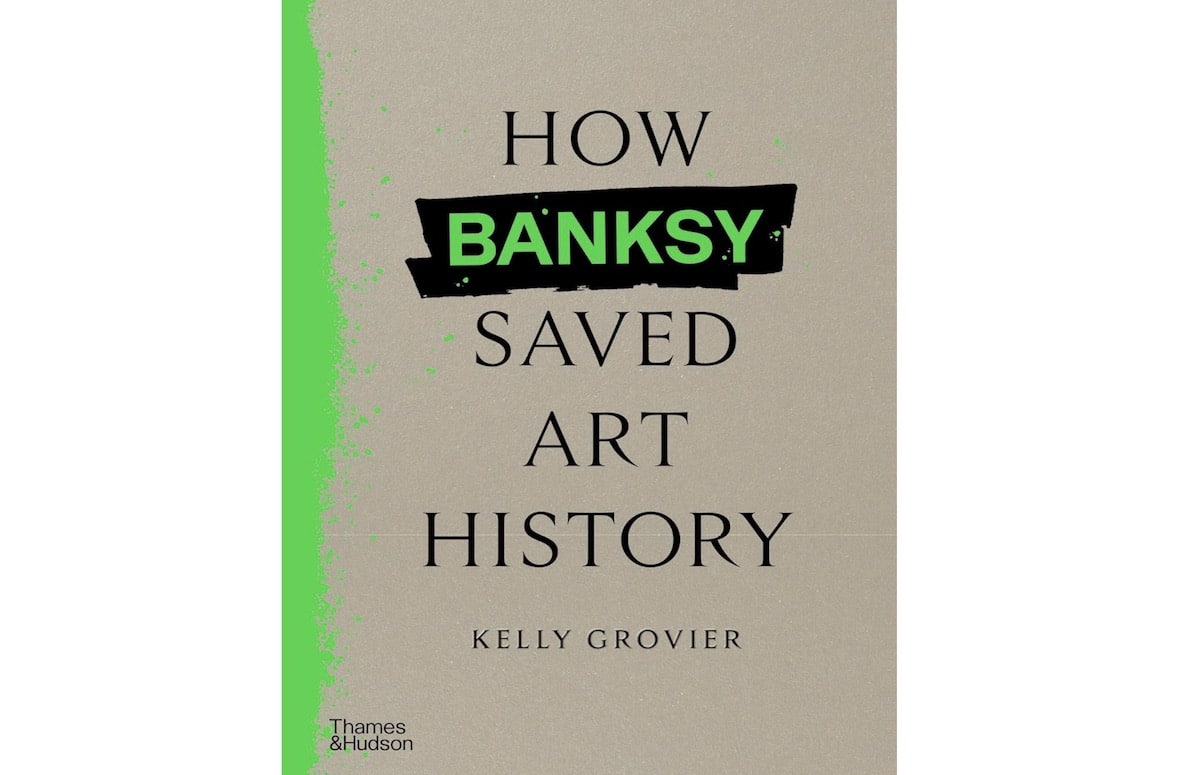
How Banksy Saved Art History by Kelly Grovier examines the history of art through the lens of the enigmatic street artist Banksy.
As arguably the most famous and controversial contemporary street artist, Banksy stands out due to his frequent allusions to key historical artworks. For the last 30 years, his works have acted as a powerful statement about the progression of art.
With stencils, cans, and perpetual anonymity, Banksy has positioned himself as a provocateur within the fine art sphere. He does not seek to build upon the foundations of established practice but to subvert it. Typically, we think of his work being painted onto raw cityscapes, far removed from the white cube of the gallery or museum. However, there is a deep knowledge of art history underpinning many of Banksy’s street interventions, temporary installations and ‘found’ and modified works.
In revisiting and playfully altering some of the great artworks of the Western canon, Banksy forces us to reconsider our preconceptions of art. Whether it’s the crude depictions made at Lascaux, the light-hearted reinterpretation of Monet’s Water Lilies, or the transformation of Vermeer’s The Girl with a Pearl Earring into a piece of contemporary art, Banksy imbues these familiar and hallowed images with new meaning. In doing so, he does not diminish their legacy, but allows us to see and relate to them in a fresh way.
Kelly Grovier is a prize-winning art writer and regular contributor to BBC Culture. Previous writing credits include The Times Literary Supplement, The Independent, Sunday Times, The Observer, RA Magazine and Wired. He is the author of the highly acclaimed A New Way of Seeing: The History of Art in 57 Works; On the Line: Conversations with Sean Scully and The Art of Colour: The History of Art in 39 Pigments. He co-edits the scholarly periodical European Romantic Review.