

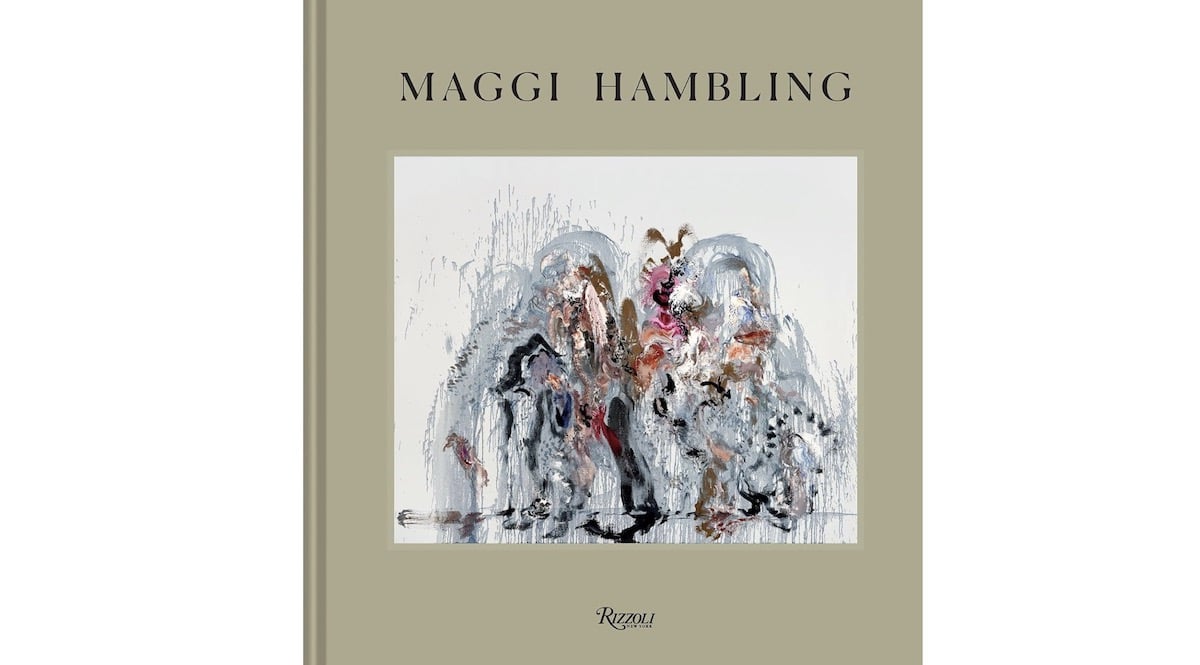
Maggi Hambling has never been one for half-measures, and this hulking new monograph—published to mark her eightieth birthday doesn’t bother with restraint either. It arrives image-heavy, argumentative, slightly chaotic in places, and all the better for it. You leaf through it and feel the physicality of a life spent dripping paint, metal, clay, and, occasionally, the public’s patience.
The book is a “definitive” illustrated study, not something that signals the end of a career. The book crackles with the vitality that has shadowed Hambling since her early days under Lett Haines and Cedric Morris at the East Anglian School, back when she was still figuring out how much mischief a line could carry.
The essays are an uneven, spirited mix from critics, curators, and the usual suspects of Hambling supporters. They trace her beginnings through the smoky ascent of the 1980s, when she became both a painter’s painter and a lightning rod for cultural clashes that never dilute. The book covers the scratchy, searching sheets that sit behind the more flamboyant canvases and the monumental sculptures. You sense how central the act—almost the ritual of drawing has been: the hand steadying the thought.
And then there are her breakthrough moments: the National Gallery residency in 1980, the Jerwood Prize in 1995, the smoking, lip-curled Oscar Wilde that plonked itself down near Charing Cross in ’98 and became a kind of queer pilgrimage site, the divisive Scallop on the Aldeburgh beach part tribute to Britten, part lightning conductor for local fury still looks like it was washed up by a storm and decided to stay.
Hambling’s later output, those storm-charged canvases of waves, the climate-stricken seascapes, the sombre War Requiem installation,s gets the complete, lavish treatment.
Reproductions are crisp enough to get a good idea of the quality of the painting, and the pace of the pages mirrors the work itself: restless, a little haunted, occasionally snarling. Themes of love, death, and memory, those companions, surface again and again, but they never feel tired. More like tide patterns: always returning, constantly shifting.
What the monograph captures best is the strength of her personality Not the caricature of Hambling, the chain-smoking, sharp-tongued sculptor who caused uproar with her Mary Wollstonecraft figure in 2020, but the artist who has spent six decades wrestling with how to make feeling visible. The book is alive in the way her best paintings are alive: prowling around the edges of things, refusing to sit still.
As a portrait of one of Britain’s most provocative and committed artists, it earns its heft. And if you close it feeling a little breathless, well—Hambling would probably be pleased.
Maggi Hambling (Hardback) Sean Burns (author), JamesCahill (author) Publisher: Rizzoli (Mondadori Electa) ISBN: 9788891844569


