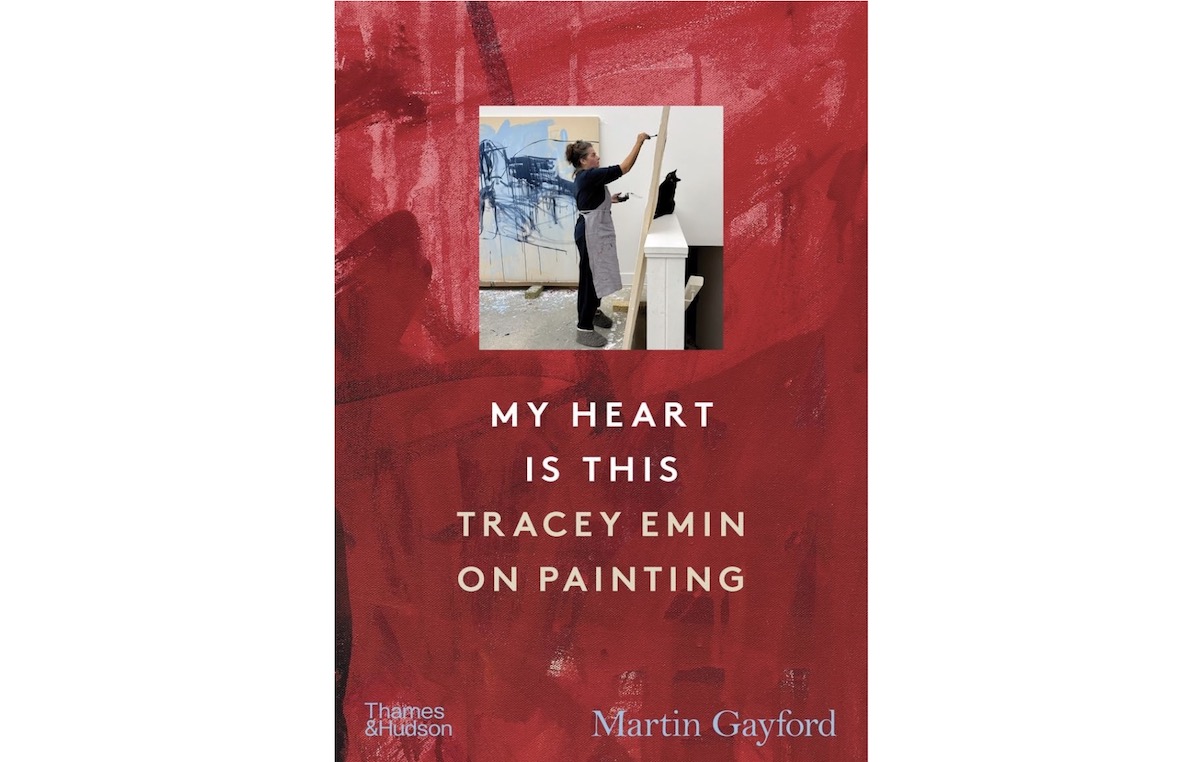
Emin has always worked from the inside out. Her art questions identity, memory, and emotional exposure, returning repeatedly to love, desire, grief, and the awkward terrain of self-examination. Honesty, for her, is not a principle but a method. “The most beautiful thing is honesty, even if it’s really painful to look at,” she says, a remark that quietly underpins the book’s tone.
Gayford’s conversations with Emin move through painting in a way that feels unscripted, occasionally wandering, but revealing all the same. She speaks about how she paints, why she paints, and what painting gives back to her. There is a sense throughout that the act itself is inseparable from living a process rather than a product. The book takes on additional weight in light of her cancer diagnosis four years ago, an experience that reshaped both her outlook and her practice. Painting, here, becomes not just an artistic pursuit but a form of survival, or perhaps recovery.
The structure is simple: dialogue, reflection, image. Yet within this looseness, the reader gains a vivid sense of Emin’s working environment and is influenced by the studio’s clutter and intensity, the presence of other artists, and the push-and-pull of past and present. The illustrations, generously included, do more than document; they punctuate the text with moments of pause, offering glimpses of the work as extensions of the conversations themselves.
Emin’s voice dominates, as it should. She talks about drawing in terms of instinct rather than theory. “Drawing is an extension of the soul,” she says, describing the movement from mind to hand to paper and back again — a cycle she regards as cleansing, almost alchemical. Such statements might risk sentimentality in another context, but here they land with a kind of unvarnished directness. Her reflections are blunt, sometimes disarmingly so, yet rarely self-conscious.
What emerges is a portrait of an artist reconsidering her relationship with painting at a crucial moment in her life. There are passages on learning — or relearning — how to paint, and on confronting physical vulnerability alongside creative urgency. The book lingers on the question of why painting still matters, particularly now, when Emin speaks of it as essential and non-negotiable.
Gayford, an experienced observer of artists and their processes, largely steps back, guiding the conversation without imposing heavy interpretation. Readers familiar with his previous studies of painters will recognise his interest in how art actually happens — the practical and psychological mechanics behind the work. Here, however, the emphasis rests firmly on Emin’s perspective, her cadence, her confessional mode of thinking.
The result is less a critical study than an intimate record of a moment in an artist’s life. It captures Emin in transition: reflective but restless, fragile yet defiant, still testing what painting can hold. There are no tidy conclusions, no grand theoretical claims. Instead, the book offers fragments of thought, flashes of clarity, and the sense of a practice continually being redefined.
For those interested in Emin’s work — or in the broader question of how artists sustain their vision through upheaval — this is a revealing and often moving account. It shows painting not as an isolated discipline but as a way of navigating existence itself. And, like Emin’s work, it leaves certain questions unresolved, which may be precisely the point. – PCR
Price £25.00


