
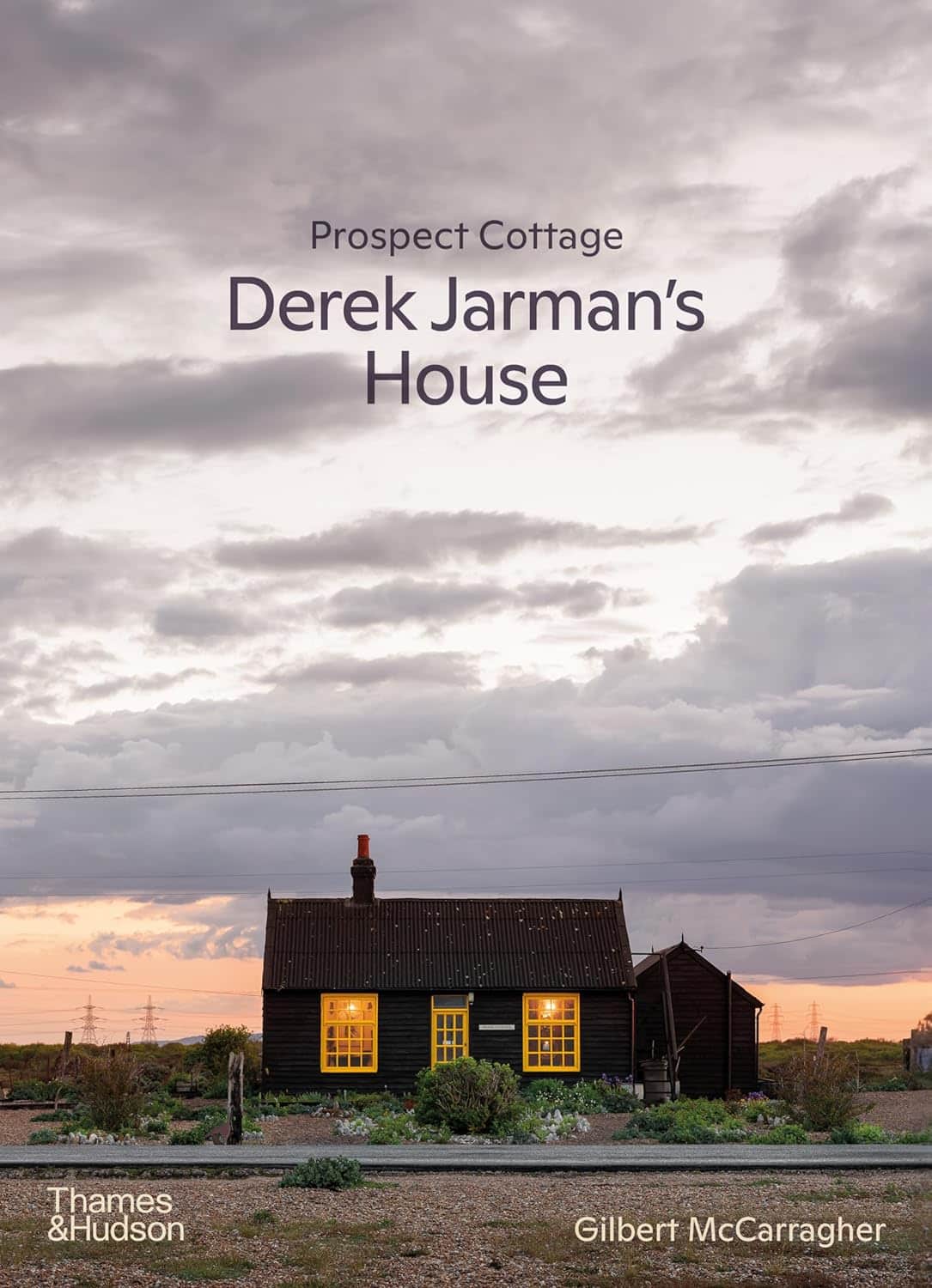
In “Prospect Cottage: Derek Jarman’s House”, McCarragher and Borzello provide readers with unique insight into the private domain of a celebrated British ‘cult’ artist and filmmaker. A combination of beautiful images and considered pieces allows us to understand Prospect Cottage as Derek Jarman lived and created within it towards the end of his life.
Since 1986, Derek Jarman and his partner, Keith Collins, have spent considerable time and effort converting Prospect Cottage to suit their needs and tastes. After Derek’s death in 1994, Keith sought to protect the house and its surrounding grounds from outside scrutiny, fitting netting over the windows to obscure the cottage from those admiring Prospect’s famous gardens.
It fell to McCarragher, himself a lifelong friend and long-term resident of Dungeness, to capture Prospect Cottage for the first time in some time. He takes us inside the house, allowing the reader to discover the secrets and stories of each successive space.
With a Foreword by Frances Borzello, we learn many fascinating facts about the house and how it came to play such a significant role in the final chapter of Jarman’s life. The result is a richly layered and rewarding volume, populated by McCarragher’s images and accompanied by Borzello’s writing.
“Prospect Cottage: Derek Jarman’s House” will therefore stand not only as a record of this remarkable building but also as a statement about what can be achieved when we allow ourselves to create. For fans of Derek Jarman’s output or simply those interested in how our homes can shape our lives, it will be essential reading.
Derek Jarman (31 January 1942 – 19 February 1994) grew up in the small town of Northwood, Middlesex. Coming from a very traditional background, he developed his interests while attending university in London, studying initially at King’s College and subsequently at the Slade.
He went on to explore all forms of visual media: painting, directing, producing, scriptwriting and tending a large and varied garden. In each case, his output became known for its uninhibited approach to subject matter and style, and he quickly established himself as one of the key figures of the UK underground art world in the 1960s-1970s.
As a director, Jarman made his name in 1976 with the release of Sebastiane, a lavish and explicit portrayal of the life of Saint Sebastian. Since then, he produced numerous films of varying lengths and styles, all unified by their striking cinematography and engagement with contemporary issues.
These included frequent examinations of sex and gender, as well as overt condemnation of political and cultural establishment, exemplified by films such as Jubilee, The Tempest and Caravaggio.
His output as a painter and writer was equally impressive. His autobiographies Dancing Ledge (1984) and Modern Nature (1991) remain two of the most evocative books ever written about the nature of being alive.
Finally, Jarman cultivated the grounds of a run-down property in Dungeness, Kent, into the extraordinary and varied garden seen today. His interest in this led to the compilation of his life’s work in the form of Derek Jarman’s Garden, published posthumously in 1995.
Jarman died having maintained his lifelong commitment to breaking free of any perceived restrictions in his life and art. His influence can still be felt in the work of countless artists and directors today, and his life’s achievements serve as a lasting reminder of the value of creative freedom.