
Surely there can be no one in Britain today who does not know that the Bayeux Tapestry recounts the events leading up to the Battle of Hastings, when Britain was last invaded. True, our memories of this period may be hazy, as for many of us the Anglo-Saxons appeared in the curriculum between the ages of 7 and 12.
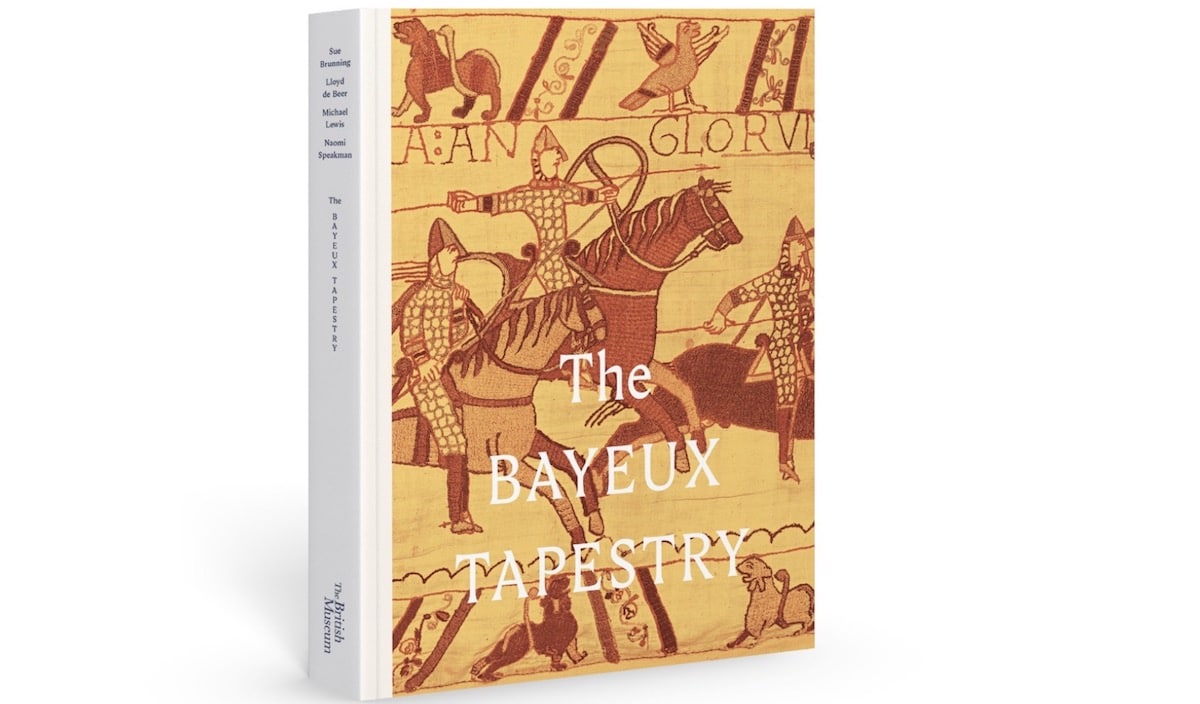
The tapestry, which as now known should be termed an embroidery, was made in the years following the conquest of England by William, Duke of Normandy, shortly to be William the Conqueror. It covers the events of 1065 and 1066. Unsurprisingly, it is a slightly biased account, weighted toward the Norman side of events, and omits several other events significant to the Anglo-Saxons. Since its subject is almost 1000 years old, it is difficult to be certain of many things, so much having been lost to time. This is where this publication excels: the authors reference and illustrate contemporary documents in the embroidery and describe, accessibly and in quite some detail, what they admit was a particularly chaotic period in British history. Included is a much-needed cast list of dramatis personae, setting the stage for the conquest and going through each character’s contribution, putting it in its historical context. Aside from the confusing line of English succession at that time (every heir apparent seems to die early), there is an invasion the tapestry entirely omits.
Norway, led by Harald Hardrada, invaded Britain, and Anglo-Saxon Harold defeated him at Stamford Bridge near York on 25 September, less than three weeks before he fought the Battle of Hastings, where he lost his life.
They not only place the tapestry and the objects it depicts within eleventh-century life; they call attention to how the borders are both decorative and informative. They show daily life: building, farming, craft work, and the influence of far-flung places by the inclusion of a peacock and are also entwined in the story through the inclusion of Halley’s comment and the ghost boats in the scene of Harold’s coronation and the many bodies hacked to pieces and being stripped of their armour.
Interestingly, the authors point to the influence of classical art that the makers must have known about: attempts to convey depth and the occasional inclusion of a Roman-style cloak to indicate William’s status. Related articles are illustrated, coins showing Edward the Confessor, Harold and William, a rare surviving Norman helmet with its nose piece intact (who knew so few survived their form seems so ubiquitous due to the tapestry).
Much of what is currently written on the tapestry focuses on this period in our history, overlooking the embroidery’s material history. It is without doubt the most famous surviving embroidery in the world, and its condition and vibrant colours indicate that, despite its age, it cannot have travelled or been displayed extensively. It is worth noting that the Victorian copy of the tapestry in Reading is badly faded and has lost much of its contrast despite being so much younger. So unique, yes, but it nevertheless falls into a Germanic tradition of storytelling through wall hangings. That tradition, in turn, is a secular part of what, in a couple of centuries, would become Britain’s most luxurious export, Opus Anglicanum (English Work), shimmering goldwork that survives mainly in Church treasuries. The oldest pieces are the Cuthbert embroideries in Durham, dating to the 10th century. The Bayeux tapestry is a secular piece, worked in wool on linen, but with the same stitching techniques as used in Opus Anglicanum. Fragments survive of embroidered seal bags, book covers, cushions, clothing, wall hangings, bed hangings, horse trappings and banners, and the publication illustrates surviving fragments of tapestries and embroideries.
Women played an important role in this tapestry; although only three are included, they must have formed the main workforce in its creation. The Domesday Book indicates a woman could earn a living as an embroiderer at that time. But who was its overall designer? There are no clues.
Whoever they were is shown to have drawn on illuminated manuscripts, many of them in Canterbury’s library, thus strengthening the argument that it was made in Canterbury.
The book also deals with the tapestry’s later life. It illustrates the spool it was kept on and shows it being unspooled for visitors to see. It refers to Napoleon’s interest, and that of the Nazis, in it for political propaganda ends. In 2000, it was turned into a cartoon about the Iraq War. It was political when it was made and remains so today.
For those who have seen the tapestry and want to go deeper than forty minutes of viewing allows, or for those who have not managed to obtain tickets, this is the publication for you. It is lavishly illustrated, showing the tapestry in full, and includes details where relevant when episodes are referred to in the text, eliminating the need to flip backwards and forwards.
‘The Bayeux Tapestry’, Edited by Sue Brunning, Lloyd de Beer, Michael Lewis, Naomi Speakman, The British Museum Press, London, 2026