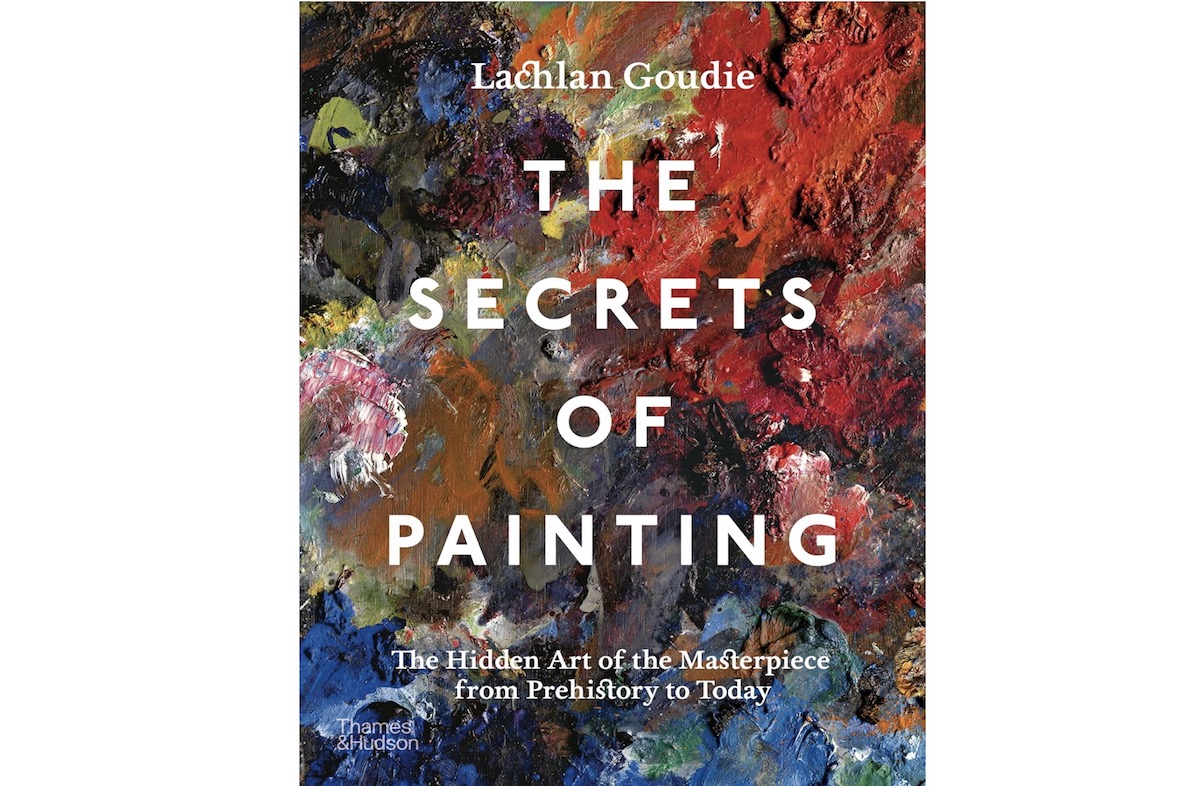
Most art books start with why. Why did they paint it, what did it mean, what was the cultural context, who was the patron? Lachlan Goudie starts with how. It’s a different question, and it leads somewhere more interesting than you might expect.
Goudie is a practising artist, which matters here more than it usually does in art writing. He knows from direct experience that masterpieces don’t arrive serenely. They come out of a fight — dirty hands and crushed pigment, hog-hair brushes and linseed oil, rabbit-skin glue and pulverised chalk. The physical struggle between artist and materials is not incidental to the work. It is the work, or at least inseparable from it. That’s the argument this book makes, and it makes it well.
The scope is genuinely ambitious. He started 36,000 years ago, at Chauvet, with charcoal and mineral pigments on cave walls. The paintings there are extraordinary by any standard — compositionally sophisticated, spatially aware, made by people who understood what they were doing with a surface. From that original big bang, Goudie traces the entire material history of painting: ink, fresco, egg tempera, oil paint, canvas, watercolour, gouache, impasto, tube-manufactured paint, collage, household gloss, acrylic, digital media, and AI. Each chapter focuses on a technical turning point and embodies it through a specific artist. Giotto. Artemisia Gentileschi. Alma Thomas. Anselm Kiefer. David Hockney. The selection is wide enough to avoid the obvious without feeling forced.
What makes the book work is that Goudie has actually conducted the research. He has mixed historically accurate materials, studied with contemporary practitioners, and interviewed conservators who have spent careers on these questions. So when he explains what Rembrandt was doing with crushed glass and brick dust in his oil colours, or why Song Dynasty court painters used inks perfumed with cloves and honey, or how artists in Roman Egypt painted with molten beeswax, it reads with a first-hand knowledge of what it would feel like to hold those materials and use them.
The book’s central claim — that as each generation of painters exploits the new material innovations of its era, it transforms the character of its work and propels art history forward — is not especially radical as a thesis. But Goudie earns it by grounding it in specifics rather than assertion. The technical turning points he identifies are real turning points, not retrofitted narrative convenience. The move from panel to canvas, the invention of the collapsible paint tube, the arrival of acrylic — each of these changed what was physically possible and therefore changed what artists made. Cause and effect, demonstrated rather than declared.
At over 384 pages and 220 illustrations, it’s a substantial, well-designed, well-produced book that works both as a sustained argument and as a reference. Simon Schama called it “an epic of what humanity is capable of, written at the exact moment when we’ve already assumed machines can, or will, do everything better.” That framing is timely. A book that insists on the irreducible physical specificity of making — the hand, the material, the surface, the struggle — arrives at a useful moment.
It’s also a good read. Accessible without being simplified, serious without being airless. The broadcaster in Goudie keeps the prose moving and the details vivid. The artist in him keeps it honest.
The Secrets of Painting is published by Thames & Hudson on 2 April 2026, £38.00 hardback.


