Update: Italy’s culture minister wants representatives on the Venice Biennale board to resign. Alessandro Giuli said this week that he had lost confidence in Tamara Gregoretti, who has sat on the Biennale’s board since March 2024, accusing her of failing to flag to the ministry that Russia was planning to return to the exhibition in May. The ministry’s position is blunt: Gregoretti “did not deem it necessary to announce the possible presence of the Russian Federation at the next Biennale.” Given the political temperature around anything involving Russia right now, that omission, if that’s what it was, is not a small one.
The dispute is widening. Russia’s plan to reopen its pavilion at the 2026 Biennale, its first appearance since the 2022 invasion of Ukraine, has been generating fury for weeks. Now it has pulled the Italian government into open conflict with its own appointee. It will not stop there.
Russia is to participate in the Venice Biennale for the first time since Putin launched his full-scale invasion of Ukraine in February 2022. The announcement has been met with anger from dissidents, Ukrainian arts figures, and the punk protest collective Pussy Riot, who described it as a “serious blow to Europe’s security.”
Update: The European Union has warned it may withdraw funding from the Venice Biennale if Russia is allowed to exhibit — the latest and most significant pressure yet on organisers over a decision that has been causing uproar since it was announced. It would be Russia’s first appearance at the world’s most important art exhibition since the 2022 attack.
The Russian pavilion’s programme, titled “The tree is rooted in the sky” after a phrase drawn from the French philosopher and mystic Simone Weil, will centre on folklore and world music, including a three-day festival running from 5 to 8 May, ahead of the Biennale’s official opening. The festival will be filmed and screened within the pavilion. Putin’s international cultural envoy, Mikhail Shvydkoy, said Russia intended to present “a multilingual polyphony of cultures” that would not be denied “the right to artistic self-expression.”
Pussy Riot were considerably less measured. In a Facebook post, the group wrote that since the start of the full-scale invasion, cultural soft power had “become part of Russia’s military doctrine and an instrument of hybrid warfare,” and that the Kremlin had long used culture to legitimise the regime abroad. They drew a pointed historical parallel: “We remember that in 1934, Hitler and Mussolini enjoyed Art together at the Biennale. In 1942, the Biennale was dedicated to military Art, while the exhibition catalogue contained no mention of World War II. It is nothing new that totalitarian regimes use Art to normalise their power.” The group said it intends to protest Russia’s participation.
The Biennale defended its decision, stating that any country recognised by the Italian Republic can participate by sending a notification of intent, and that it “rejects any form of exclusion or censorship of culture and art.”
The organisation described Venice as “a place of dialogue, openness, and artistic freedom,” expressing hope for “the cessation of conflicts and suffering.” The decision sits awkwardly alongside other recent moves by Italian institutions, which have cancelled performances by Russian musicians perceived as supportive of Putin. Last July, a concert by conductor Valery Gergiev was cancelled following widespread protests.
Ukrainian art critic and curator Kostiantyn Doroshenko told The Art Newspaper that Russia’s return had caused outrage “not only in the art world, but also in society as a whole.” He noted that the Russian pavilion building in the Giardini, designed by architect Alexey Shchusev and completed in 1914, was originally funded by the Ukrainian patron Bogdan Khanenko. He also recalled that international figures boycotted the tenth edition of Manifesta, held at the Hermitage in 2014, following the annexation of Crimea. “Since then, the situation has become even more egregious,” he said. Doroshenko described Russia’s planned programme as “a classic colonial approach to representing countries and peoples through their exoticisation and marginalisation in relation to modernity.”
The pavilion’s programme includes Malian sound artist Diaki Kone, known as DJ Diaki, who stated he saw his involvement as “a rare opportunity to bring the sounds of West Africa to life in such a prestigious international artistic context.” He described his intention to fuse West African rhythms with Russian folk elements and electronic music. He said that for him, “art and music are spaces for encounters that transcend political tensions.”
Others involved tell a different story. The folk group Toloka, whose work emphasises Russian nationalism and targets a young audience, posted an Instagram video of one of its members having his head shaved before military service, set to a song framing conscription as the patriotic duty of every healthy male.
The pavilion’s commissioner, Anastasia Karneeva, is the daughter of a former FSB general and current deputy chief executive of Rostec, the Russian state-owned defence contractor. Smart Art, the company she co-founded with Ekaterina Vinokurova, who is Sergey Lavrov’s daughter, was contracted in 2019 to manage the pavilion for ten years. Karneeva had not responded to requests for comment at the time of writing.
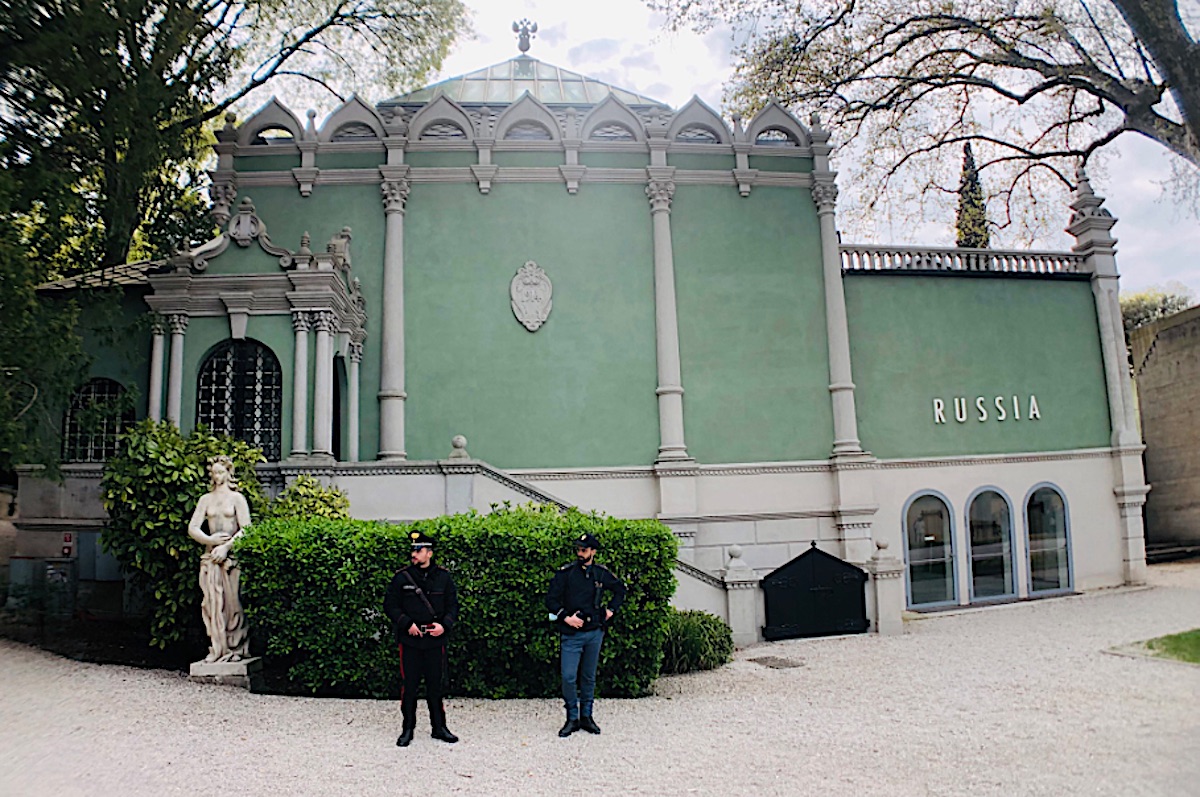
Russia Venice Biennale Photo © Artlyst