Quilla Constance, aka QC, has become known over the past two decades for her performances and related films and TV interventions – energetic, colourful and somewhat anarchic assaults on the absurdity of hegemonic systems which restrict and marginalise people on the basis of sex, race, class or sexual orientation. But she has also painted consistently, and films, paintings and an installation of costumes are brought together in her solo show ‘Activating Intersections’ at New Art Exchange, Nottingham. Our conversation concentrated on QC’s most recent monumental figurative paintings, which stem from open studio workshops at Tate Modern in which participants wore her designs of costumes – they are shown in poses, wielding props and occupying settings which highlight the performative nature of identity and power.
PCK: You have a black father and a white mother. How does that play into your work?
QC: My practice operates precisely at the fault lines of hybridity. I firmly believe that mixed-heritage subjectivities warrant rigorous, standalone discourse. We must not be subsumed by the reductive, tokenistic frameworks often deployed in search of a singular, “authentic” Black identity. My mixed-heritage experience is defined by a condition of perpetual, liminal flux—navigating an erasure where I am concurrently excluded from both Blackness and Whiteness.
This tension has drawn criticism from certain Black academics who misread my subversive re-performance of the cakewalking golliwog stereotype in Pukijam. I have faced accusations of failing to perform Blackness “adequately” or of catering to a white gaze. I counter this by anchoring my work in historical reality: chattel slavery encompassed a vast spectrum of complexions, and colourism has always cut both ways. Crucially, the cakewalk was originally birthed by enslaved Black people as a brilliant, satirical subversion of the affectations enacted by white plantation masters. While the white hegemony subsequently co-opted and weaponised this caricature to enforce subjugation, my intentionality in Pukijam is to violently reclaim this injurious trope. By decontextualising it, I weaponise it anew to rupture contemporary colonial frameworks.
I frequently engage with Black female artists who confess a reluctance to express rage, fearing they will merely reify the “aggressive Black woman” trope. But artistic expression demands access to the entire emotional spectrum. If white male artists like Paul McCarthy—whose work I deeply admire—are lauded for their irreverence, anger, and transgression, Black and brown women must be afforded the same conceptual latitude without facing immediate ghettoisation. Navigating the elitist art world as a working-class, mixed-heritage woman means constantly falling between institutional cracks.
PCK: What do you think lies behind those views?
QC: The absurdity lies in the gatekeeping—the notion that my artistic license to explore and communicate Blackness can be revoked based on arbitrary metrics of authenticity. This resistance often stems from a defensive position. I suspect that some Black critics, hyper-aware of historical trauma, fear that deploying these tropes risks reinforcing harmful stereotypes. I respect that anxiety; working with satire is a high-stakes conceptual tightrope. However, I urge critics to interrogate my intentionality, which is rooted in absolute creative integrity. Artists must be granted the radical agency to take risks, fail, and destabilise difficult subject matter rather than sanitise it.
Historically, my practice has also sat uncomfortably within the Western art market’s narrow framing of “Black Art.” We have witnessed a commercial phenomenon where Western galleries aggressively institutionalise a highly specific, geographically localised market—often hyper-focusing on continental African artists under 30. While their visibility is vital, the art market has weaponised their success to establish a monolithic standard of Black creative output. This commercial strategy systematically marginalises Jamaican, biracial, and overtly intersectional diaspora narratives, casting them as “less authentic.”
PCK: Is it a problem for you to face such criticisms?
This systemic friction is a source of profound frustration, yet it serves as the ultimate catalyst. It fuels a cathartic, activist practice that actively deconstructs and liberates the complexities of my intersectional position. Ultimately, then, I do not view this institutional friction as a deficit. Rather, it acts as an indispensable dialectic. It is the precise friction required to expose the limits of commercial art-world gatekeeping. Dismantling these exclusionary structures paves the way for a more expansive, nuanced cultural landscape.
PCK: You show costumes, as well as paintings and films, featuring strikingly dressed subjects. What is your interest in clothing?
QC: My fascination lies in the semiotics of the dressed body—specifically, the complex layering of cultural signifiers and how individuals navigate them. There is a persistent, romanticised myth among painters that the human form is at its most authentic or “natural” when naked. In reality, the body is never a blank canvas. Even in nudity, the physical form is so heavily coded by societal conditioning that it merely emulates cinematic tropes, becoming effectively “clothed” by its own gestures (as explored by theorists such as Kenneth Clark). These gestures span a spectrum from highly formulaic, commercialised glamour poses to raw, atavistic expressions of sexuality. Ultimately, sexual drive is a primal, evolutionary force of procreation that operates on a scale far more powerful than art itself.
While art can critique or subvert the mechanics of the gaze, the sexualization inherent in viewing a nude artwork can never be entirely neutralised. When artists—regardless of gender—claim their nudes are completely de-sexualised, I find that structurally impossible. In my past performance work such as Happy Christmas Mom & Dad (2006), I deliberately co-opted and weaponised this hyper-sexualisation. However, for my show at New Art Exchange, I have (largely) chosen to invert that strategy. I am deliberately accelerating the semiotic density by over-layering ornate garments, ramping up aesthetic excess to critically interrogate the very clothing codes that dictate our societal identities.
PCK: Though artists do also point to nudity as more ‘timeless’?
QC: Certainly, and I do not contest that impulse if an artist’s inquiry is rooted in abstracting the human condition. However, my practice is explicitly urgent and historically situated. I am far more compelled to generate radical, contemporary dialogues that directly confront historical legacies, rather than retreat into the safety of “timelessness.” Specificity is vital to the critical conversations we must have right now.
Furthermore, the sartorial interventions in my paintings and costumes intentionally collapse temporal boundaries. By conflating historical and contemporary dress, I stage a visual clash between disparate eras and what I term “tribal attires.” I am deeply invested in how aesthetic motifs and patterns migrate and repeat across seemingly disconnected cultures over time. Consider how a Rococo corset can formally echo a Jamaican carnival headdress or vice versa. Investigating these intersections allows me to ask: is this a history of colonial appropriation, or does it reveal a profound, subterranean shared humanity that destabilises our rigid, superficial categories of race, gender, and class?
PCK: You often pose in costume in front of your paintings?
Yes, I satirise the tradition of male Modernist painters posing next to their works. I want to send that up overtly and theatrically but also insert my black female body into this artworld protocol on my own terms – also, when I pose with my work it can be difficult to tell the difference between the performance and the painting, which toys with the potential for serious paintings to also function as props – this blurs boundaries between art forms, urging viewers to ask what constitutes so-called high and low art. I think some less progressive commercial galleries find this sort of work uncomfortable to market because it appears more accessible and entertaining – it speaks to people outside the art world.
PCK: What lies behind your particular painterly language?
The paintings are highly strategic, incorporating a range of tropes and signifiers to create and negate tensions between learned languages. I often employ varying degrees of realism as a legitimate language to activate a mutation, so the tension is often visible in the manipulated signification rather than in the technique. That said, I also play with varying degrees of realism, abstraction and cartoonish surrealism in a single canvas –
I aim for my work to be conceptually robust, but equally engaging for anyone who doesn’t care about art theory. I have no interest in making art that only appeals to half a dozen academics. Instead, my exhibition at New Art Exchange playfully subverts and reclaims the traditional, often elitist ‘white cube’ gallery space, making it a place for everyone.
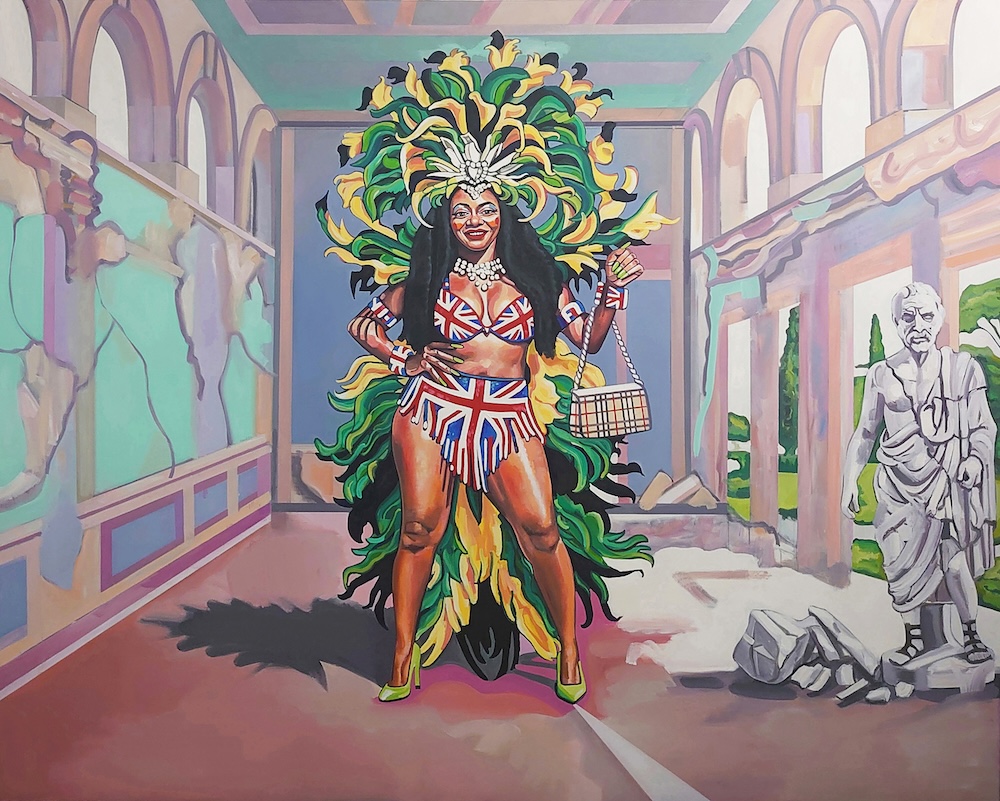
Quilla Constance: Coronation 1, 2026 – Oil on canvas, 240 x 195 cm
PCK: You are showing three ‘Coronation’ paintings, which you describe as ‘implosions of Britishness’. What’s the content of Coronation 1?
QC: Coronation 1 is an unapologetically overt, maximalist subversion of national myth-making, depicting an alternative British coronation ceremony. The composition frames a Black female figure who is simultaneously wearing a Union Jack bikini and a Jamaican carnival headdress, defiantly clutching a quintessentially British Burberry handbag. This tableau unfolds within a decaying neoclassical interior, alongside an ancient sculptural hybrid evoking Roman-era slave traders. By staging this intervention within a neo-classical framework, I am making a crucial historical point: the horrors of the slave trade and imperial exploitation extend vastly further back into Western civilisation than the 17th- and 18th-century statues currently being challenged in public spaces. Yet, the work is equally a testament to resilience; it asserts that historically subjugated bodies possess the radical autonomy and strength to transcend these oppressive architectural and historical frameworks.
In rendering the central figure, I am also satirically colliding (so-called) low-culture pop aesthetics with (so-called) high-art traditions. I have fused the hyper-stylised visual language of Marvel superhero comics with the nostalgic, rigid orthodoxy of mid-century British Ladybird book illustrations. These are vernacular art forms routinely dismissed by the gatekeepers of “high art” gallery spaces, which traditionally revere classical aesthetics. By deliberately conflating comic book heroism, colonial textbook nostalgia, and imperial ruins into a single canvas, I am actively imploding the monolithic, sanctified narratives of British identity.
PCK: She looks joyfully assertive.
QC: Precisely! And radical joy is itself a potent form of political resistance, though I believe it’s necessary to take things further.
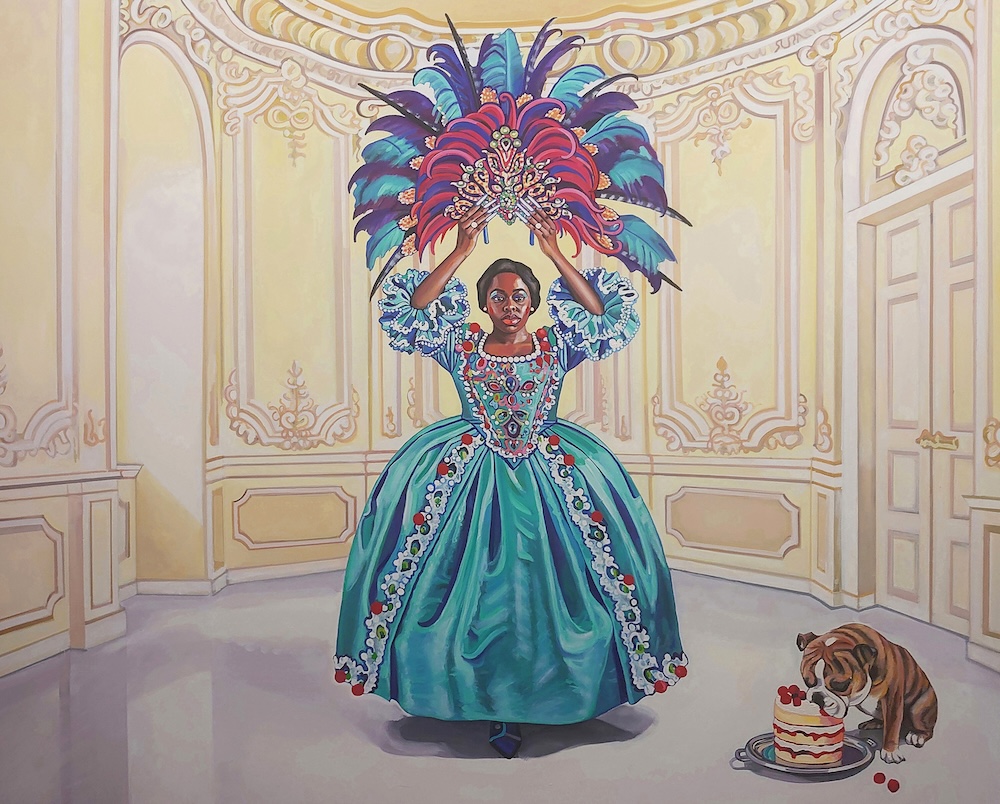
Quilla Constance: Coronation 2, 2026 – Oil on canvas, 240 x 195 cm
PCK: How about Coronation 2?
QC: Coronation 2 engineers a conceptual and aesthetic mutation. It is directly informed by the state-sanctioned theatre of King Charles III’s coronation, specifically exploring how that spectacle performs status and constructs national identity. My objective is to dismantle this choreography—to rework and re-perform it—thereby exposing imperial attire and national pageantry as mere hollow tropes that can be actively undone, rewritten, and reclaimed to generate marginalised agency. The work builds directly upon the foundational performance theories of Judith Butler, José Esteban Muñoz, and Peggy Phelan regarding the fluidity of identity and the power of disidentification.
To achieve this, I strategically employ an over-identification with the tropes of quintessential Britishness to trigger an aesthetic implosion. Consider the surreal absurdity of a British bulldog chowing down on a Victoria sponge! This curated catastrophe does more than just unveil the highly constructed, formulaic nature of institutional power; it forces a radical, alternative subjectivity to emerge from the cracks. This mutation does not merely destroy Britishness—it aggressively expands it.
Compositionally, I feel this manifests as a dizzying conflation: a Rococo gown, excessive pearl strands, and the iconic bulldog are juxtaposed with the majestic height of a Jamaican carnival headdress that directly usurps the position of the British crown. The subject’s dress is further adorned with the literal spoils of this domestic implosion—such as cherries salvaged from the ruined cake. These elements serve as transgressive embellishments, re-coding her agency from within the belly of the hegemonic beast.
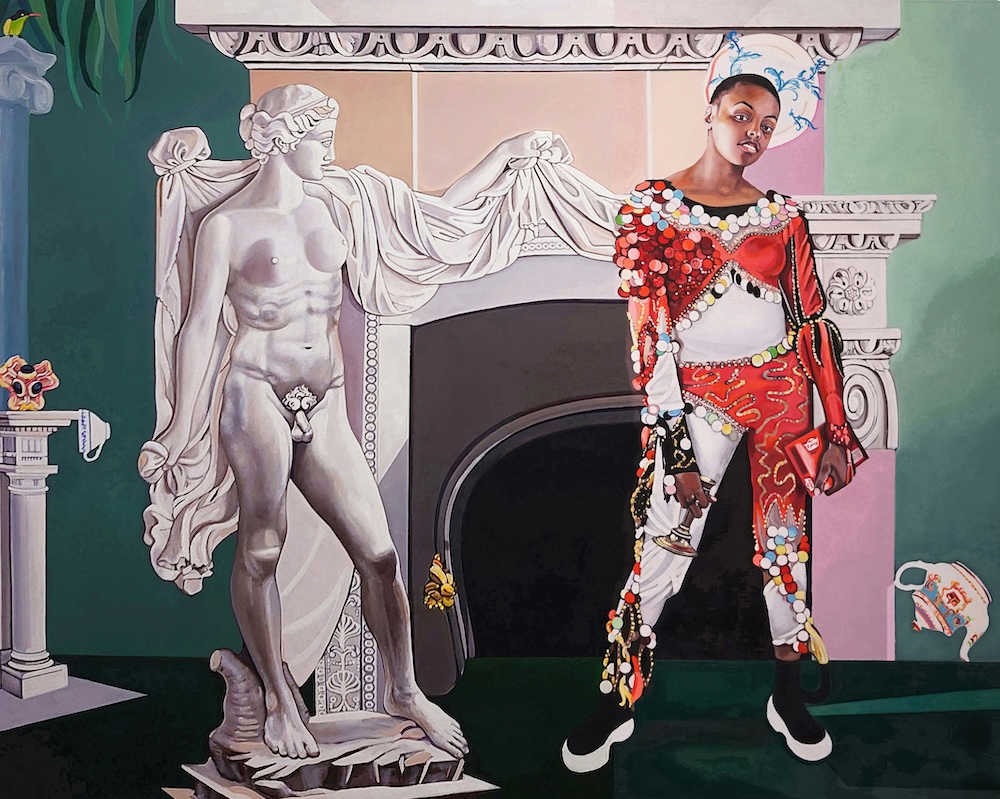
Quilla Constance: Ackee’s Majestic Smile, 2026 – Oil on canvas, 240 x 195 cm
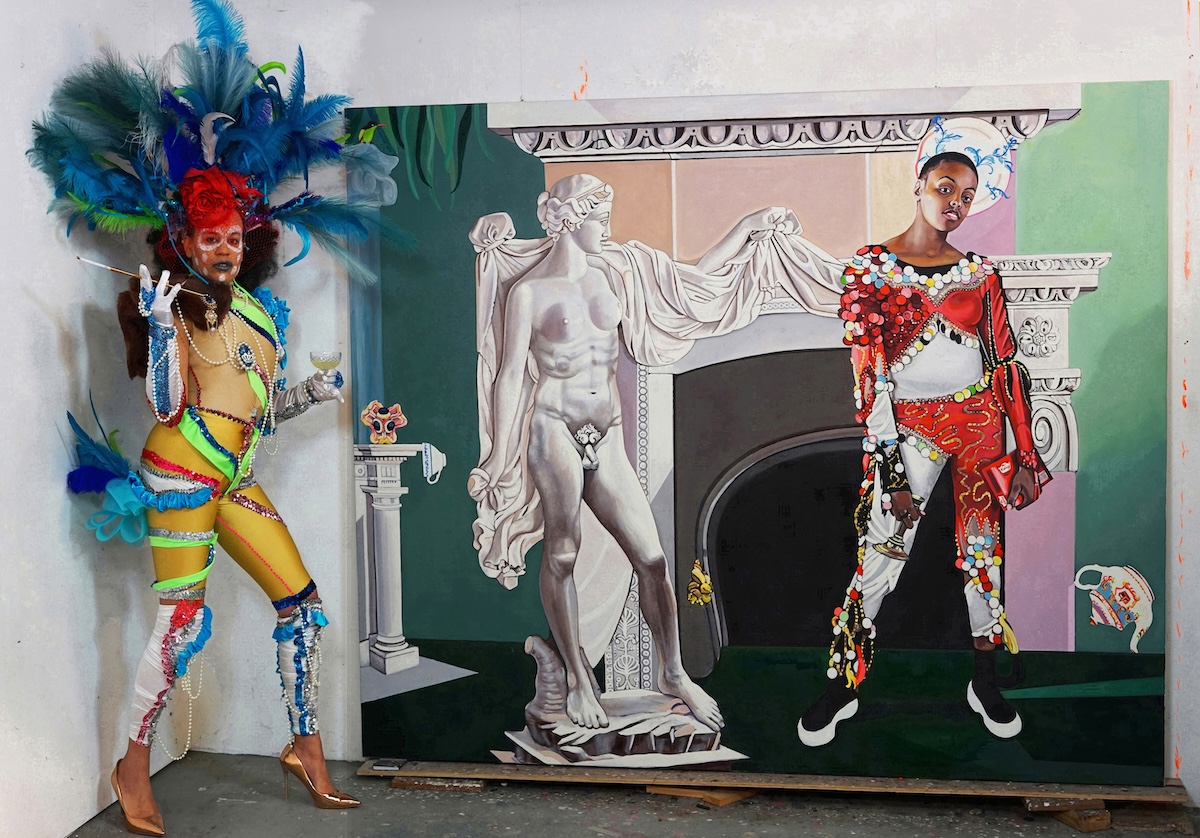
PCK: What’s the statue in Ackee’s Majestic Smile?
QC: That sculpture operates in tandem with the imperial amalgamation seen in Coronation 1. For this piece, I have staged a formal, sculptural synthesis of Michelangelo’s David and Praxiteles’s Aphrodite. By merging these canonical cornerstones of Western art history, the figures form a queer, solidary alliance. They openly celebrate the beauty of liminality, in-betweenness, and non-binary subjectivities. By literally inscribing this fluid identity in stone with the visual lexicon of classical architecture, I ensure that this transgressive positioning is accorded monumental gravity, thereby forcing its legibility and acceptance within traditionally exclusionary, hegemonic frameworks.
PCK: Most of the figures in the paintings originate from the workshops you held at Tate Modern in 2019-20. Why do you include them?
QC: Integrating these participants into my paintings is an extension of my commitment to socially engaged practice and institutional critique. The invitation via Tate Modern’s Tate Exchange programme to occupy the Southwark room in the Blavatnik Building provided a critical platform to democratise an otherwise elitist gallery space. Over 1,000 participants—many of whom historically felt alienated by institutions like the Tate—entered my open studio, co-produced with National Portfolio Organisation, Bedford Creative Arts.
By donning my custom costumes and interacting with an eclectic array of props—ranging from Mr Kipling cake boxes to raw cassava—these participants activated a series of radical, activist performances. These actions were set to genre-busting music mashups I created with producer Rafflesian. The space became an immersive crucible in which everyday people spontaneously challenged systemic narratives of race, class, and gender.
By enforcing a strict ban on phones and mirrors, I stripped away digital alienation, cultivating a visceral, somatic atmosphere akin to a contemporary manifestation of Situationist International or Dada performance art. It resurrected avant-garde tactical media to confront late-stage Capitalism.
Furthermore, these workshops functioned as a live institutional critique; we occupied the Tate at a moment when the institution itself was publicly navigating complex legal and financial controversies concerning its former patron, Anthony d’Offay, creating a highly charged dialectic between grassroots community liberation and institutional precarity.
PCK: What is the role of the Caribbean Ackee fruit?
QC: The Ackee fruit operates as a potent allegory for historical trauma, survival, and subsequent post-colonial reclamation. When unripe, the fruit is inherently toxic; it must ‘smile’—or naturally open—to become safe for consumption. Historically contextualised as a staple food forced upon enslaved populations, it has since been radically reclaimed as Jamaica’s national dish. In my work, I position it on the mantelpiece in tense dialogue with British colonial teacups and teapots. These porcelain objects are deliberately rendered in a state of precarious imbalance, mocking the fragility of imperial structures. Furthermore, the blue bone-china motifs leap out from a surreal halo, embellishing a vision of black feminist activism. By introducing the Jamaican hummingbird—the doctor bird—hovering above, the composition introduces a vigilant, knowing witness to the inevitable erosion of institutional imperialism and the lingering remnants of the British Empire. The figure on the right, from my Tate workshops, nonchalantly clutches a Mr Kipling cake box – mocking the expectation of how they should be perceived in relation to it. This painting is designed to work in dialogue with ‘Sista Signifier ’, which features the same figure, albeit clutching the cake box in utter bemusement.
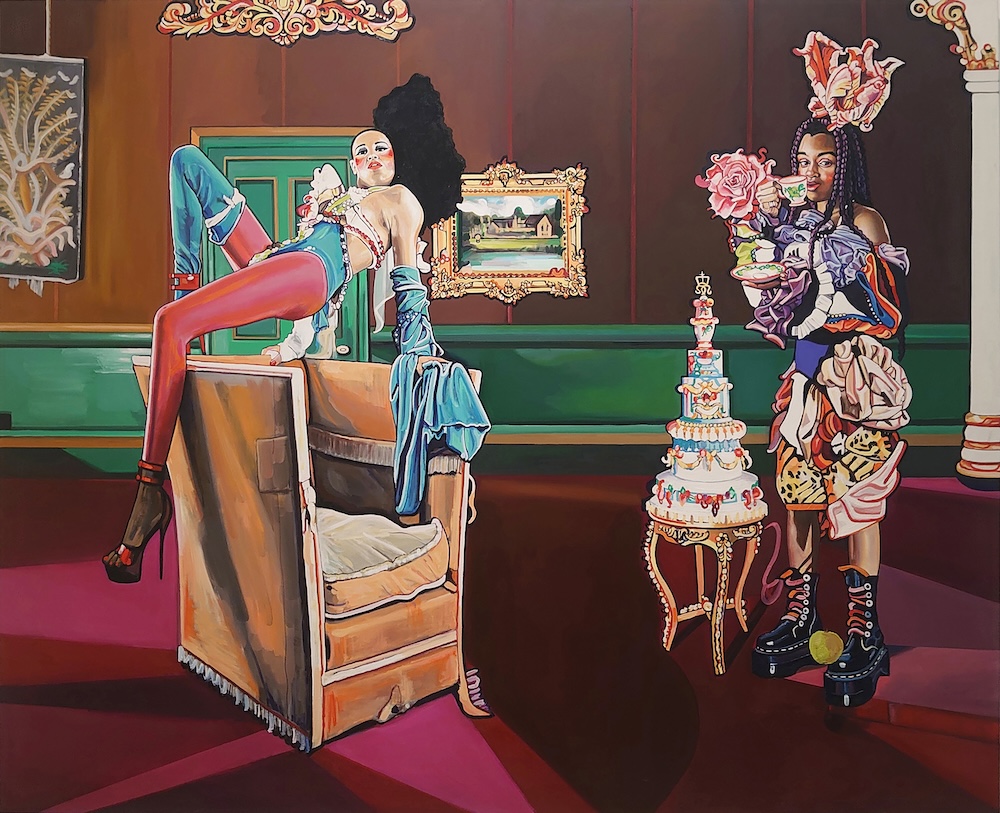
Quilla Constance: High Tea, 2026 – Oil on canvas, 240 x 195 cm
PCK: Is that you in High Tea?
QC: High Tea is my inaugural self-portrait, engineered to construct highly confrontational spatial politics. The viewer is forced to intellectually negotiate my afro before their eye can penetrate the Regency painting behind it; my afro physically clips and disrupts the boundaries of the ornate historical frame.
Visually, I also cultivate a fiercely androgynous, hybrid presence. I intentionally challenge the rigid medical and social imperatives that seek to enforce conventional femininity onto bodies with elevated testosterone and muscular builds. Architecturally, the canvas is an arena of controlled destabilisation. I straddle a dilapidated Regency chair on a severely tilted floor, blocking the door behind me. This body language denies the viewer a comfortable point of escape.
My broader series of works emerged from rigorous research and site-specific field studies at British stately homes inextricably tied to the transatlantic slave trade—such as Paxton House and Stoneleigh Abbey. These properties continue to accumulate cultural and financial capital from the historical spoils of slavery. By manipulating, fracturing, and subverting these opulent interiors within my paintings, I strip them of their institutional authority and reclaim them as sites of resistance.
PCK: That’s quite a cake!
QC: The cake is an absurdly extravagant, Baroque, and deliberately phallic construct designed to enact a clownish, carnivalesque critique of the lavish lifestyles funded by human bondage. It serves as a visual bridge connecting Western Baroque excess with tribal aesthetics, collapsing timelines to expose the grotesque underpinnings of high-society wealth. The placement of the apple beneath the subject’s feet is an explicit nod to René Magritte’s surrealist inquiry into the deceptive nature of representation—a reminder that nothing is quite as it appears. The second subject does not consume from the bone-china cup; she poses with it, displaying a sardonic awareness. It is a calculated subversion of the colonial gaze.
PCK: There’s obviously a lot of planning in these paintings?
QC: My methodology is deeply strategic and meticulously planned to generate productive semiotic tensions. The paintings are engineered as open texts, relying on the inherent malleability of cultural objects and tropes. These symbols do not possess fixed, essential, or latent truths. Instead, their meanings can be actively manipulated, reconfigured, and activated to generate agency for historically marginalised subjects. My practice sits deliberately and strategically at the threshold of multiple art-historical traditions—bridging realism, abstraction, and surrealism—to disrupt standard modes of looking and assert a radical, interdisciplinary black feminist presence within the contemporary art landscape.
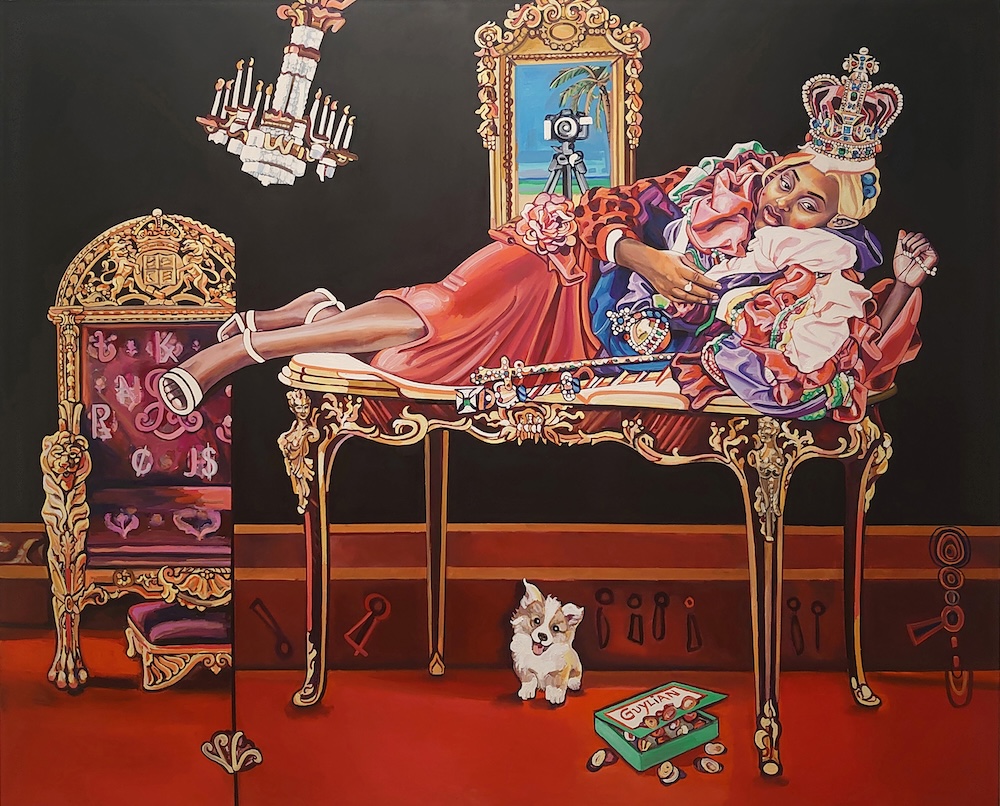
Quilla Constance: Buckingham Bling, 2026 – Oil on canvas, 240 x 195 cm
PCK: In Buckingham Bling, you use a background from Buckingham Palace. Have you visited?
QC: Yes, I conducted initial on-site architectural sketches, which I subsequently synthesised with digital archival research and literature on imperial estates. The resulting composition is a strategically disjointed, surreal reimagining of the royal residence. Where historical documentation or physical access is intentionally restricted by the state, I consciously insert my imagination to fill the gaps! This allows me to re-author this regal interior entirely on my own terms—effectively granting myself the radical permission to fully reside within, and occupy, an exclusionary elitist space built on the foundations of colonial extraction.
PCK: There’s a lot going on?
QC: Crucially so. The composition operates as a hyper-saturated matrix of competing cultural signs. For instance, the royal Corgi is depicted as drawn toward Guylian chocolate seashells. I chose Guylian because it represents an aspirational luxury—mass-produced confectionary that mimics high status without genuinely possessing aristocratic pedigree. By creating a formal parallel between the seashell contours of the chocolates and the ornate, undulating Rococo furniture within the palace, I am staging a satirical send-up of class performance. Furthermore, the Corgi sits precariously close to these sweets, posing a latent biological threat because chocolate is toxic to dogs.
There is also a deliberate engagement with contemporary subcultural hierarchies, specifically through the inclusion of cosplay elf ears—a motif highly prized in online female subcultures as a fantastical, alternative definition of beauty. I view this carnivalized scene through a garish, quasi-cartoonish street-art aesthetic, which intentionally serves as the antithesis of the reverent, sober language traditionally demanded by classical portraiture.
Finally, the work deconstructs the historical trope of the reclining female nude. It prompts a critical meta-inquiry into artistic production: has the subject staged the camera herself to reclaim authorship over the objectifying gaze, or has an external painter rendered her in a way that conforms to classical formal constraints?
While she initially appears positioned on a table like consumable flesh, her expression is assertive—weaponising that very objectification and throwing the limitation directly back at the spectator.
PCK: Are you criticising the monarchy?
QC: My canvases are not driven by a reductive, purely anti-monarchical didacticism. Rather, they interrogate the democratic possibilities of universal empowerment. I reject the deterministic premise that inequality of birth should dictate unequal access to societal agency. In that sense, I am fascinated by the aesthetic glamour, pageantry, and somatic power of royalty—but I believe that the capacity to enact, perform, and subsequently mock that status should be accessible to all.
To theorise this, I draw directly from the concept of the “carnivalesque” formulated by the philosopher and literary theorist Mikhail Bakhtin. Bakhtin analysed the structural playfulness and subversive debauchery of medieval carnival festivals, highlighting the ritual of “crowning and decrowning”—a process where a marginal figure is temporarily crowned king of the festival, celebrated, lampooned, stripped of regalia, and ultimately dethroned. This ambivalent performance underscores the absolute relativity of institutional power and social hierarchies, framing them as cyclical constructs of death and renewal. Through my practice, I champion these types of role reversals, destabilising precisely and rejecting hegemonic frameworks of power from within the canvas, and indeed, through my performances and workshops.
PCK: Is that a blonde wig she’s wearing?
QC: Yes, and within Western visual culture, the choice of a blonde aesthetic is never merely a neutral cosmetic preference. Blondeness is a highly loaded signifier that yields immense socio-cultural currency for women; historically, it has been positioned as the absolute zenith of Western feminine beauty—a look intrinsically tethered to white supremacy, imperialism, and colonial domination.
Trailblazing theorist bell hooks examined this phenomenon rigorously, particularly within the pop music industry, mapping how entertainers elevate a hyper-stylised Caucasian archetype that was popularised by Marilyn Monroe and later systematically co-opted by figures like Madonna and Beyoncé. This raises profound, uncomfortable questions: are Black and Brown women who adopt these Caucasian beauty aesthetics actively denying their ethnic heritage? Is it a form of subversive empowerment and a reclamation of tools historically denied to them, or does it inadvertently perpetuate a deeply problematic, colonial stereotype? My practice does not seek to provide neat, airtight answers to these questions. Instead, it is designed to systematically map these contradictions, raise critical questions, and expose structural tensions within a highly complex cultural matrix.
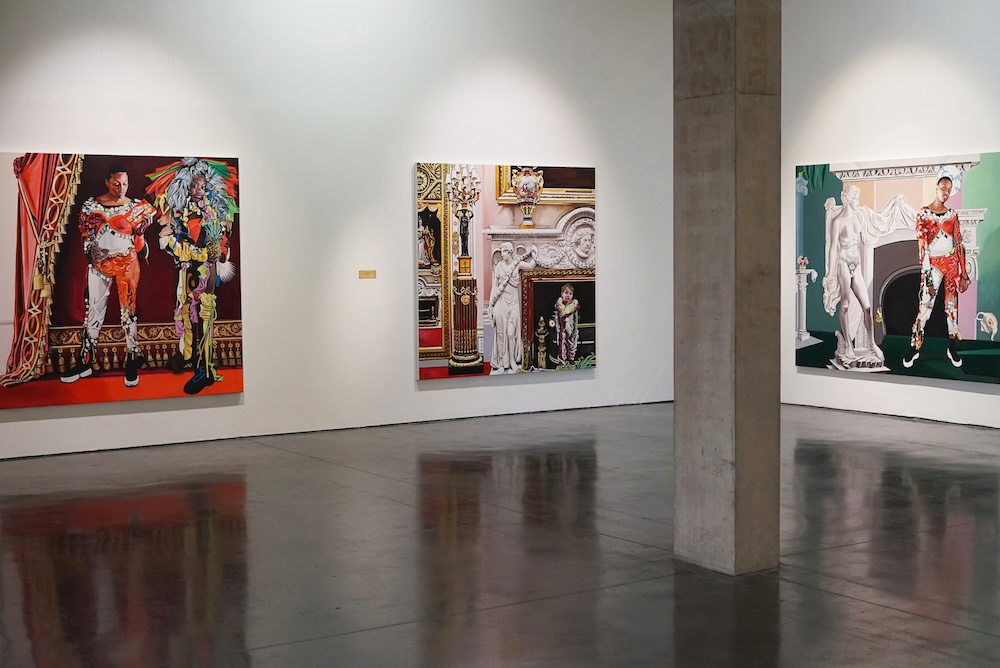
‘Activating Intersections’ at New Art Exchange – Installation view
Quilla Constance: Activating Intersections continues at New Art Exchange, Nottingham to 16 Jan, 2027. All images copyright Quilla Constance, 2026.
Top Photo: QC in the studio with ‘Akee’s Majestic Smile’, 2026