One of only two known examples of Zaha Hadid’s VOLU Dining Pavilion is coming to auction at Hermitage Fine Art in Monaco on 8 April, with an estimate of €900,000-€1.1 million. The structure, which a private collector has held since it was sold at an amfAR benefit auction in Cannes a decade ago, is among the most architecturally significant objects to appear at auction this year.
Hadid is rightly celebrated for the buildings that made her reputation, the great sweeping public structures in cities from Beijing to New York to Milan. But she also worked at a smaller scale, producing lighting, paintings and pavilions that extended her formal thinking into more intimate contexts. The VOLU Dining Pavilion was one of these, conceived alongside Patrick Schumacher, her longtime partner at Zaha Hadid Architects, as a commission for the Revolution Project at Design Miami in 2015, the year before her sudden death. The brief was to demonstrate the creative potential of prefabricated structures, with thirty leading architects and artists each contributing a design for the Manila-based company Revolution Precrafted Properties. It was Revolution Precrafted that also built the edition now coming to sale, giving the work a double layer of historical interest, given the company’s subsequent rise and fall.
At the time of its launch, reports suggested that Hadid intended to produce 24 pavilions, each priced at $484,000. In practice, as far as Hermitage Fine Art has been able to establish, only two were ever made. “There is no publicly available record confirming how many were ultimately produced,” auction assistant Louise Bonin confirmed. The first edition was sold at Sotheby’s a decade ago. The example now at Hermitage is the second, commissioned by the HIV and AIDS research charity amfAR for its 2016 Cannes benefit auction, where it appeared alongside prizes including a week at Leonardo DiCaprio’s house. The anonymous buyer who acquired it that evening paid a reported €1.3 million and has held on to it ever since. They are now consigning it directly.
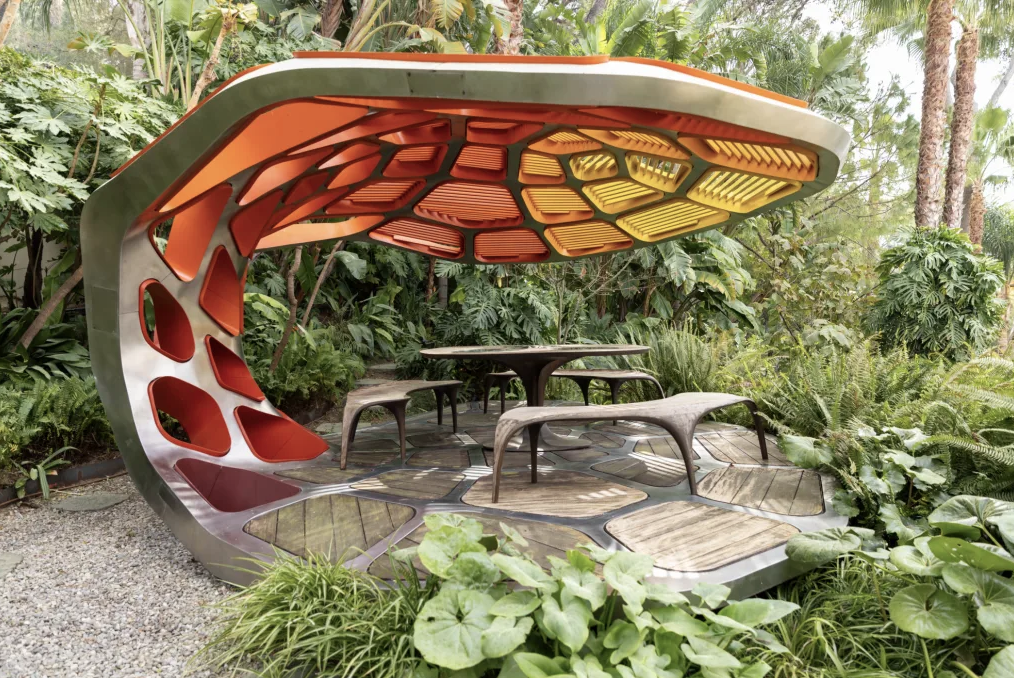
The pavilion itself is a clamshell structure built on a 215-square-foot steel base, inlaid with a mosaic of sustainably sourced American oak. Metal bands run through the base and converge into a central stem fitted with cutouts, designed to frame views of the surrounding landscape. Above this, a slatted awning is engineered to manage both sunlight and shade. Three benches and a matching table, also in American oak, are included. The whole thing sits somewhere between furniture and architecture, sharing the biomorphic quality of Hadid’s larger pavilion works while bringing it down to the scale of a garden or terrace.
This edition is further distinguished by its colouring. Where the first VOLU Pavilion was finished in the sleek metallic palette more typical of Hadid’s output, amfAR requested something quite different, resulting in a vibrant tropical colourway that sets this example apart within Hadid’s pavilion work and gives it an identity specific to its own history.
Among Hadid’s larger pavilion projects, the VOLU sits in interesting company. The temporary Burnham Pavilions she designed for Millennium Park in Chicago and the 270-metre Zaragoza Bridge Pavilion in Spain both operate on the same formal principles, using flowing organic forms to generate enclosure and movement simultaneously, though obviously at vastly different scales. The VOLU translates those ideas into something a private collector could actually install and use, which is part of what makes it unusual within her body of work.
Hadid died in March 2016 at the age of 65, just months after the VOLU Pavilion debuted at Design Miami. Zaha Hadid Architects continues to operate under Schumacher’s direction and remains one of the world’s most influential architectural practices. Works directly connected to Hadid herself, particularly those at the intersection of design and fine art, have attracted sustained collector interest in the years since her death.
The secondary market for Hadid’s non-architectural work remains relatively thin, which makes each auction appearance an occasion. The VOLU Pavilion, which sold at Sotheby’s a decade ago, was something of a landmark at the time. This second edition, now with a credible provenance trail that runs through amfAR’s Cannes auction and a decade of private ownership, is likely to generate similar attention.
Hermitage Fine Art design and jewellery sale takes place in Monaco on 8 April.