

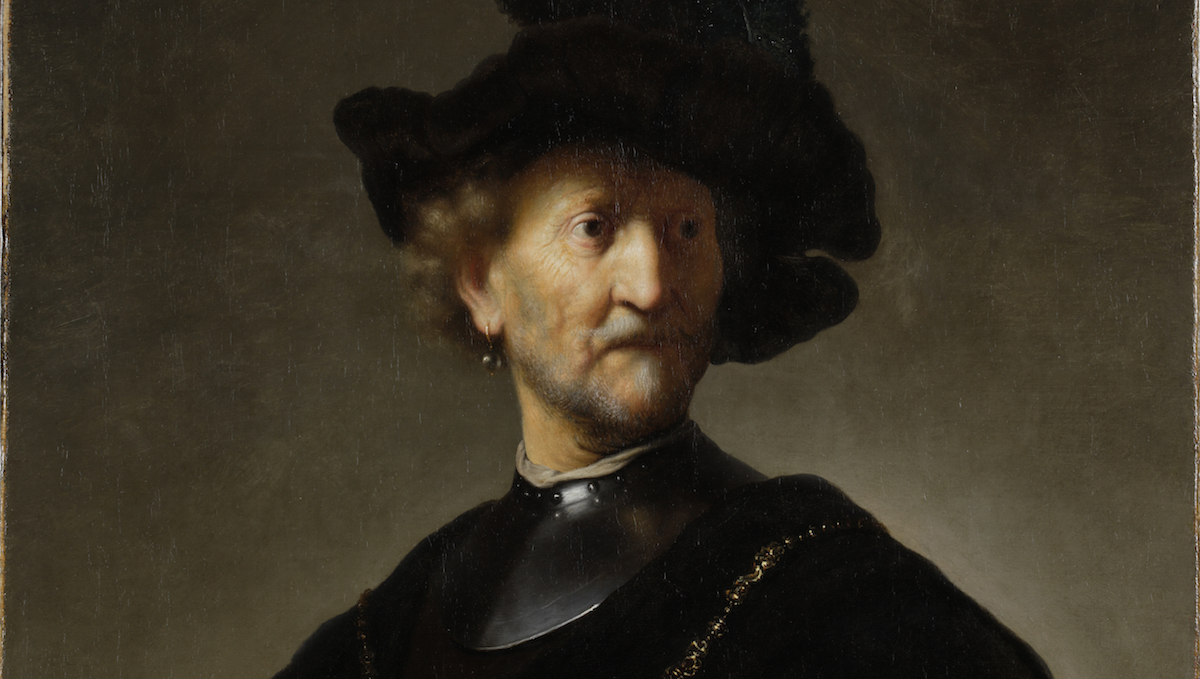
In a dark corner of the Art Institute of Chicago, two paintings hang side by side. Both are titled Old Man with a Gold Chain. Both depict the same elderly figure, long believed to be Rembrandt’s father. To the casual eye, they look almost identical. The label between them reads: Double Dutch: A Rembrandt and a Workshop Copy. One of the world’s foremost Rembrandt scholars thinks that label tells only half the story.
The painting on the left, executed on an oak panel around 1631, is in the Art Institute and is widely accepted as an original work by Rembrandt. The slightly smaller canvas to its right is on loan from a UK private collection owned by Sir Francis Newman. It is currently attributed to an unidentified artist working in Rembrandt’s workshop. Gary Schwartz, the American-born Dutch art historian whose scholarship on Rembrandt has defined the field for decades, believes this attribution is wrong.
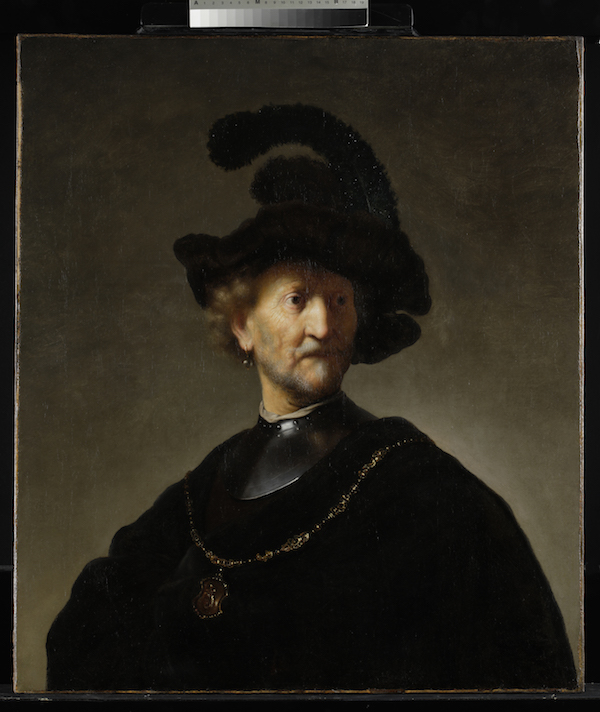
Rembrandt van Rijn (1606–1669) Old Man with a Gold Chain
Schwartz argues that the canvas version was not made by a workshop assistant copying the master’s panel, but was painted by Rembrandt himself as an autograph replica. This was not a common practice in seventeenth-century Dutch painting, which is precisely what makes the claim significant. Authenticated autograph replicas by Rembrandt are extraordinarily rare, and if Schwartz is correct, the Newman canvas would represent one of the most substantial reattributions in the field for some years.
Crucially, he is not making this case on connoisseurship alone. Scientific analysis carried out by the Hamilton Kerr Institute at the University of Cambridge supports his position. The technical research into the canvas version points to a hand and working method consistent with Rembrandt rather than those of a workshop follower, lending the argument a material basis that goes beyond visual assessment.
The exhibition, running at the Art Institute of Chicago until 17 May, presents both paintings together and allows visitors to examine them directly. Seeing them in the same room, at close range and in comparable light, the question ceases to be an abstract scholarly dispute and becomes genuinely open. The handling, the quality of attention in the face, the way light falls across the chain: these are things that reward sustained looking.
Whether the institution ultimately revises its label or the art historical consensus shifts remains to be seen. But the case Schwartz is making, backed by Cambridge’s scientific findings, is not easily set aside.
Rembrandt van Rijn (1606–1669)
Rembrandt Harmenszoon van Rijn was born in Leiden in 1606, the eighth of nine children in a reasonably prosperous miller’s family. He enrolled at Leiden University at fourteen but left almost immediately, choosing instead to apprentice with the local painter Jacob van Swanenburgh. After three years, he moved to Amsterdam to study briefly under Pieter Lastman, whose interest in history painting and dramatic lighting left a lasting mark. By his early twenties, Rembrandt was back in Leiden, running his own studio and already producing work of a quality that attracted serious attention.
He settled permanently in Amsterdam in 1631, and the following decade was the most outwardly successful of his life. Portrait commissions arrived steadily from the city’s merchant class, and The Anatomy Lesson of Dr Nicolaes Tulp, painted in 1632, established him as the foremost portraitist in the city at a stroke. He married Saskia van Uylenburgh in 1634, moved into a large house on the Sint Anthonisbreestraat, and spent freely on art, antiquities, textiles and curiosities. The household was wealthy and conspicuous about it.
The 1640s brought losses that altered him. Saskia died in 1642, the year he completed The Night Watch, a painting so compositionally bold that some of its subjects reportedly complained about their depiction. Three of their four children had already died in infancy. Rembrandt’s spending continued to outpace his income, and in 1656, he was declared insolvent. His house and collection were sold off. He spent the rest of his life in more modest circumstances in the Jordaan district, supported in part by his companion, Hendrickje Stoffels, and his son, Titus, both of whom he outlived.
What the later paintings lost in social comfort, they gained in depth. The self-portraits from the 1650s and 1660s are among the most penetrating images of ageing and self-examination in the history of painting. The Jewish Bride, The Return of the Prodigal Son, and the late portraits of anonymous figures carry a quality of attention to human vulnerability that has no real precedent and few successors.
He died in Amsterdam in 1669, a month after burying Titus, and was buried in an unmarked grave in the Westerkerk. The house on the Sint Anthonisbreestraat is now a museum. The paintings are everywhere.