
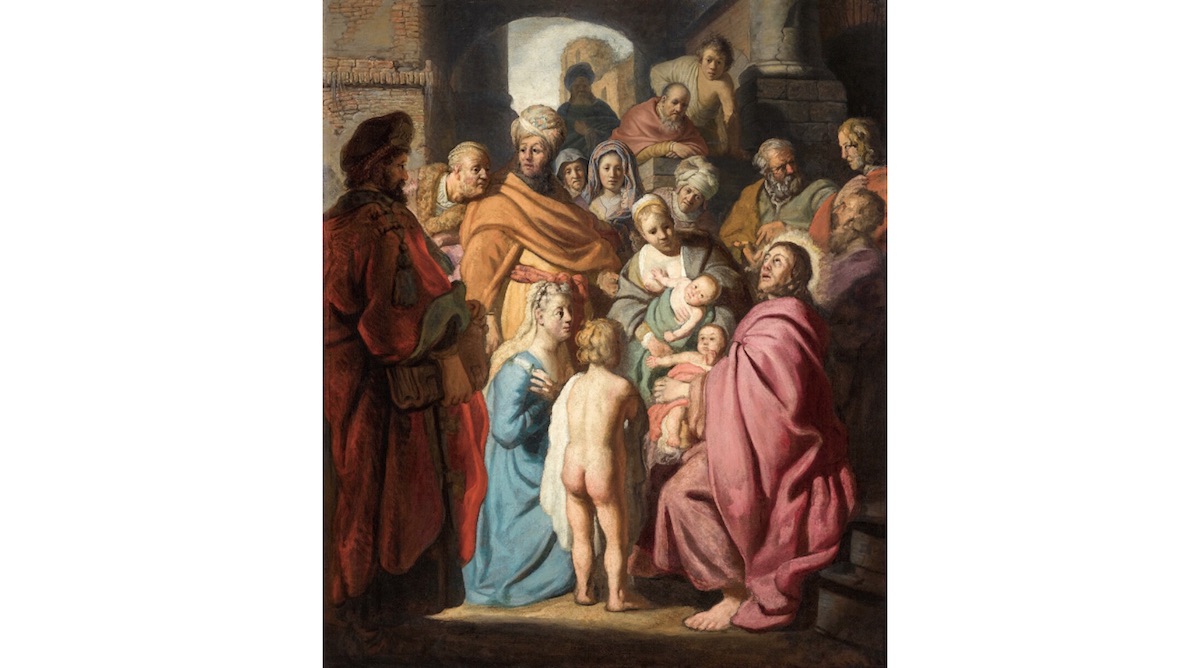
Update: ‘Let The Little Children Come Unto Me’ by Rembrandt sold for $10.59m at Sotheby’s.
A work by Rembrandt, which had a guarantee, was the headline sale at Sotheby’s ‘Old Master & 19th Century Paintings and Sculpture Evening Auction’ on 1 July in London. The sale totalled $49.91m (GBP37.71m), meeting the pre-sale estimate.
A little-known early painting by Rembrandt is to hit the auction block at Sotheby’s in London on 1 July, with an estimate of around $15.8 million, following a restoration that has removed crude overpainting applied by an unknown hand sometime after the work left Rembrandt’s studio. What has emerged from beneath that later intervention is something considerably more interesting than the altered version that had survived for centuries: an unfinished painting entirely by Rembrandt himself, including a self-portrait that adds a new entry to the artist’s already substantial catalogue of self-images.
The painting, Let The Little Children Come Unto Me, was begun in Leiden, probably around 1627, and left partly unfinished before Rembrandt moved to Amsterdam around 1631 to 1632. It was subsequently completed by another hand, and rather crudely at that. The overpainting has now been stripped away to reveal the work in its original state: the upper portions, including the architecture and six fully resolved figures, entirely by Rembrandt, while the lower section remains in the blocked-in state in which he left it, the figures laid in with broad, confident brushwork but faces and hands not worked up to completion.
Among the changes made by the unknown later restorer was replacing a turban with a more conventional Dutch cap on one of the foreground figures. The turban has now been restored. It carries an inscription reading either 18 or 28, which specialists believe may refer to the Gospel of Saint Luke, suggesting the turbaned figure represents Saint Luke himself, gazing at the scene of Christ blessing the children while holding his Gospel tucked under his arm.
The subject is drawn from parallel accounts in Mark, Matthew and Luke, depicting the moment after Christ rebuked his disciples for turning away parents who had brought their children to him, and blessed the children with a laying-on of hands. The disciples to the right are shown in conversation, apparently still processing a development they had not anticipated.
What makes the painting exceptional beyond its subject matter is what it reveals about Rembrandt’s working method. In his history paintings up until the 1650s, he consistently painted from the background forward, and this canvas makes that process unusually legible. The upper portions are fully resolved, the figures rendered with the specificity and psychological weight already characteristic of the young artist. The lower figures, by contrast, exist in a state of becoming: the lighting is understood, the poses are established, but the finishing touches are never applied. Seeing a Rembrandt in this condition, with its working method laid bare rather than concealed beneath a finished surface, is genuinely rare.
The self-portrait, identifiable from comparison with the extensive sequence of early etchings and small painted self-portraits Rembrandt produced in Leiden from around 1628, appears near the top of the composition: a young man with his left shoulder uncovered, seemingly leaning forward to observe the miraculous scene below, but characteristically turning to look directly out at the viewer instead.
Including himself in history paintings was a habit Rembrandt maintained throughout the Leiden period, from his earliest dated work, The Stoning of Stephen of 1625, through several pictures of 1626, but abandoned when he returned to history subjects after settling in Amsterdam in the mid-1630s. Other figures in the painting are believed to include his mother, part of a domestic circle that Rembrandt regularly cast in sacred roles during these early years.
The question of who completed the painting after Rembrandt set it aside has attracted scholarly debate. One persuasive candidate is Claes Cornelisz. Moeyaert, an Amsterdam painter fourteen years Rembrandt’s senior, had trained under the same teacher, Pieter Lastman. Moeyaert’s own treatment of the same biblical subject, painted around 1635 and now in Karlsruhe, is strikingly similar to this canvas in its colouring, lighting, architectural setting and the placement of the repoussoir figure at the left edge of the composition. The similarities are close enough that Moeyaert must have known this painting firsthand, which would place the later completion in Amsterdam after Rembrandt arrived there with the unfinished canvas.
The removal of the overpainting and the restoration of the turban have returned the work as nearly as possible to the state Rembrandt left it in, making it, as specialists have noted, entirely from his hand. For scholars of the Leiden period, the painting adds a new self-portrait to the record and sheds fresh light on a formative phase of one of the most studied careers in the history of Western art. For anyone standing in front of it, the sensation of watching a mind at work across nearly four centuries is, by any measure, something worth the price of a Sotheby’s paddle.
Read More
Visit