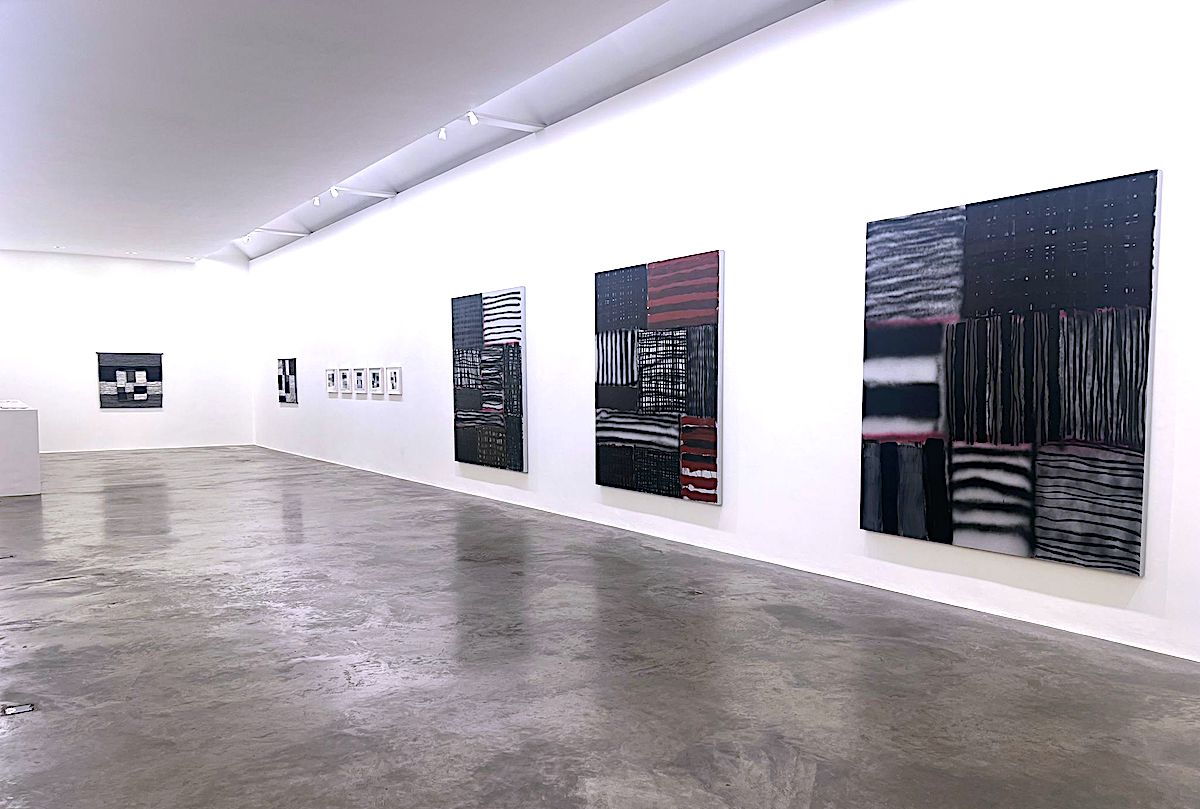
A number of exhibitions mark Sean Scully’s 80th birthday this year, including the just-opened Tapestry, at Kerlin Gallery in his hometown of Dublin, where four distinct bodies of recent and new works are on show. Stepping into the lofty gallery, three monumental, gritty works in oil, spray paint, and oil pastel on aluminium, with small traces of outline in pink, dominate the space. To the left of these are a set of delicate drawings that speak to the two woven pieces at the end of the gallery. Opposite these are four oil on copper works and one work on aluminium anchors the end wall between these.
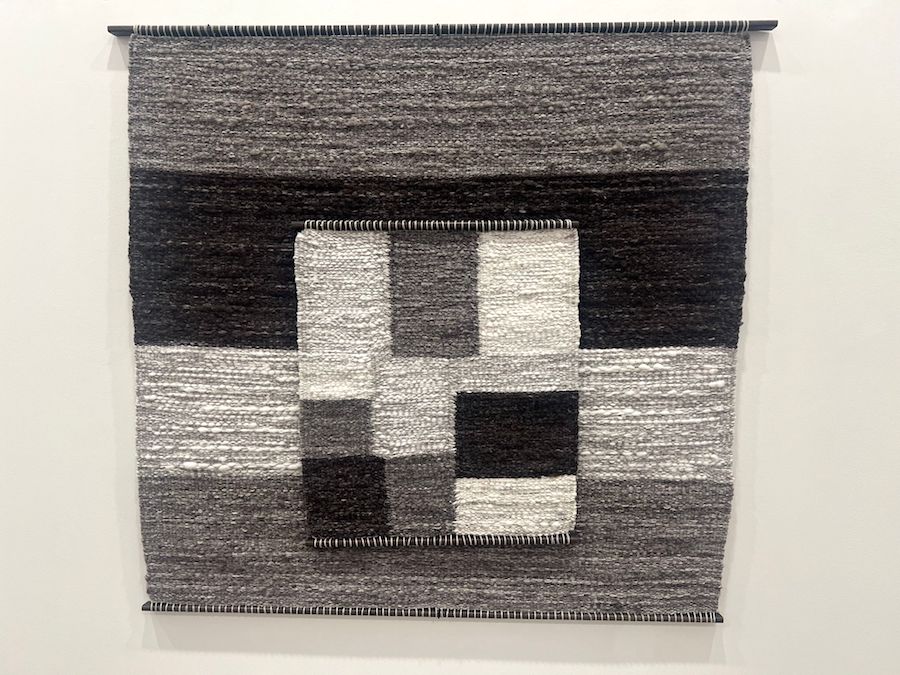
Scully says that his work is concerned with weaving things back together. Here, two handwoven tapestries, hung as if still on their loom frame, ooze texture – the knubbliness of the warp and weft of the natural hand-spun undyed wool yarn so tactile you want to run your hand over it. The vertical warp threads form the structural foundation of the tapestry, while the horizontal weft threads through the warp, creating the layered texture, much like the horizontals and verticals of Scully’s other works on display. I met weaver Marco Sierra at the gallery opening, and he told me he’s returned from living overseas to continue the family business, Mourne Textiles, set up by his Norwegian-born grandmother Gerd Hay-Edie in 1949. She was a pioneering textile designer and handweaver, working with Sybil Connolly on her clothing designs and creating fabric for Robin Day’s furniture. Their workshop is situated halfway between Dublin and Belfast on the east coast in Rostrevor, County Down. Sierra speaks to me of translating Scully’s pencil drawings into these rich tapestries, of winding the bobbin on the loom to create a woven picture. This collaboration with local craftspeople allows for a new medium in Scully’s oeuvre that speaks to the history of craft and of making, of spinning a yarn and weaving a tale. The lack of colour in the woven pieces and the intimate drawings (bar a slight heathery tinge in a couple) contrast with the works in the rest of the gallery.
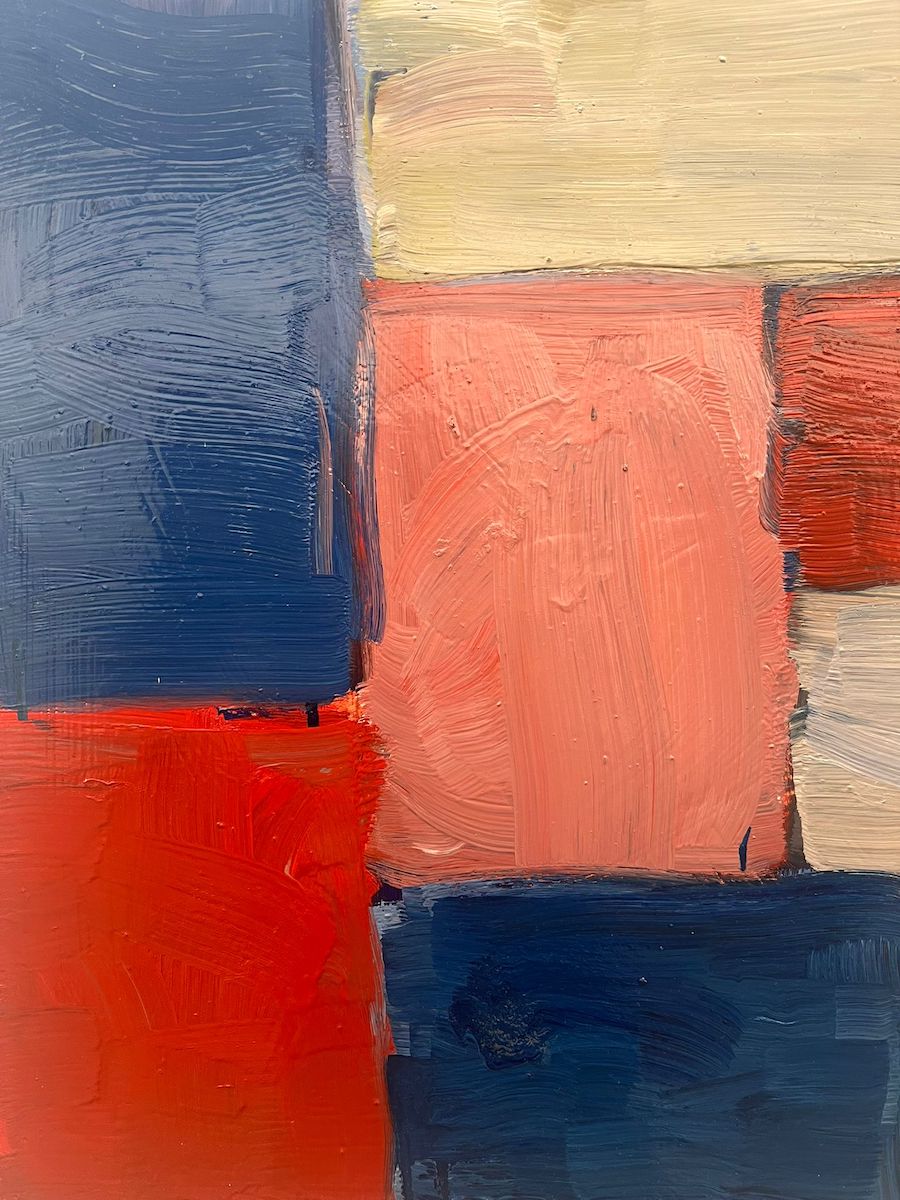
The four works on copper have a translucence that’s both luscious and iridescent; the richly coloured rectangles together create intimacy, passion and emotion that touch the soul. The apparent rapidness of the brushstrokes heavily laden with thick colour, sometimes in unusual hues – the almost mustard yellow, the fleshy pink that hints at Guston – show how masterful Scully can be with paint. The odd flash of pinky-red bare copper lurking in the synapses between rectangles evokes those streaks of pink robe seen peeking out from behind the tree trunk in Piero’s Baptism. Yet in Wall Dark Pink, the unpainted bare copper space that runs along the bottom teases us and begs us to ask why it was left blank. Scully tells me he varnishes the copper so it doesn’t oxidise, showcasing the vibrant purity of this ancient element.
Scully has a studio in Tappan, New York, and one of the works on copper is titled Tappan Wall Yellow. Looking up the location, I find that the Tappan were a Lenape people who inhabited that region before European colonisation. The hidden voices of those peoples and the stories of their ancestors have now been obliterated, like so many indigenous voices around the world, yet, looking at this work, knowing this, perhaps Scully hasn’t quite obliterated their layered stories. He’s almost covered the entire surface with thick oil paint, but there are still small glimpses and cracks through to the glimmering copper that lies beneath and to those ancient tales. These small but deliberate breaks or cuts through to the ground could also allude to Islamic art, where imperfections are purposefully made by the maker as only God is perfect, or the wabi sabi concept, where beauty itself is imperfect and impermanent.
The three huge works from the Stack series seem to conjure deconstructed flags and symbols, or the grids of a claustrophobic cage. They’re rough, robust, they’re threatening, and you sense them leering and looming over you. I turned my back on them to gaze at the sublime copper paintings on the opposite wall. Scully tells me working with spray paint is easy – it’s street art with all its mark-making bravado screaming ‘look at me’. I want to silence them and concentrate on the colours of these four works on copper ground. The fact that Scully can create something so muscular, almost aggressive, yet also pencil those beautiful drawings, paint the luminous. But it’s the tender, fragile, yet layered works on paper that convey so much emotion in one tiny drawing.
Sean Scully: Tapestry, Kerlin Gallery, Dublin, 28 November 2025 – 24 January 2026
Visit Here