
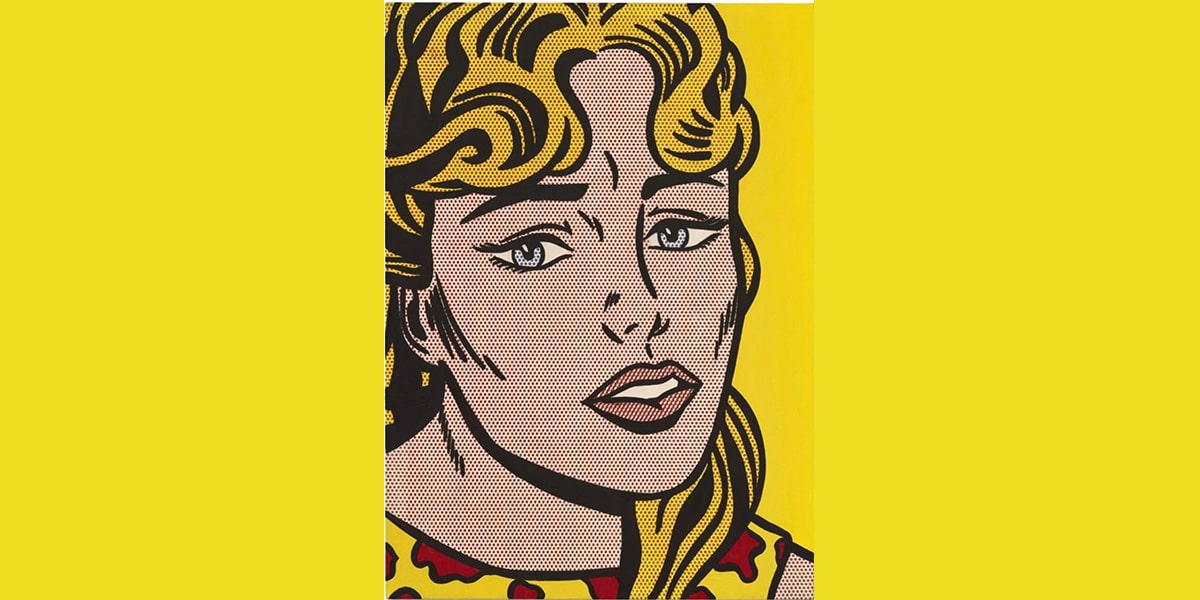
Roy Lichtenstein’s Anxious Girl, estimated at between $40 million and $60 million, will appear at Christie’s New York on 18 May as a highlight of the 20th Century Evening Sale during Spring Marquee Week, making its first-ever public appearance after more than thirty years in the same private collection.
The work was formerly owned by Horace and Holly Solomon, figures who occupied a genuinely central position in the New York art world of the 1960s. Their apartment functioned as an informal museum of the Pop moment, hung with works by Andy Warhol, James Rosenquist, Claes Oldenburg and Lichtenstein himself.
Holly Solomon’s relationship with the artists of the era was not only that of a collector. She was a presence, a participant, someone who understood what was being made around her and moved toward it with unusual instinct. In 1966, Warhol produced his now famous nine-panelled portrait of her, establishing her as what contemporaries called the Princess of Pop. Mapplethorpe, Rauschenberg, Artschwager and Lichtenstein all created works of hers in turn. Lichtenstein’s I… I’m Sorry, depicting a distressed young woman in tears and painted just one year after Anxious Girl, was also formerly in her collection and now hangs in The Broad in Los Angeles. The Solomons understood what they had.
Anxious Girl dates from 1964, a year that is at the absolute apex of Lichtenstein’s career and within a concentrated period of production that has come to define his reputation. Between 1963 and 1965, he made a group of paintings featuring lovelorn young women derived from mass-produced romance comics, works of which only ten depict a single female subject in a tightly cropped frame. These paintings constitute the most coveted group within his output, and Anxious Girl is among the finest of them. The last time a work from this series appeared at auction was November 2015, when Lichtenstein’s Nurse sold at Christie’s New York for $95 million, establishing the artist’s current record. That benchmark, more than a decade old and set by a work of comparable rarity, provides the context within which the current estimate should be read.
The painting depicts a young woman with blonde curls and blue eyes, her skin rendered in Lichtenstein’s signature Ben-Day dot field, a printing technique developed in the late nineteenth century and repurposed by the artist as the central element of his visual language. The dots in Lichtenstein’s work are not mechanically produced. Each one is applied by hand, a meticulous process that inverts the apparent logic of his engagement with mass reproduction. The woman’s brow is furrowed, her expression caught between anxiety and resignation, her inner life legible through the most economical of pictorial means.
The source material is a 1963 comic from DC’s Girls’ Romances series, titled Too Much to Ask!, in which the heroine is torn between two suitors. In the original image, she appears between the two men with a smooth forehead. Lichtenstein removed the suitors, tightened the frame and added the crease to her brow, transforming a generic illustration of romantic indecision into something considerably more psychologically loaded. The simplification is, as always with Lichtenstein, the point. Sara Friedlander, Chairman of Post-War and Contemporary Art at Christie’s, has described the work as distilling complex visual cues into three core elements, line, colour and form, deployed to convey deep human emotion through the vernacular of the comic strip. That description is accurate, though it understates the difficulty of what Lichtenstein was actually doing: finding in the clichés of popular culture a genuine emotional register without either condescending to his source material or being captured by it.
Anxious Girl sits within the series’ hierarchy. Its thirty years away from the public gaze have kept it entirely outside the scholarly and commercial conversation. The work arrives without the fatigue that comes from overexposure, fresh to a market that has not had the opportunity to form a settled view of it. Against that advantage must be set the fact that its condition, exhibition history and precise standing within Lichtenstein’s output will now be subject to the scrutiny that major evening sale lots inevitably attract.
This is a rare opportunity. Works from Lichtenstein’s Girl series of this period do not come to market. When they do, the results tend to be definitive. Christie’s will be hoping that 18 May proves no exception.
Photo: Roy Lichtenstein, Anxious Girl (1964). Courtesy of Christie’s Images Ltd 2026
Roy Lichtenstein’s Anxious Girl is offered at Christie’s New York on 18 May, with an estimate of $40 to $60 million.