

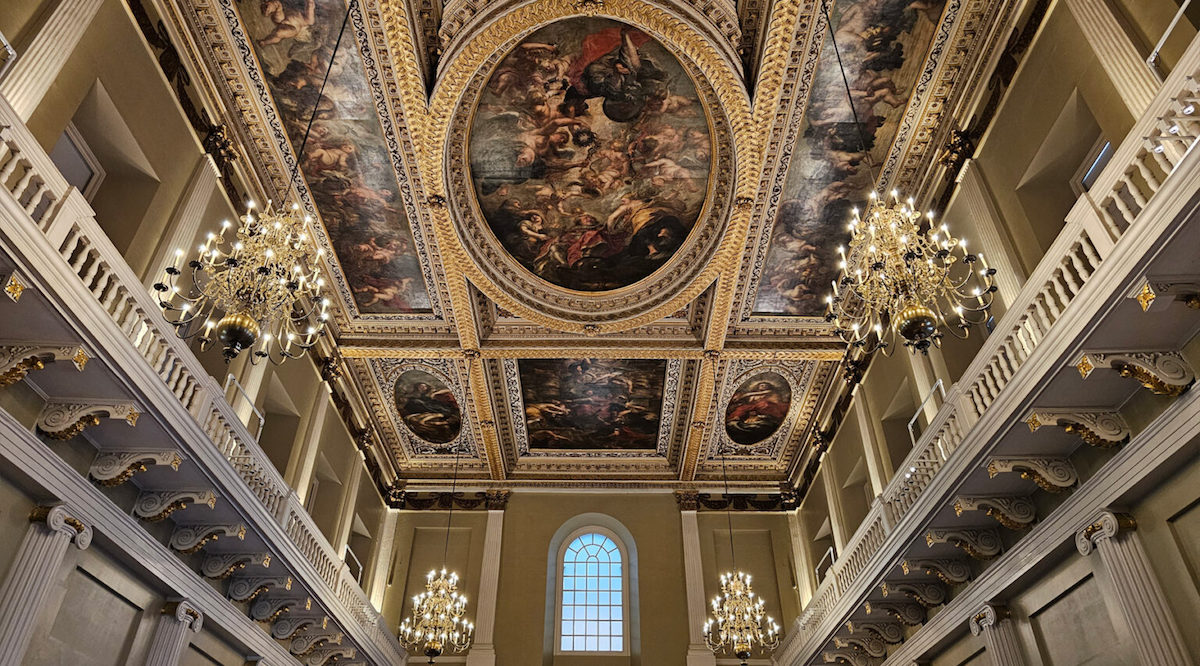
After four centuries of London wear and tear, The Banqueting House on Whitehall will reopen to the public after a significant restoration delivered by Historic Royal Palaces. For the first time in its history, you can reach the Main Hall without navigating stairs.
The Rubens ceiling is one of the great painted interiors in Europe, and until now, there has been no lift. It will now have step-free access, and for a room of this significance in a building this old, this is a great feat.
Inigo Jones completed the building in 1622 for James I, the last full survivor of the Palace of Whitehall, most of which burned down in 1698. Jones was introducing classical Palladian architecture to Britain in real time, and the Banqueting House is where that argument was made most forcefully. It was built for masques, those elaborate court entertainments that combined theatre, music, and an enormous amount of money, but it quickly became a space for diplomatic ceremony and royal occasions as well.
The ceiling came later. Charles, I commissioned Rubens in 1630 to paint nine panels glorifying his father, James I. Rubens delivered. The canvases were installed in 1636, and they remain, uniquely, in the exact space they were made for — the only surviving Rubens still in situ in its original setting. Thirteen years after they went up, Charles walked beneath them on his way to the scaffold outside. The irony of a ceiling celebrating divine kingship becoming the last thing a king saw before his execution is the kind of detail that history occasionally produces and novelists wouldn’t dare invent.
The restoration has done what good conservation work does — addressed what was failing without much change. New air-source heat pumps on the roof, reconnection to the Whitehall District Heating System, and substantially improved temperature and humidity control. The Rubens panels now exist in a more stable environment than they have for years, which matters more than any amount of reinterpretation or rehanging. A new English oak floor has been laid throughout, sustainably sourced, replacing the previous one after the heating pipes beneath required attention.
The floor removal turned out to be unexpectedly interesting. Archaeologists were given access to the space beneath for the first time since 1964, and found objects left by earlier craftsmen. That kind of accidental discovery is part of what makes restoration work on buildings of this age worth doing carefully and slowly.
Preview days have been running through spring — 20 March, 3 April, 1 May, 29 May, 26 June — with tickets at £7.50 for adults. The full reopening with a new visitor experience launches on 1 August, after which regular open days resume in the autumn. Adult tickets from August will be £10, concessions £8, under-16s and Historic Royal Palaces members free, and £1 for those receiving means-tested benefits, which is a pricing structure that at least gestures toward the idea that buildings like this should be for everyone.
The Banqueting House is five minutes from Westminster, Embankment, or Charing Cross. There is no good reason not to go.