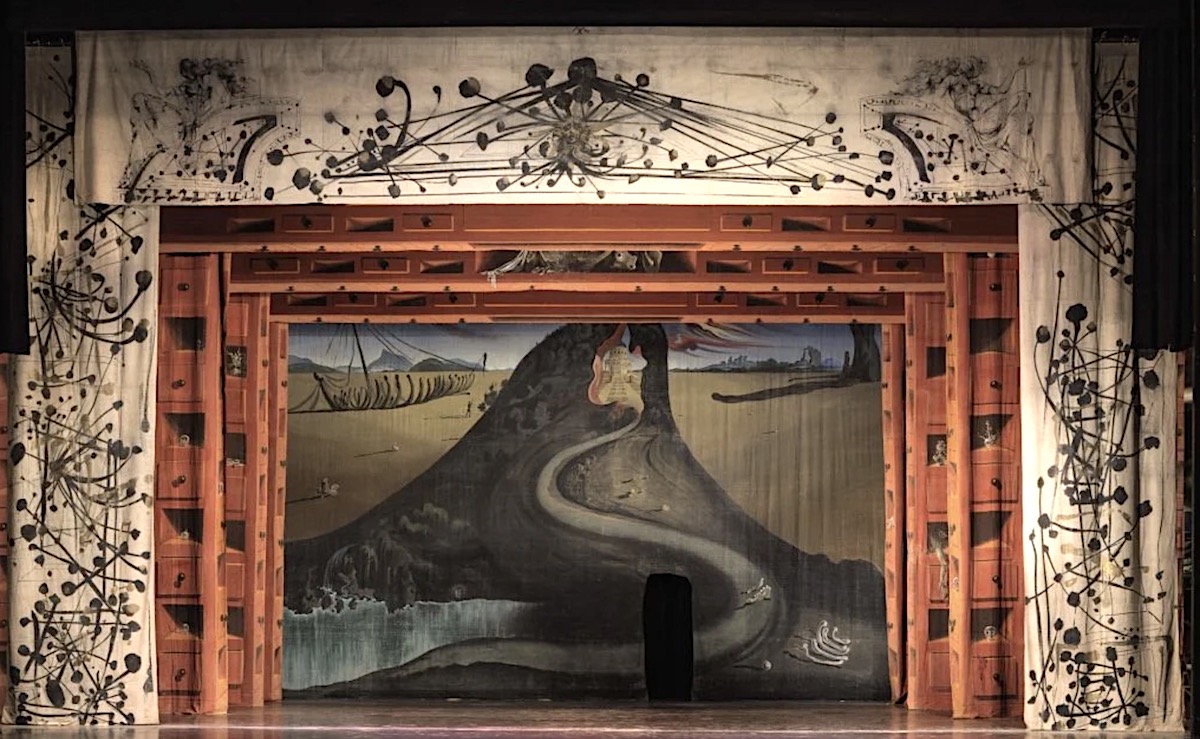
Salvador Dalí’s largest known work, a sprawling stage set created in 1939 for the Surrealist ballet Bacchanale, is about to return to the market, and Bonhams seems confident that the piece will command real attention. The auction house has given it an estimate of about $350,000, a bold but not over-the-top estimate given the mood around Surrealist collecting right now.
The set itself is enormous. Thirteen panels, four canvases, stretching roughly sixty-five by one hundred feet. Dalí conceived it as the visual engine of what he described, with typical flair, as his first paranoiac critical ballet. It opened at the Metropolitan Opera in New York in November 1939. The central motif centres on the Mount of Venus, though the whole thing seems to spill outward into myth and dream before settling into anything familiar.
Dalí didn’t stop at painting. He wrote a libretto. He designed costumes. He pulled in Léonide Massine from the Ballets Russes de Monte Carlo and even Coco Chanel, whose costumes never actually crossed the Atlantic because of the darkening political climate in Europe. The production was a crucible for a certain kind of late-thirties excess, both glamorous and faintly doomed.
Bonhams is positioning the work as the centrepiece of its fourth annual Surrealism sale on March twenty six. Emilie Millon, one of the specialists guiding the sale, discusses how the piece immerses the viewer in Dalí’s universe, a place where psychoanalysis, mythology, and art history blur into something half-theatrical and half-feverish. She may be right. Even in photographs, the panels seem to breathe.
The estimate is roughly double what the work made at Sotheby’s New York back in 2018. That earlier result was already unusually strong. Things have changed since then. The piece has been shown in Madrid, then in the same city at the Círculo de Bellas Artes, and then in Milan. Its public life has sharpened its aura a little.
Surrealism, as a category, has continued to surprise analysts. While other corners of the market have gone soft in the past few years, Surrealism has marched on. Sales have climbed by more than 60% since 2020. The 2022 total of more than $600 million in Surrealist works almost matched that figure in 2024. And when Sotheby’s offered the Pauline Karpidas trove last autumn in London, the bidding was restless and occasionally exuberant. Dalí, Magritte, Ernst. 75% of the Surrealist works were fresh to the market, and they pulled in more than $41 million.
Paris feels newly charged by all this. Bonhams renovated its Paris space in 2021, betting that the city’s gravitational pull was returning. They were probably right. During last year’s Paris auction week timed to match Art Basel, Christie’s and Sotheby’s brought in more than two hundred million dollars between them, a sharp jump on the previous year.
This March sale also includes other magnets. Eleven Francis Picabia works will be on view, including La Polonaise from 1940, a painting with an estimate similar to the Dalí. And a concentrated painting by the Belgian artist Jane Graverol, titled Tête en l’air, will also go under the hammer, with an estimate just under $40,000. Graverol’s work sits in that same crisp, uncanny place where Magritte often dwelt, though her voice is unmistakably her own.
Last year’s Surrealism sale at Bonhams Paris totalled about one million euros. More than half the lots found buyers. This spring’s consignments have already reached 1.5 million euros, suggesting the room will have some energy when the doors open.
Top Photo: Courtesy Bonhams Paris