
Through the endless London mizzle, I went in search of the light. I had heard of an exhibition, Seurat and The Sea, opening at the Courtauld, dedicated to the mirage of seascapes Georges Seurat (1859–1891) painted over five summers on the Northern coast of France. A tonic to the monotonous greyscale of England’s wettest winter, this landmark coastal display is the first in the UK devoted to Seurat in almost 30 years, and the only exhibition ever focused on his seascapes. Uniting 26 works and preparatory drawings, this show promises to chart the evolution of his radical style through the recurring motif of the sea and track the subtle yet profound development of his practice before his tragic, untimely death at 31.
“We began looking at his oeuvre and realised that his seascapes constituted more than half of his 45 canvases,” says Dr Karen Serres, curator of the exhibition, “and that these works were a vital part of his creative process.”
By distilling his works, the Griffin Catalyst Exhibition at the Courtauld has a clarity of focus, one that invites sustained looking and a meditation on the limits of perception – then brings us to the sudden precipice of his untimely death. Paris born and bred, his most celebrated canvas, Sunday Afternoon on the Island of La Grande Jatte, or Bathers at Asnières, depicts scenes of Parisian leisure. “Very few people realise that every summer he left Paris and went to the Northern coast of France, on his own, not for leisure but to ‘cleanse his eyes of the days spent in the studio’. It was his way to reconnect with natural light, how to render it, and experiment with it,” says Dr Serres.
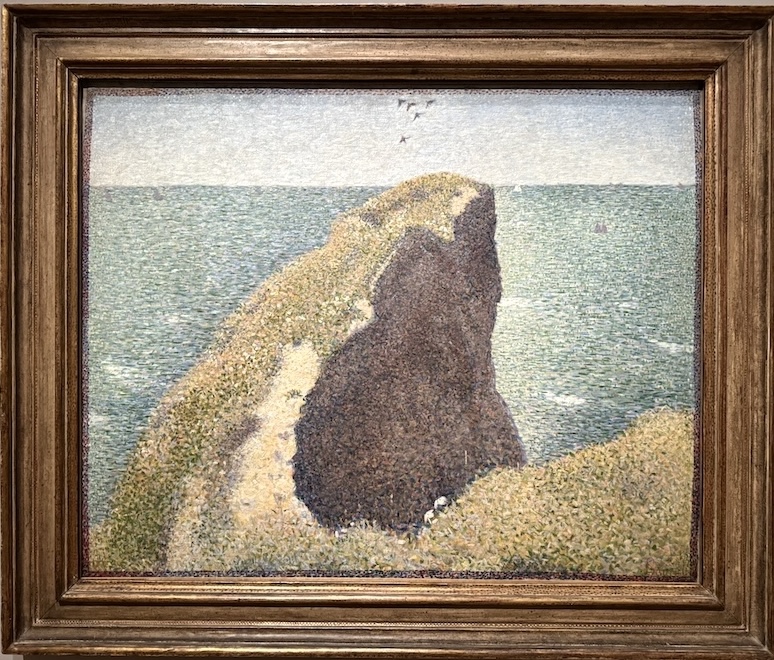
Georges Seurat (1859-1891), Le Bec du Hoc 1885, oil on canvas, Tate: Purchased 1952
Immediately, I am rewarded. There in the first room is a masterpiece (to my mind the masterpiece): five little birds, cresting the sunlit tip of a vast cliff edge, its sweeping banks dressed in the salty, windswept blooms of summer, cut short by the magnificent violence of a sheer rocky drop – cast in the bruised tones of shadows. Le Bec Du Hoc, named after the beak-like shape of this promontory a few kilometres east of Grandcamp, Normandy, opposite the Isle of Wight, was painted in 1885, his first of five summer campaigns, and finished in 1888-89. Instead of jutting out to sea, in this work, the cliff seems to float dramatically above it – like a strange, crumbling pyramid. Rendered in tiny, pixelating strokes and dots, the image is simultaneously monumental and impossible to grasp. You are required to find exactly the right distance from the painting to experience its true optical effects; I am left teetering.
During his brief time on earth, the French post-Impressionist developed a radical new way of painting, influenced by contemporary treatises on optics by scientists such as Michel-Eugène Chevreul, Ogden Rood, and Charles Blanc. Following the loose, broken brush strokes of the Impressionists, whilst adopting a near-scientific methodology of codifying and experimenting with perception and vision, he developed a radical technique of applying dots of pure, unmixed colour on the canvas. This technique, which would become known as Pointillism (Neo-Impressionism) or Divisionism, was originally called chromoluminarism by Seurat and characterised by the separation of colours into individual dots or patches that interact optically. By requiring the viewer to combine the colours optically rather than physically mixing pigments, Divisionists believed they were achieving the maximum luminosity according to science; they also prefigured the age of digital colour and pixels.
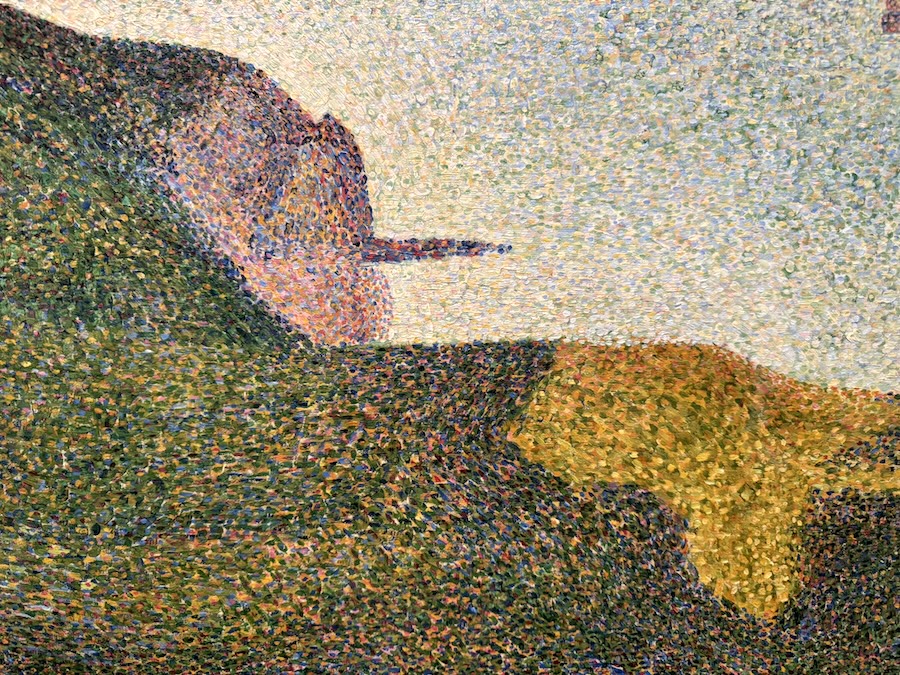
Georges Seurat (1859-1891), The Semaphores and the Cliff – 1888 (reworked about 1889) – Detail
Instead of surface colour, there was colour that one would apprehend from a certain distance, that would then disintegrate as you approach – like the electromagnetic snow that used to appear on a television screen without a clear signal. Using opposite colours on the colour wheel – greens underscored with flecks of red, the blues enhanced by oranges – Seurat created a third thing. Sometimes it was tone (burnt oranges and leafy greens), but in certain places on the canvas, we perceive a kind of glare, as if trying to look at the sea in the midday sun. His paintings are not just of something; they are like hallucinations (or flashbacks) that only coalesce at a certain distance under specific conditions.
“I hope what this exhibition does, by showing you the sequence of works that he did every summer, is allow you to really understand the evolution of his technique, and to understand that he did not emerge as a painter fully formed,” says Dr Serres.
Seurat’s contemporaries used to talk about his summer work and his winter work, and water seems to be the thing that unites everything (which is also true of our blue planet). Each summer, he went to study somewhere new: Grandcamp (1885); Honfleur (1886); Port-en-Bessin (1888); Le Crotoy (1889) and the ominously named final destination Gravelines (1890). This exhibition features examples from all five of these summer “campaigns” – where the light, the coastal features and the texture of the place were different.
On the wall opposite the entrance to the show, we find a row of small studies, including Man Painting a Boat, 1883, the perfect impression of an artist at the water’s edge. Deft, crisscross brushstrokes confirmed that he could paint like his masters (Seurat had studied at the École des Beaux-Arts under Henri Lehmann), so he looked for another way. In his earlier works, Seurat used dashes and crisscross strokes to form main elements before overlaying them with a loose ‘skin’ of large dots. Eventually, he would come to rely entirely on smaller dots – and yet these were never uniform, and often elongated or directional.
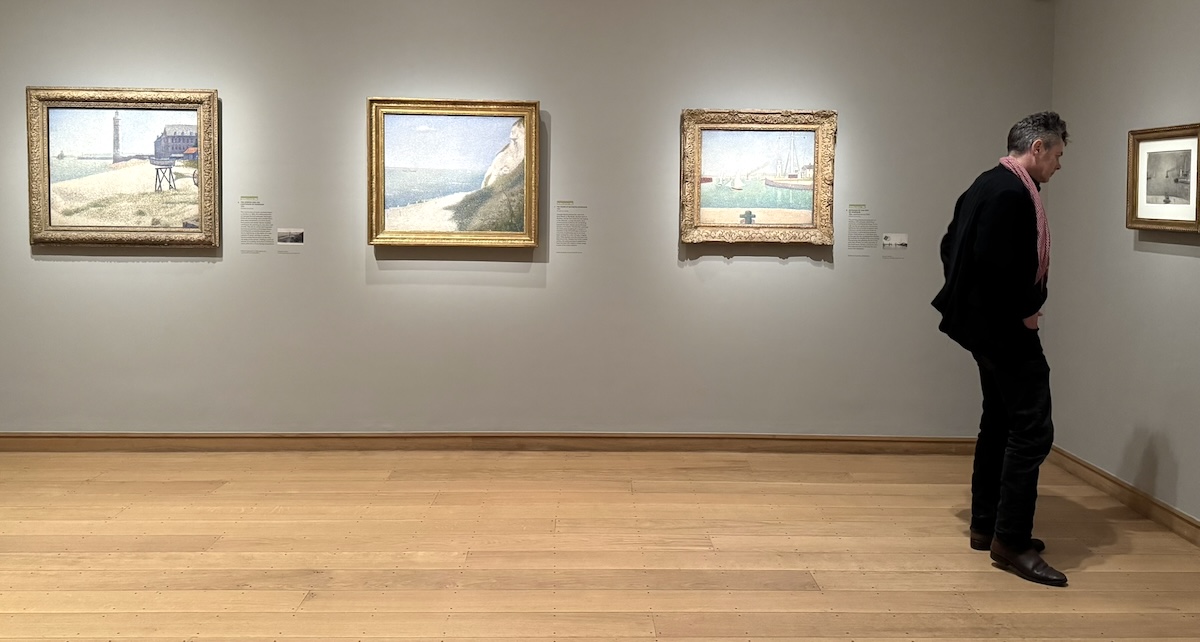
To illustrate Dr Serres thesis, in the main second gallery, we are shown a complete sequence of works, hung in their original order, painted in the summer of 1888 at Port-en-Bessin, Normandy. “Seurat loved this little port, nestled between two very tall cliffs… these paintings have not been seen together since 1889.” Dr Serres tells us that it was very important for Seurat that these paintings were seen as a group. “He would paint five or six canvases en plein air and then finish them in his Paris studio, then show them at Le Société des Indépendents.” Established in response to the rigid traditionalism of the official government-sponsored Salon, this was run by artists including Odilon Redon, Seurat and Paul Signac, and there was no jury (its slogan was “sans jury ni récompense”).
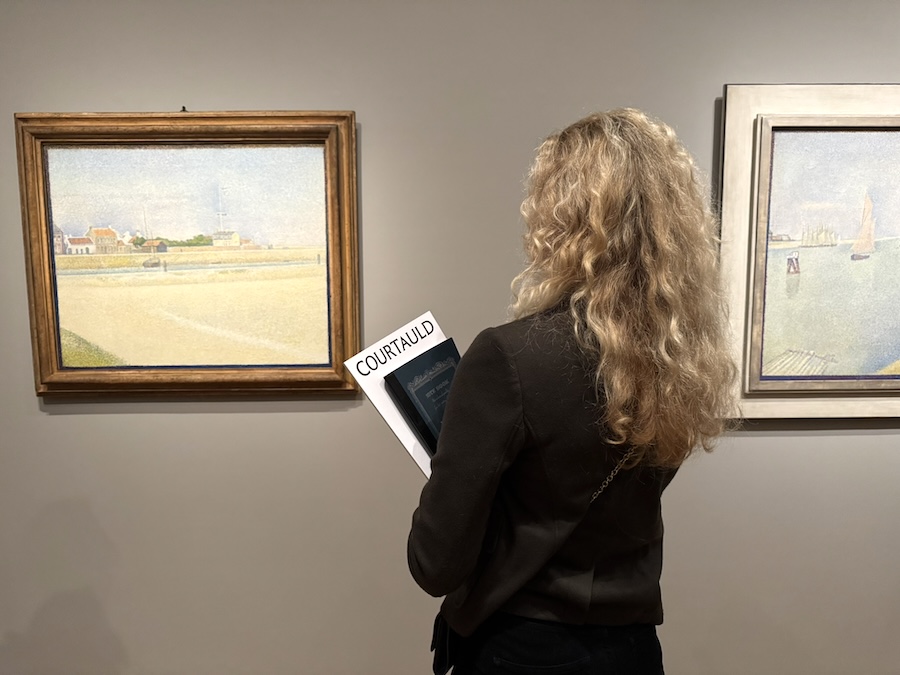
Nico Kos Earle looking at The Gravelines paintings, Seurat and the Sea, The Courtauld ©Artlyst 2026
What is most remarkable about the suite, which includes a sequence of diminishing perspectives from the port that culminates in a depiction of the dramatic cliffs to the west, is their drive towards a kind of transcendence. They begin from a point within the human world, including figures, flags and boats, that seem to combine to create a composite image of the port, but then he turns his back on the port and brings us dramatically to the edge of this little world. Roger Fry’s essay, ‘The Dial’, describes Seurat as having an artistic personality which combined qualities usually considered incompatible: on the one hand, his extreme and delicate sensibility, on the other, a passion for logical abstraction and an almost mathematical precision of mind. Like the contrasting dots of colour Seurat used to create something new, this tension was powerfully generative – like the seasons. We see this potential in his drawings, made with conté crayon on paper with a rough surface; instead of line, there is heft.
In looking, we come to understand that painting is not about surface at all; like water, it is all a reflection. We apprehend complementary dots which combine to create colours and form in our imagination. Very far from formulaic exercises, these are contemplative studies of a place drenched in sunlight, an exercise that cleansed his city-weary eyes, and what we see is somehow a reflection of the artist’s vision. I stop and wonder: did Seurat anticipate the pixel? Does a mind that is melting with overexposure to the digital image appreciate these more for their honest rendering of the elements that make us believe we are standing there on the quay, looking out to sea? A show that is utterly heartbreaking for how it leads us to the sudden end of his life, it also reminds us of the powerful renewal of light. I really need to be standing there right now, believing in the light bouncing off the sea.
Nico Kos Earle
The Courtauld holds the largest collection of works by Seurat in the UK. Due to his early death at the age of 31, Seurat has a very small pool of works and exhibitions devoted to him are rare.
The Griffin Catalyst Exhibition: Seurat and The Sea, The Courtauld Gallery, 13 Feb – 17 May 2026
Visit Here