

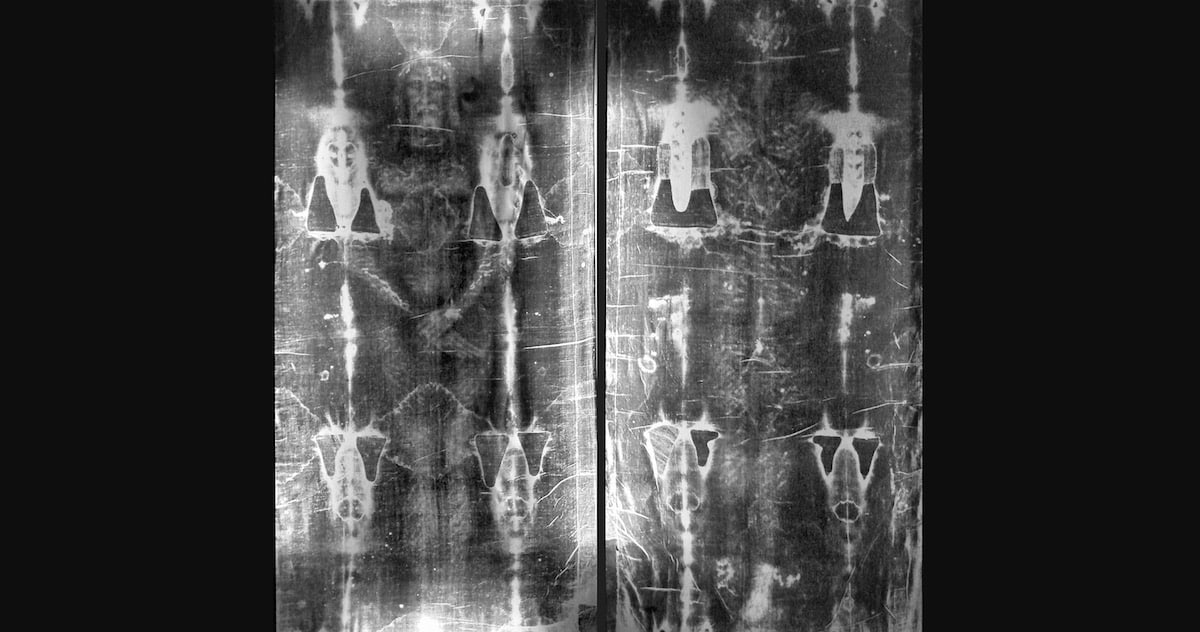
New research into the Shroud of Turin has found DNA from carrots, cats, dogs, cattle, pigs, wheat, corn, peanuts and bananas on its surface. Whether this tells us anything meaningful about one of history’s most contested religious relics depends entirely on who you ask and what you were already inclined to believe before you asked them.
The study, conducted by genomics researchers Gianni Barcaccia of the University of Padua and Alessandro Achilli of the University of Pavia, reanalysed genetic material collected from a fragment of the Shroud in 1978. The technique used metagenomics, which sequences all the genetic fragments present in a sample and matches them against known species, producing what the researchers describe as evidence of the cloth’s extensive exposure across the Mediterranean region and the possibility that the yarn used to make it originated in India. Posted on the preprint server bioRxiv in March, the paper has not yet been peer-reviewed. That caveat matters rather a lot.
The Shroud itself needs little introduction. Housed in the Cathedral of St John the Baptist in Turin, it is a 4.4-by-1.1-metre linen cloth bearing a faint sepia-toned image of a bearded man with closed eyes and crossed arms. Since it first appeared in the historical record in the 1350s, when a Catholic Church official in Lirey, France, displayed it as the cloth that wrapped the body of Jesus after the crucifixion, it has been one of the most hotly debated objects in the world. The argument started almost immediately. Between 1355 and 1382, a Norman scholar wrote a treatise identifying it as a “patent” fake. Around 1389, the bishop of the region wrote to the Pope reporting that an artist had confessed to making it.
Interest since a 1989 study published in Nature, in which three independent laboratories radiocarbon-dated a fragment of the cloth, found with 95% certainty that it was made between 1260 and 1390, not 2,000 years ago during the lifetime of Jesus. Believers in the Shroud’s authenticity have dismissed these findings ever since, though the methodology has withstood scrutiny. Carbon dating remains the most robust scientific evidence in the debate, and no subsequent study has overturned it.
The new research doesn’t claim to overturn it either. What Barcaccia and colleagues are arguing is more modest — that the genetic material on the cloth suggests it travelled extensively, and that some of the yarn may have come from the Indian subcontinent, which could be consistent with a Near Eastern origin. “Overall, the reappraisal of the outcomes from the analysis of the DNA traces found on the Turin Shroud suggests the potentially extensive exposure of the cloth in the Mediterranean region and the possibility that the yarn was produced in India,” Barcaccia wrote in a statement.
The problem, as outside experts are quick to point out, is that this interpretation is one of several equally plausible explanations for the same data. The Shroud has been transported and displayed across France, Switzerland, Belgium and Italy over the centuries. It has been handled by countless people from distant places, exposed to open air in multiple environments, and touched by objects brought from around the world. The presence of banana DNA, as historian Andrea Nicolotti of the University of Turin drily notes, does not prove the Shroud spent time in Malaysia or the Philippines. It proves the Shroud was touched by someone who had handled a banana. Which, over seven centuries of public display, seems entirely unremarkable.
Nicolotti, who wrote what is probably the most comprehensive scholarly history of the relic, points to another problem that predates the new study entirely. The weaving style of the Shroud would have required a horizontal treadle loom with four shafts — a technology that didn’t exist in the Mediterranean before the Middle Ages. Treadle looms are thought to have originated in China around CE 1000, with the four-shaft version introduced by the Flemish around the thirteenth century. A cloth made in Jesus’ time couldn’t have been woven this way.
The methodological concerns raised by independent scientists are serious. Christina Warinner, an anthropologist at Harvard who studies ancient microbiomes and was not involved in the research, acknowledges that the human and microbial findings are probably trustworthy. The plant and animal results are another matter. They were produced using an alternative DNA-matching method known to perform poorly with both plants and animals. “The coral, animal and plant IDs will all need to be very closely scrutinised and verified,” she said, adding that she suspects most are data artefacts. Allison Mann, a biological anthropologist at the University of Wyoming, was more direct: “There is a lot of legwork that needs to be done, actually, to convince me of any of these results.”
If the paper is submitted to a peer-reviewed journal, reviewers will almost certainly request additional validation before publication. There are additional genomic techniques that could determine whether the DNA on the cloth is ancient or represents recent contamination, a distinction the current study can’t make. What would definitively settle the question of the Shroud’s age is new radiocarbon dating, which would require cutting another fragment of the cloth. The Vatican is unlikely to permit that.
So the carrots, the cats, and the corn don’t resolve anything. The Shroud of Turin remains exactly what it was before this study: a medieval linen cloth with an extraordinary image, a provenance that places it firmly in fourteenth-century France, and a cultural power that has outlasted every scientific attempt to put the argument to rest.
Top Photo: Wikimedia Commons