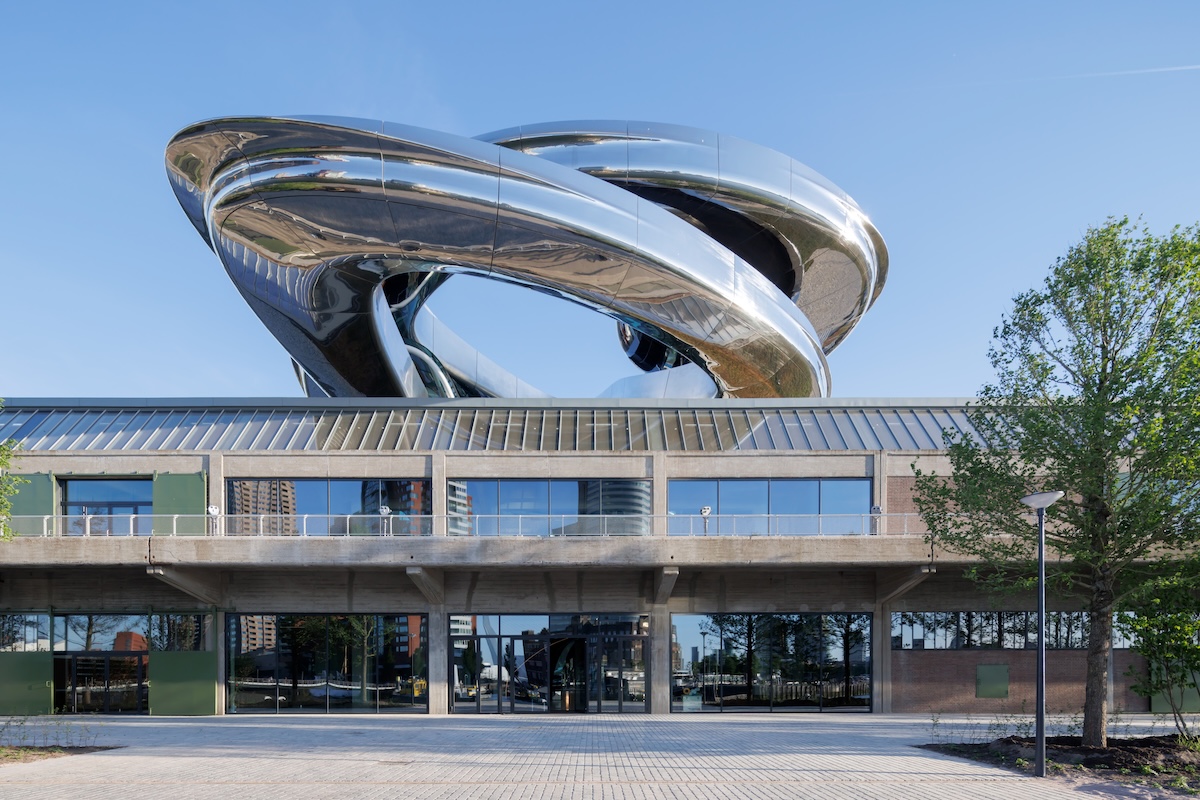
The Fenix, Rotterdam’s new art museum, is dedicated to human migration. It opened in May 2025 in a former shipping warehouse. The building has been redesigned for purpose by MAD Architects, a Chinese architectural firm. A double helix twisting staircase forms part of the ‘Tornado’. Visitors who reach the top, via stairs or lift, can look out over the city, the Rotterdam skyline, and the docklands that were once vital with passenger and cargo ships. The stainless-steel-covered construction, which constantly changes appearance with the weather, is a symbol of migrants’ travels across the world.
The inaugural exhibitions have been two permanent collections, including ‘All Directions: Art that Moves You’ with pieces by Red Grooms, Cornelia Parker, Francis Alys, Grayson Perry, Yinka Shonibare and many more mixed media artworks. The other permanent collection is a photography-centred show, ‘The Family of Migrants’, inspired by Edward Steichen’s ‘Family of Man’ at the Museum of Modern Art in New York City.
In November 2026, the Fenix opens its first temporary exhibition. ‘Mouthfool’ from the Berlin-based artists’ collective Slavs and Tatars. The group explores the geographical area bounded by two significant walls, the former Berlin Wall and the Great Wall of China. This region stretches from Eastern Europe to Central Asia and encompasses many languages, with a main emphasis on the Slavic and Turkic language groups and on the Latin and Arabic scripts.
Language and linguistic change is rarely the focus of a visual arts exhibition. As a writer and linguist who sings in as many languages as I can manage, I was particularly excited to see what would be done with this show and how playful, modern, and visually focused the exhibits would be. I was so impressed by how they made such a complex subject, with so many different stories that are generally not so well known in the West, accessible, fun, and fascinating. Children are actively engaged in language learning every day, and their parents and carers are on this journey with them. For a contemporary art show, this felt like an unusual hybrid with the aims and scale of educational shows from world-class museums of science and academia. Fun, informative, great art and wonderful stories – this was the word that I heard most often from the curators, ‘story’.
My personal interest in the Baltic language group (Latvia, Estonia, and Lithuania) was slightly disappointed, as none of this history was included despite being within the geographical range. This is a vast region affected by multiple empires, and the emphasis is on ‘Slavs and Tatars’.
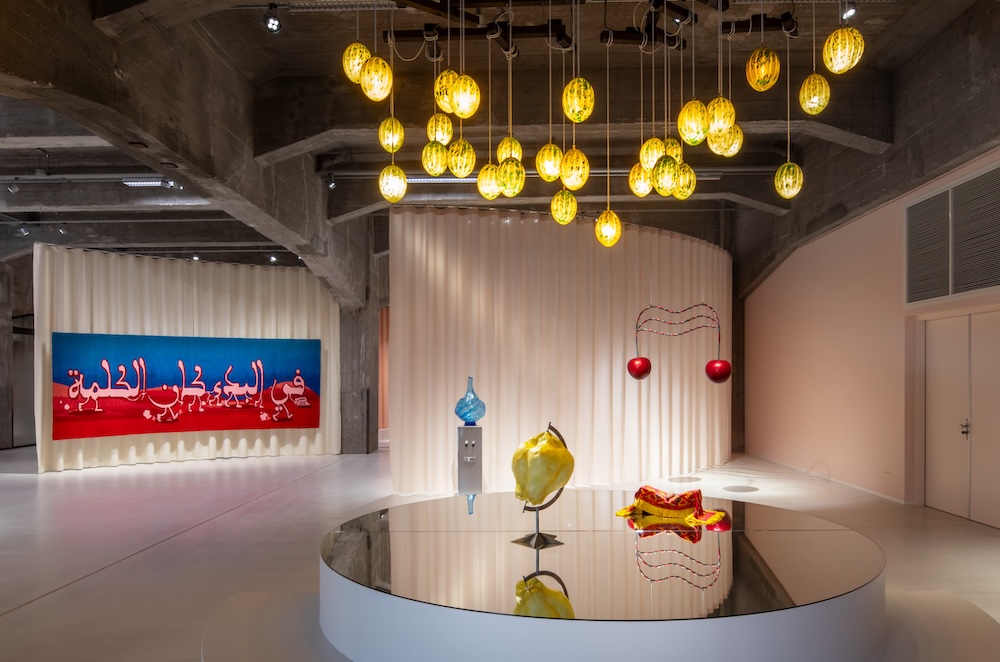
Installation view of Slavs and Tatars, Mouthfool at Fenix, Rotterdam. Photo by Eddo Hartmann
The tongues of this region have been heavily culturally moulded and challenged by the various empires and powers that have intervened in language and cultural expression. In the twentieth century, the ambitions of the Soviet Union changed the nature of writing, with an insistence on Cyrillic alphabets. The influence of Western capitalist ideas meant that many preferred to align themselves with Europe and adopted the Latin alphabet after the collapse. The previous influence of the Ottoman and Persian empires, together with the religious expansion of Islam and Christianity, is evident in the use of the Arabic script.
The first piece encountered in the exhibition is ‘uTonge Twist Her’ (2013), whose opening emphasises language change in the region in terms of script. A severed red tongue twists around a pole. The piece plays on feminine gender – is the tongue pole dancing, seducing listeners? I was immediately made to think of the cutting out of women’s tongues to control the language of their children by male invaders who spoke a different language. This legend is not from the geographical region but from the Breton state to explain the Brythonic name for the county ‘Llydaw’ as originating from the phrase for ‘half-silent’.
Other significant pieces include ‘False Friends’ (2025), five terracotta jugs with faces made from Ottoman Arabic letters. This artwork was inspired by Hurufism, a fourteenth-century movement within Islam in which followers put forward the idea that facial hair – eyebrows, eyelashes, moustaches and beards – correspond to letters of the alphabet. The visuals are playful and align with contemporary illustration and graphic design, in which writing systems might be reconfigured for other, playful purposes. I’m thinking of Saul Steinberg in particular, an emigrant from Romania to the USA who described himself as ‘a writer who draws’.
A favourite piece of mine was Salamoia (2019), a water cooler with a tank shaped like an ‘imamah’, a turban worn by some Muslim men. It is very witty and works so well on a humorous, modern level, imagining diversity in the office and the conversations between different people around the water cooler. Yet the important story behind the piece comes from the tales of Shia Islam. In the seventh century, Imam Hussain, a grandson of the Prophet Muhammad, and his army were cut off from the River Euphrates, with no access to water, during the Battle of Karbala. He and his forces did not survive the battle. The martyrdom and heroism are commemorated annually during the month of Muharram. The empty water cooler commemorates this suffering and educates visitors.
PrayWay (2012) allows visitors who take their shoes off to climb aboard a Persian carpet and meet and read. The shape brings together two traditional objects: the rahle, a stand used to hold holy books while they are being read and the takht, a raised platform from teahouses. It floats in the air, excitingly, comfortably, invitingly.
This is an exhibition in a museum of migration on the banks of a river used for shipping cargoes as well as humans, and it uses the story of the transport and distribution of fruit to stand for many different transitions and changes in human experience and culture. ‘Never Give Up the Fruit’ evokes the empire of China and the story of the Uyghurs, a Turkic-speaking people whose homeland is in Xinjiang, also home of the Kumul melon. The high ceilings of the warehouse are the perfect place to hang the wooden rafters shaped like two Chinese characters spelling Hami, the name of the original city of the melons. From them dangle thirty-two blown-glass fruits that angle lights that may shine happily. It evokes moonlight gardens, tea ceremonies and romance. A legend tells of Iparkan, the granddaughter of a Uyghur khan, who was brought back by the Chinese emperor to Beijing, where she felt homesick, and of the melons that were brought to the palace to cheer her. In China, Iparkan is known as Xiang Fei, the emperor’s favourite consort.
Next to this work, a giant rap video, the Contest of the Fruits (2021), presents a modern version of a nineteenth-century Uyghur poem in which the quince, the mulberry, the pear, and the pomegranate fight for position. This draws on the tradition of al-Munāẓara, a poetic debate that seeks truth or enlightenment through characters who take on different opinions and points of view. The Uyghurs are the second largest predominantly Muslim ethnicity in China, where they live with linguistic and cultural restrictions.
The witty exhibits continue with the metal panels’ Tranny Tease pour Marcel’ (2009 – present), an expanding series of language-focused memes realised as wall-mounted plates. This includes one piece from each of a different linguistic family. ‘To Mountain Minorities’ (2014) in Georgian, which uses a single letter to change the roughly translated phrase ‘Long Live Georgia!’ into ‘Long Live Kurdistan!’
With such highly politicised and aggressive subject matter, it is quite wonderful how the exhibition remains so playful. The wit and charm of the pieces, the stories that are so eloquently realised in art, are impressive and heartwarming. The simple finish and scale of the exhibition area work brilliantly to display these diverse works. The final effect is complex, and as a visitor, one is overwhelmed only by the rich, tragic, and inspiring histories, not by the clutter or ever-blowing presentation.
Alongside the ‘Mouthfool ‘, the permanent collection ‘All Directions’ has been enhanced by ten new artworks, including pieces by Dina Danish, Beya Gille Gacha, Slavs and Tatars, Steve McQueen, Emmanouil Bitsakis, Šejla Kamerić, Felipe Romaro Beltrán and Aitan Ebrahimoff. In this selection, I was moved by the digitally photographic woven tapestries by Sarah Abu Abdallah that display the Ramsi tomato, the unofficial symbol of Qatif. Climate change and urbanisation have affected the crop, and the pictures show it rotting in the boxes. The domestic photographs are very engaging and also remind us that homes are changing beyond recognition and that our family memories are decaying before our eyes. A universal story that we can all recognise.
Slavs and Tatars: Mouthfool, 19 November 2026–9 May 2027, Fenix, Paul Nijghkade 53072 AT Rotterdam
Visit Here