

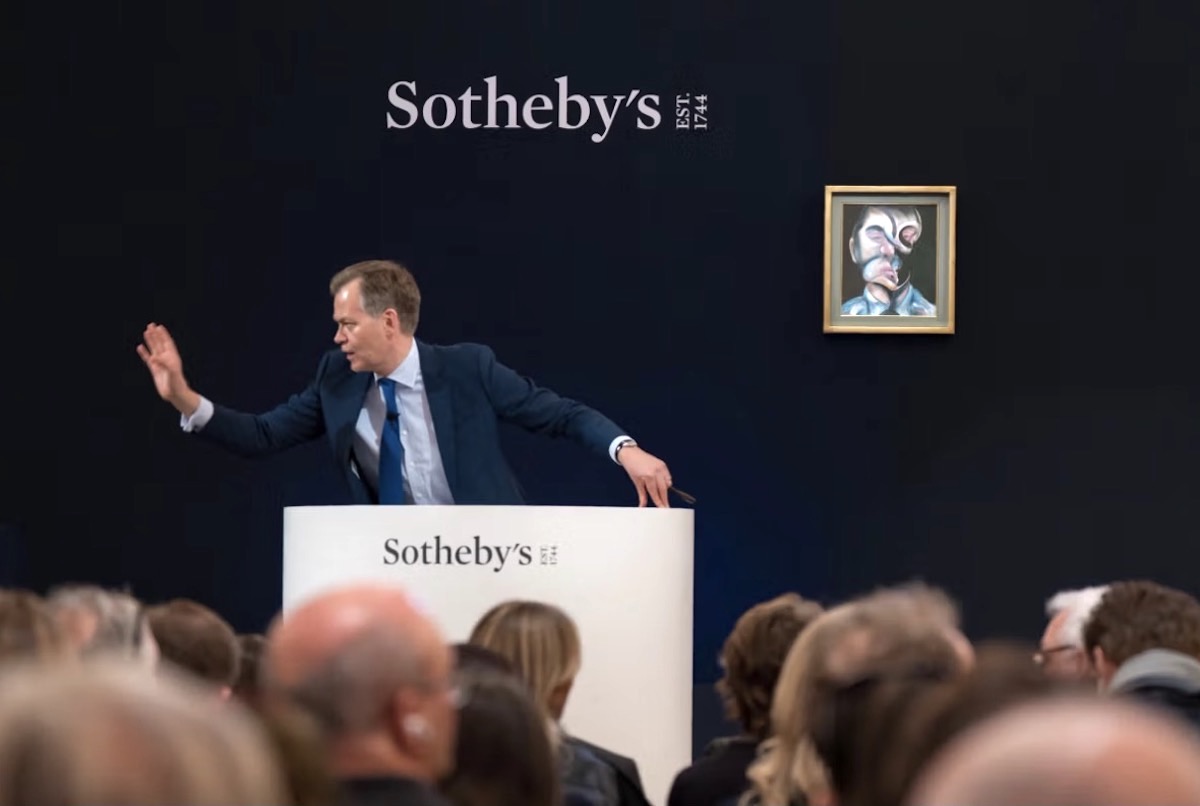
Sotheby’s packed auction totalled £131m, setting a record for Leon Kossoff. The rooms were full. Properly full, not London-auction full, which is a different thing entirely.
The 54 lots hammered to £106.4m, or £131m with fees, comfortably inside the pre-sale estimate of £96.1m to £136.4m. More than double last year’s equivalent, which made £63m with fees. Not quite the £136m of 2023, but close enough that nobody was complaining. The sell-through rate was 98% by lot. One Robert Ryman white painting, estimated at £500,000 to £700,000, was withdrawn before the gavel fell.
The draw, for many in the room, was a group of School of London works from Joe Lewis’s collection, the billionaire currency trader whose family trust controls Tottenham Hotspur—four pictures, all unguaranteed. The top lot was a 1972 Francis Bacon self-portrait, once gifted by the artist to his doctor in thanks for stitching up his face after a drunken brawl. It made £13.5m hammer, £16m with fees, against an estimate of £8m to £12m. A phone bidder got it, via a Sotheby’s specialist.
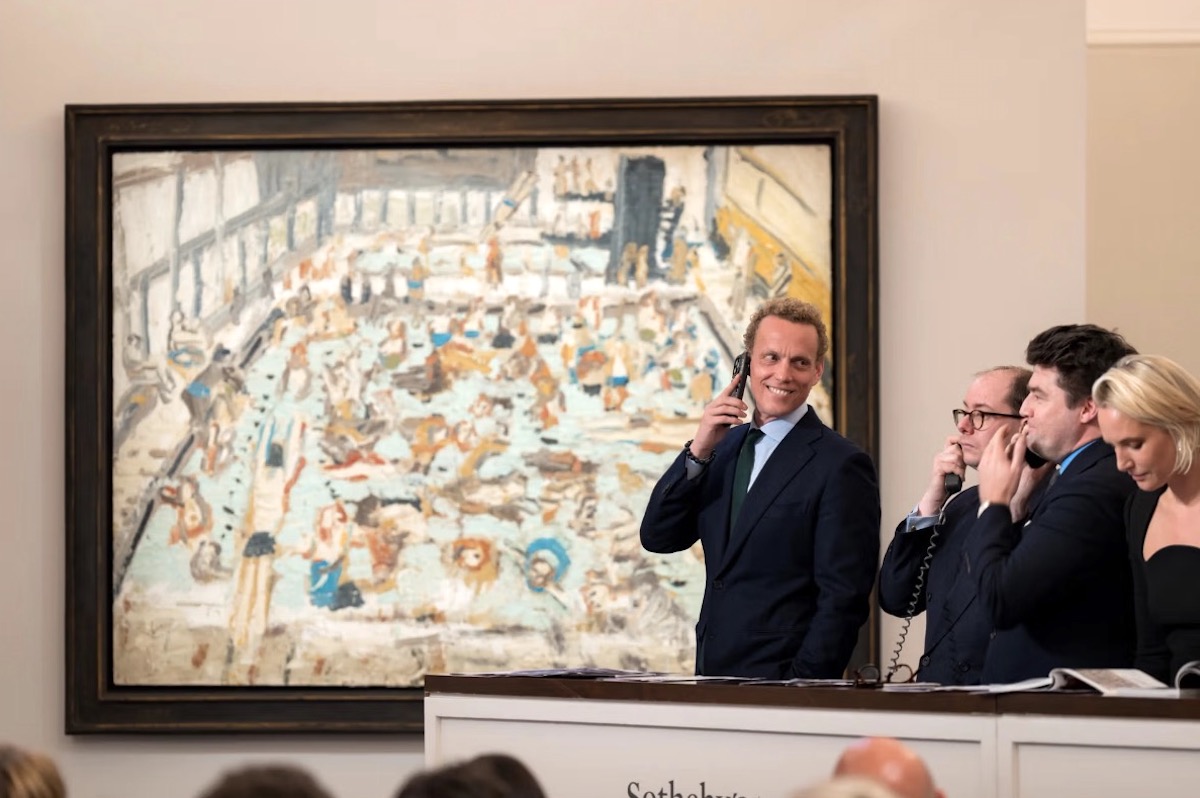
Leon Kossoff’s Children’s Swimming Pool, Autumn Afternoon (1971) Photo Courtesy of Sotheby’s
But it was Leon Kossoff who ran away with the evening. His Children’s Swimming Pool, Autumn Afternoon, painted in 1971, is one of five canvases depicting the Willesden Green pool near his home in north London. The other four are in Tate, Birmingham, and the Arts Council England. This one was in the Saatchi Collection, then Lewis’s. Until yesterday, Kossoff’s auction record stood at £1.4m, which tells you something about how overlooked he has been relative to Freud, Bacon, and Auerbach. About ten bidders chased it. Three were in the room. It hammered at £4.5m, £5.2m with fees, to a phone bidder via Alex Branczik.
The London dealer Offer Waterman described it as “completely fresh to the market” and one of the most celebrated series in Kossoff’s oeuvre. He is not wrong. Sotheby’s, sensing the appetite, moved the Kossoff to the front of the Lewis group at the last minute, hoping to kick the evening into life early. It worked, more or less. The Freud nude that followed hammered around its £6m low estimate. Not catastrophic. Not thrilling either.
A second single-owner collection, all guaranteed in-house, had a cooler reception. The headline lot was a large 1960 Lucio Fontana Concetto spaziale in black and jade green, estimated at £8.5m-£12m. It went to its third-party guarantor at the low estimate. Haon was diplomatically sanguine. “Fontana’s market hasn’t been strong since 2016,” she said. “Despite his historical significance, he is not fashionable with the younger collectors who are driving the market. Considering the retreat from Minimalism, we are pleasantly surprised Sotheby’s could still find a buyer at this price level.”
The second half of the sale slowed. Most works hammered around or below their low estimates, which is more or less what London evenings have felt like for years now. A 1986, Basquiat initially failed to sell, Sotheby’s said, due to a clerical computing error, and was later brought back to sell for £3.6m against a £6m low estimate. The house had not guaranteed it. Small mercies.
The sale’s overall character was telling. Post-Impressionist, Modern, and established contemporary works, nearly all by Brits and Europeans, the sort of canon that London still trades on with some authority. Not a single artist under 60. The youngest represented was Damien Hirst. The ultra-contemporary market, which ran hot for much of the early part of this decade, is now barely visible at this level.
Sotheby’s specialists were buoyant afterwards, in the way specialists tend to be after a sale that was not a disaster. Ottilie Windsor, the house’s head of contemporary art in London, cited three single-owner collections in one sale as a sign of returning confidence among consignors. “Beginning from the Pauline Karpidas sale in September, we’ve had a string of positive results,” she said. “Some works sold below estimate tonight, but there were multiple buyers across all levels, and that reassures sellers.”
All of this is welcome. And yet. For comparison, no consignment in this month’s London season has carried an estimate above £15m. In March 2019, five works were estimated at £20m or more. The distance between then and now is not something a single strong evening can close. Christie’s 20/21 Century sale follows tonight. If that goes well, too, there will be talk of a recovery. Whether it lasts past spring is a different question.
London, 5 March 2026