

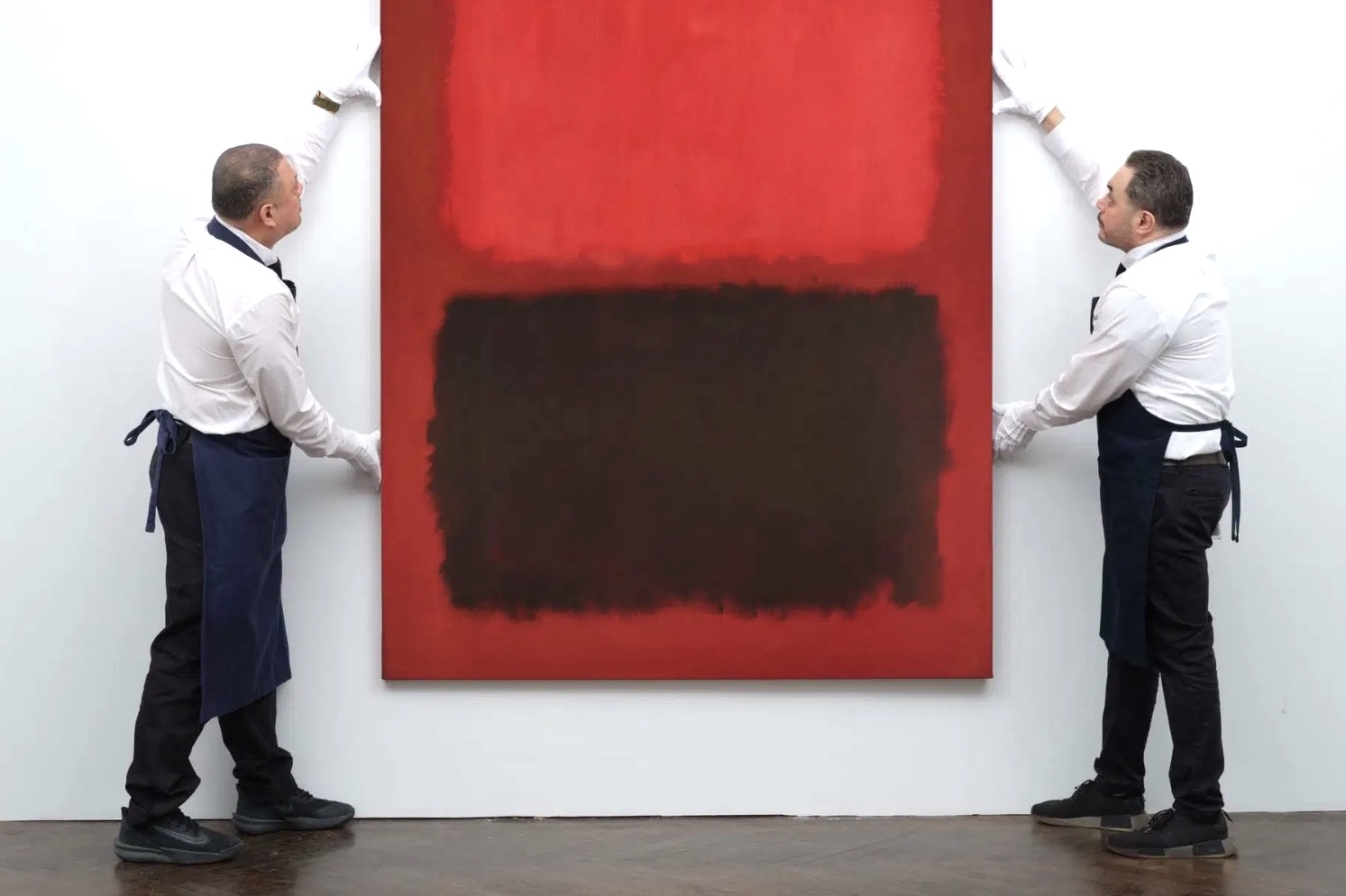
Robert Mnuchin, a successful investment banker who found a second career as a dealer of Modern and postwar art, died in December at 91. He was not a man who collected art the way many financiers do. He bought things he loved. Obsessively, repeatedly, and over decades, alongside his wife Adriana, until the walls of their life together became, more or less, the argument for why Abstract Expressionism matters. That collection, or a significant chunk of it, comes to Sotheby’s New York this May, with a total estimate of more than $130 million following his death last December.
“I love to be around art…I really believe I have the heart of a collector.” – Robert Mnuchin
Now, much of his collection is set to hit the auction block in a spectacular sale in May. The anchor is a Rothko. Brown and Blacks in Reds, painted in 1957, stands nearly eight feet tall and carries an estimate of $70–100 million. It originally came from the collection of Joseph E. Seagram & Sons, which is significant because Seagram would shortly commission Rothko’s most famous mural cycle, and you can almost feel this painting’s deep crimson acting as a kind of rehearsal for it. Only fifteen canvases of this scale survive from that year, and most are already locked up in institutions. That this one has been living in a private home for over twenty years feels, in retrospect, almost implausible.
The second Rothko on offer, No. 1 from 1949, is not quite in the iconic style we have come to expect from mature Rothko. Still, it is of interest to the historically minded buyer. It’s a transitional painting, with nebulous multiforms dissolving, the stacked bands not quite solidified yet, and it was shown at Betty Parsons Gallery the following year, which means it sat at exactly the moment Rothko figured out what he was doing. Estimate: $15–20 million.
Mnuchin always called de Kooning “Chairman of the Board”, which is the kind of thing that sounds like CEO patter until you realise he genuinely meant it. It was a de Kooning that started everything, a work bought early on at the James Corcoran Gallery in California, with Adriana nudging him toward the purchase. He never really stopped after that. The de Koonings on offer span four decades, with the late Untitled XLII from 1983 leading the group. Those final-period de Koonings have been undervalued for years; the fluid, almost dissolving passages of pink and violet in the late work are as accomplished as anything he did in the fifties, and the market has only recently started catching up to that view.
Then there’s the Franz Kline. Harleman, from 1960, is the finest example by the artist to come to auction in a decade, a claim that gets made a lot. Still, in this case, the work stands as a monumental black-and-white that carries the full weight of what Kline was doing before his death the following year. Mnuchin championed Kline relentlessly and knew the work better than almost anyone; the fact that he held onto this one for over twenty years says something.
Jeff Koons’s Louis XIV, not a great example of his work, rounds out the major lots. The bust of Louis XIV, in polished stainless steel, is the piece that marks the moment in Koons’s practice from commodities and kitsch toward art history itself. The artist’s proof from an edition of three, the remaining copies sit in the Nasher, the Broad, and the DESTE Foundation.
For a collection of this calibre, it’s a fast road to auction — he died in December.
A selection of works goes on public view at Mnuchin Gallery, 45 East 78th Street, from 11–15 March before travelling to Hong Kong, Los Angeles, and London ahead of the May sales.