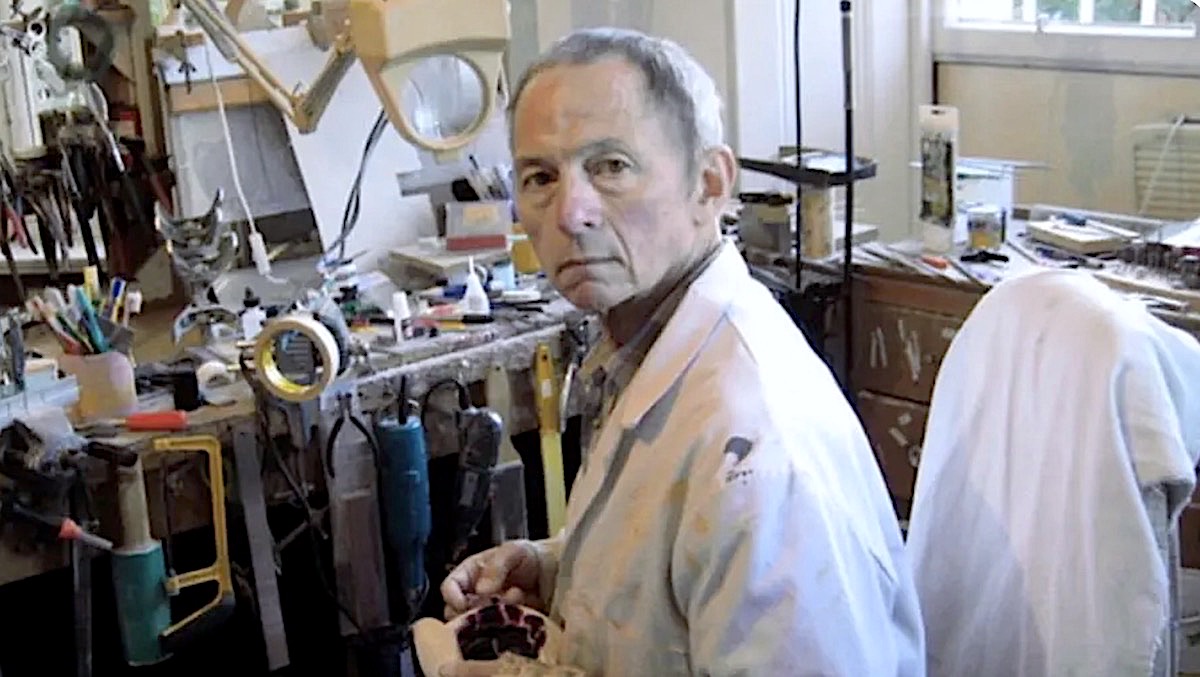
Using old toothbrushes and discarded plastic bits, PETER CHANG created iconic pieces of jewellery. The Faberge of the 21st century, his creations were objects d’art: large, unorthodox, outlandish, outrageous, extravagant, witty, sexy, flamboyant, stylish, modern! Once seen, never forgotten. High voltage colour was his trademark. Yet Chang himself was a shy, hard-working genius whose internationally famous pieces took hundreds of hours to make. His archive is now being gifted to Glasgow. They are lucky to have it. When he was living locally and in demand worldwide, they ignored him.
Born in 1944, raised in Liverpool, Chang attended Liverpool College of Art, then in 1967 left for Paris to study printmaking at the famous Hayter Printmaking Atelier, before pursuing postgraduate studies in sculpture and printmaking at The Slade School of Fine Art, London. After years working on sculptural projects, interiors and furniture design, in the late 1980s he turned to jewellery, first making earrings for his wife.
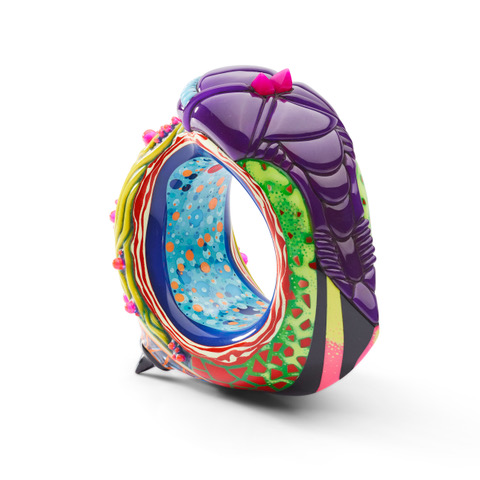
Peter Chang: Unorthodox, Outlandish and Outrageous
Colour was his passion. He found that synthetic resins and plastics provided colours unavailable elsewhere; hence fragments of razors, rulers, toys and felt-tip pens were reimagined as part of a visual vocabulary influenced by surrealism, Chinese lacquer-work, mythology, Miro, Taoism and heraldry. From such unlikely, improbable beginnings as a discarded toothbrush, Chang made silk purses from sow’s ears, fashioning joyous abstract mosaic brooches, reptilian bracelets, cloisonne earrings, lacquer-like boxes and baroque mirrors of exquisite beauty. His oriental ancestry was evident in this innate love of complex decoration, rich patterns, exuberant colour, and exotic shapes.
Occasionally Chang leapt to large-scale objects. His amazing Giant Lizard Banquet Table, a major piece of breathtaking craftsmanship, was bought by the British Council as centrepiece of the new British Council headquarters in Hong Kong. His exotic wall bannister will be at Kelvingrove.
Table or brooch, the process was the same. Chang used innovative twentieth-century materials, but his skills were ancient: painstaking, time-consuming, traditional. Tiny fragments of brightly coloured acrylic were recycled, transformed into exotic brilliance using complex mosaic and secret Japanese lacquer techniques, with hints of Byzantine mosaics intertwined with Gaudi-esque bulbous decoration – a far cry from 1960s kitsch and pop art, which Chang absorbed in his native Liverpool.
Chang’s dramatic brooches or bracelets – deceptively bold and large are in fact light as a feather and comfortable to wear – I speak from experience!
He used little machinery. He said he had more control with his hand, carving shapes in wood or polystyrene, then building up layers of resin and painting them on like runny honey! Last, he inset shapes and some glitter! He used hand planes, rasps, needle files, finishing with wet-and-dry sandpaper, from coarse carborundum to fine, ending with polish and wax. He did use power tools for piercing – a thing like a dentist’s drill.
So why plastic? “I wanted something that would reflect the age we live in, and I liked the idea of working with a substance that was throw-away. Using plastic got away from the preciousness of making a mistake. Plastic is anonymous. And people don’t question abstract jewellery.” He made detailed sketches for his brooches (some of which are now in the V.&.A.), but many developed spontaneously.
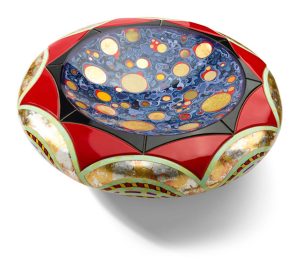
Chang’s jewellery is not for the shrinking violet or faint-hearted. A cross between a psychedelic flower, snake or insect complete with tail and horns, it requires personality in its wearer. Chang’s gorgeous objects also have a wit and humour. “I like to incorporate a bit of fun, spice it up. People take things too seriously.”
Chang received numerous international honours, including Munich’s prestigious Hofmann Prize and the Jerwood Prize for Applied Arts for his “lasting significance and daring brilliance”. Jerwood judges, who included John Tusa, ex-director of BBC World Services and former head of the Barbican, said: “In Peter Chang, we responded to his daring colours, his exuberance, his sense of fantasy, but also to his underlying balance of elegance of form.”
Chang’s work can be found at the V&A, London; the Metropolitan Museum of Art, New York; the Smithsonian Cooper Hewitt Design Museum; and the Museum of Arts and Design, New York. and the National Museums of Scotland.
Peter Chang was, above all, a friend, one of the world’s top “new’ modern jewellers, a Gem of a guy, an artist I was privileged to know.
The Magical World of Peter Chang, Lyon and Turnbull, London, till 19th September, Kelvingrove Art Gallery, Glasgow, December.
Words: Clare Henry Photos Courtesy Lyon and Turnbull