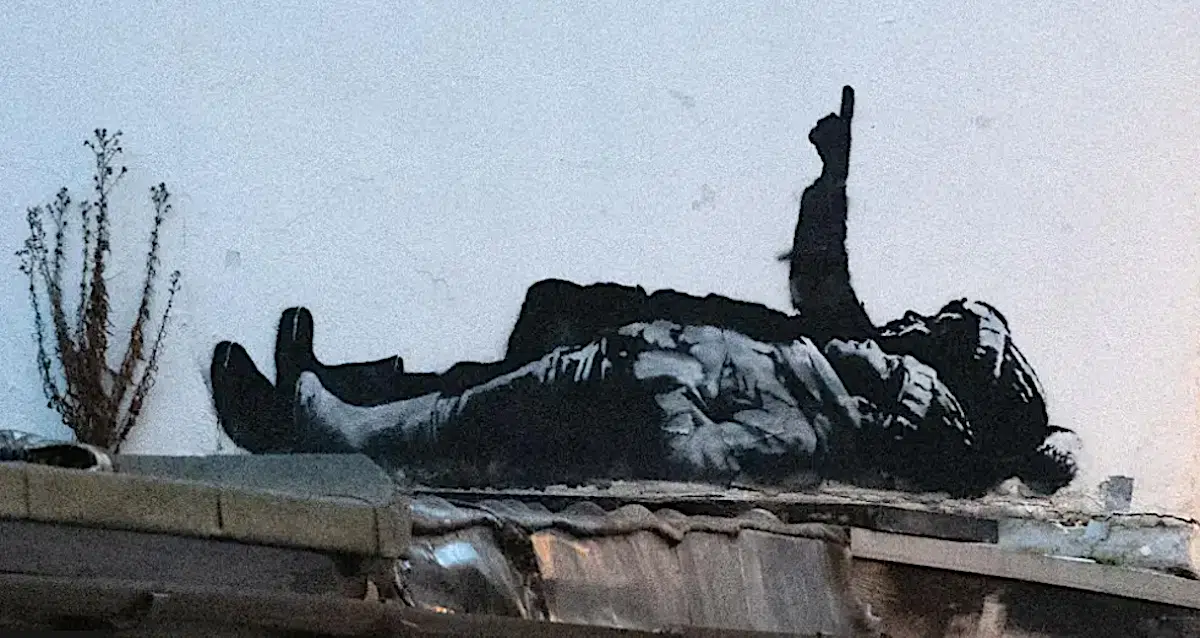
Two identical Banksy murals have appeared in London: one in Bayswater, the other at Centre Point in the West End, but the city seemed slow to notice. The work in Bayswater was spotted on Monday, painted on a wall above a row of garages on Queen’s Mews. Two children lie on the ground, winter coats, bobble hats, wellington boots, one of them pointing up at the sky. That’s it. Simple. Silent. Slightly unsettling.
Banksy, as usual, hasn’t spoken directly, though the Bayswater mural has been confirmed as his via Instagram. The Centre Point piece, spotted on Friday, is identical—but only the Bayswater work has been officially acknowledged. Identical children. Identical pointing. Two locations. Exact question: Will anyone look or realise that this is a statement on child poverty in the UK today?
At Centre Point, the imagery carries more weight. The tower has long been a lightning rod for London’s housing politics. Built in 1963, left empty for over a decade, it became a symbol of greed and neglect. The charity Centrepoint even took its name from the building, with its founder, Rev Ken Leech, describing it as “an affront to the homeless.” Now, luxury flats occupy the space. And here are Banksy’s children, pointing upward, as the city moves past them, oblivious.
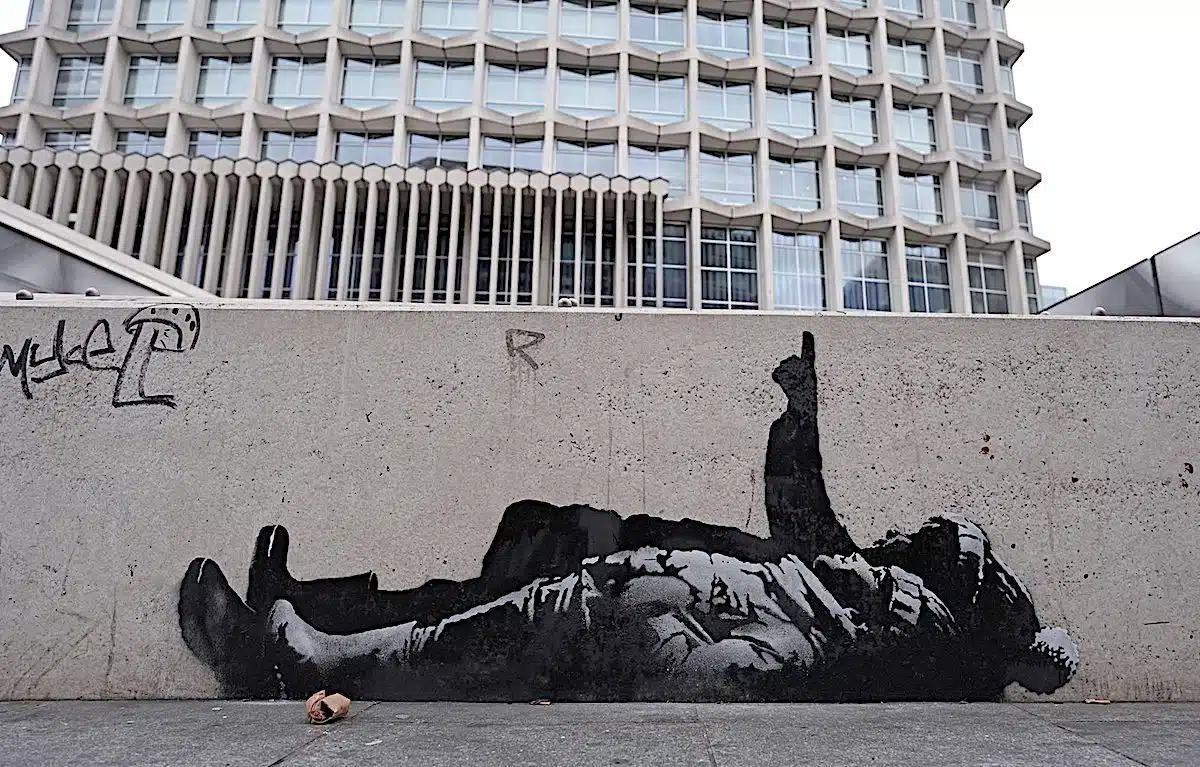
Banksy Homeless Children
Daniel Lloyd-Morgan, commenting on the Centre Point mural, called the placement poignant. “Everybody is having a good time, but there are a lot of children who are not having a good time at Christmas,” he said. He watched people pass, ignoring the artwork. “They walk past homeless people and don’t see them lying on the street. It’s kind of like they’re stargazing. The kids should be pointing up like they’re looking at the North Star.”
The artist’s previous work. In 2018, in Port Talbot, they used the same little boy as the child painted here. It’s unusual for him to reuse a character—he never does that.”
The Centre Point mural follows a string of recent London interventions. In September, a protester appeared lying on the pavement outside the Royal Courts of Justice, blood-spattered placard in hand, while a judge loomed overhead. That piece was scrubbed off within days.
Earlier in 2024, Banksy left an animal trail across the capital: goats, elephants, a gorilla, monkeys, piranhas, a rhino, and pelicans. Playful. Unexpected. Unsettling.
Banksy never comments on the relevance of either new location, but the message is clear enough. The murals point to child homelessness in the capital. They observe. The city that walks past. People ignore them. And in that silence, the work speaks louder than any caption or press release ever could.
Banksy is the most famous artist never to step forward, a name that behaves more like a disturbance than a signature. Emerging from the British graffiti scene in the late 1990s, his work arrived fast, sharp, and already formed—stencilled images that landed overnight on walls in Bristol, London, Bethlehem, and New Orleans. The anonymity was not a gimmick. It became the condition of the work itself, a refusal to let personality dilute the punchline.
The visual language is deliberately blunt—rats, police officers, soldiers, children, CCTV cameras, lovers. Executed with the efficiency of a headline, the images borrow from street culture, agitprop, cartooning, and the dry wit of British satire. Nothing decorative. Nothing accidental. Banksy’s best works look simple until they aren’t, and then it’s too late—you’ve already read them.
Politics runs through the practice, but rarely as a sermon—war, surveillance, consumerism, state violence, migration, the hypocrisies of power. The humour disarms first; the aftertaste lingers—a girl releasing a heart-shaped balloon. A protester throwing flowers. A child sewing Union Jack bunting. These are images that circulate endlessly online, stripped from their original sites yet still tethered to the places where they first appeared. Context matters, and Banksy has always understood the wall as an active surface, not a neutral one.
Despite positioning himself against the art market, Banksy has never stood outside it. Auction rooms, museums, collectors—none have escaped his orbit. The self-shredding of Girl with Balloon at Sotheby’s in 2018 was not an exit but a recalibration, turning critique into spectacle, spectacle into value. The renamed Love Is in the Bin only confirmed the paradox: resistance can be profitable, especially when well staged.
Institutions have followed. Major exhibitions, authenticated works via Pest Control, a studio operation that maintains control while maintaining the myth. Yet the street interventions continue. Works appear, disappear, get painted over, cut out, stolen, preserved behind Perspex. The lifecycle is part of the meaning.
What keeps Banksy relevant is not mystery alone. It’s timing, restraint, and a sense of when to speak—and when to vanish. In a culture saturated with opinion, his images arrive without explanation, asking the viewer to do the work. You don’t need to know who Banksy is to understand what the image is saying. That may be the point.
Banksy remains less a person than a pressure point in contemporary culture: a reminder that art can still interrupt the everyday, still irritate power, still make people stop, look twice, and argue on the pavement.