
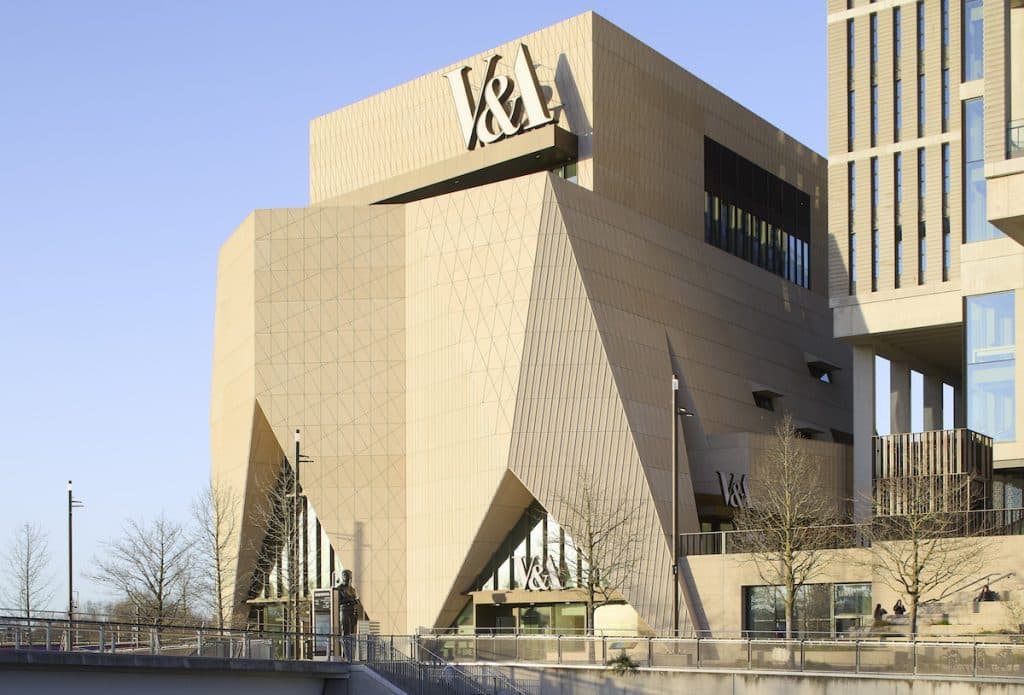
East London gains a major new cultural institution this weekend. V&A East Museum opens its doors on Saturday, 18 April in Queen Elizabeth Olympic Park, the culmination of more than a decade of planning and the most significant addition to London’s museum landscape in years. It is part of East Bank, the new cultural quarter backed by over £600 million of investment from the Mayor of London, and it arrives carrying considerable weight of expectation.
The building itself, designed by architects O’Donnell + Tuomey, is a confident piece of architecture. Five storeys of bright, generous space greet visitors who pass beneath Thomas J Price’s 18-foot sculpture A Place Beyond, which stands outside the entrance and announces something of the museum’s ambitions before you have stepped inside.
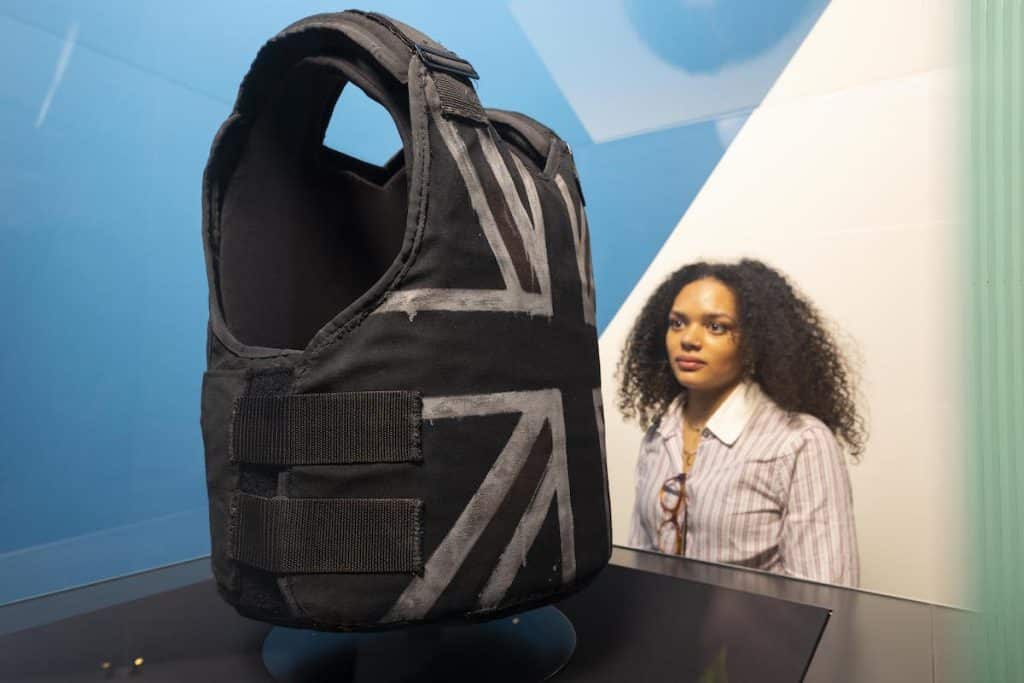
General view of Stormzy’s 2019 Glastonbury vest, designed by Banksy as it is unveiled at V&A East Museum in London’s Queen Elizabeth Olympic Park. Photo credit David Parry/PA Media Assignments
Those ambitions are most clearly legible in the opening exhibition. The Music is Black: A British Story is, by any measure, a landmark undertaking. The largest exhibition ever mounted on the impact of Black British music brings together more than 200 objects to trace 125 years of history across eight distinct genres: 2 Tone, lovers rock, Brit funk, jungle, drum and bass, trip hop, UK garage and grime. The curatorial scope is broad, but the execution is focused, and the emotional register is consistently high.
The object selection is where the exhibition makes its strongest arguments. Winifred Atwell’s piano anchors the early decades, while Stormzy’s iconic 2019 Glastonbury vest, designed by Banksy and reportedly first sketched on the back of a napkin, speaks to grime’s arrival at the centre of British cultural life. Joan Armatrading’s childhood guitar, Grooverider’s first turntable and the Super Nintendo that Jme used for his earliest musical experiments all carry the kind of biographical charge that no replica or document could replicate. These are the real things, and their presence matters.
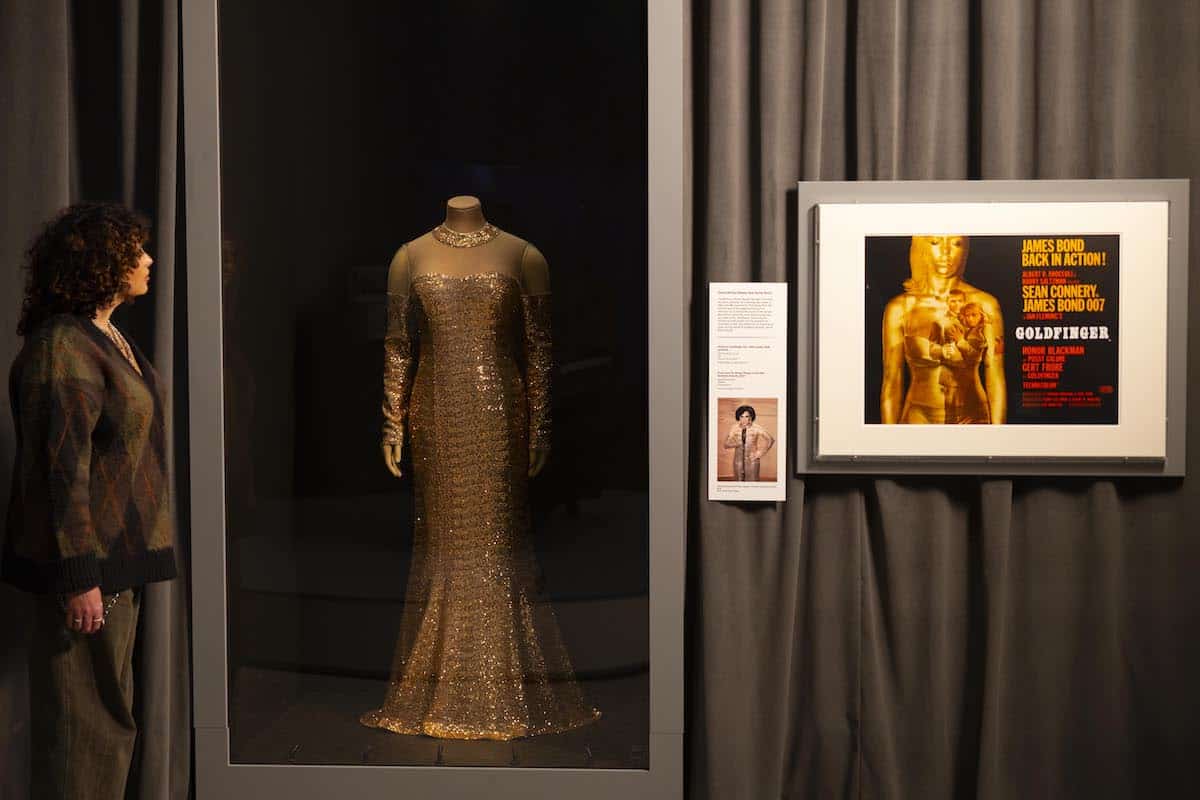
Fashion runs as a connective thread throughout. Pieces worn by Little Simz, Seal, Dame Shirley Bassey, Sade and Skin situate the music within a wider visual culture, and works by Dame Sonia Boyce, Zak Ové, Sokari Douglas Camp CBE, and Denzil Forrester bring painterly and sculptural perspectives to bear. Newly commissioned works by Sir Frank Bowling and LR Vandy give the show a sense of living engagement with its own subject.
Perhaps the most quietly significant element of the exhibition is its photography. The V&A has acquired more than 50 photographs for its permanent collection, many of which are appearing in public for the first time. Dennis Morris’s early images of Bob Marley, Eddie Otchere’s diptych of drum-and-bass pioneers DJ Kemistry and DJ Storm, and Laura Hyperfrank Brosnan’s print of Skepta’s family celebrating his 2016 Mercury Prize win are among the highlights. These acquisitions represent a genuine and overdue expansion of the collection.
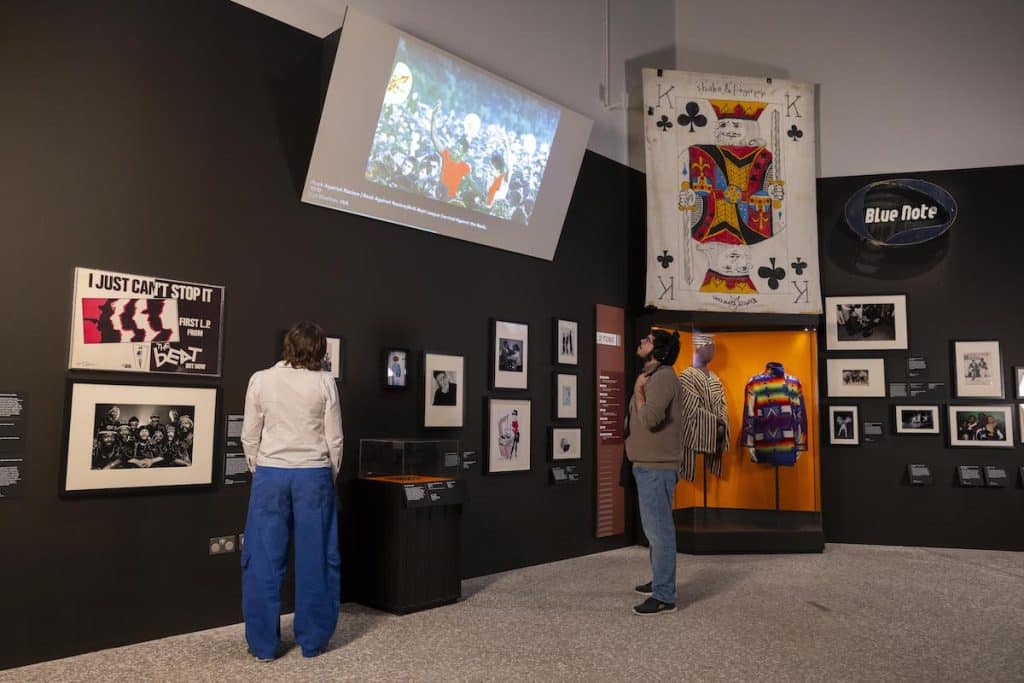
Installation shot Photo: © David Parry/
The BBC have partnered with V&A East on the exhibition, with a curated season of content available at bbc.co.uk/themusicisblack, including a new audio-visual mixtape from Shortee Blitz and Beat A Maxx. Later in the summer, The Music is Black Festival will extend the exhibition’s reach through a programme of performances and events across Queen Elizabeth Olympic Park.
Beyond the main exhibition, V&A East Museum opens with two free permanent galleries titled Why We Make. Designed by JA Projects with artist Larry Achiampong and the V&A East Youth Collective, they hold over 500 objects spanning centuries and continents, organised around questions of identity, representation, social justice and environmental action. The breadth of the selection is impressive. Photographs by Claude Cahun and Shadi Ghadirian appear alongside a Renaissance self-portrait by Sofonisba Anguissola. Fashion by Alexander McQueen and Vivienne Westwood occupies the same space as a Pussyhat carried on protest marches and carnival costumes by Keith Khan. The galleries resist easy categorisation, which is precisely their strength.
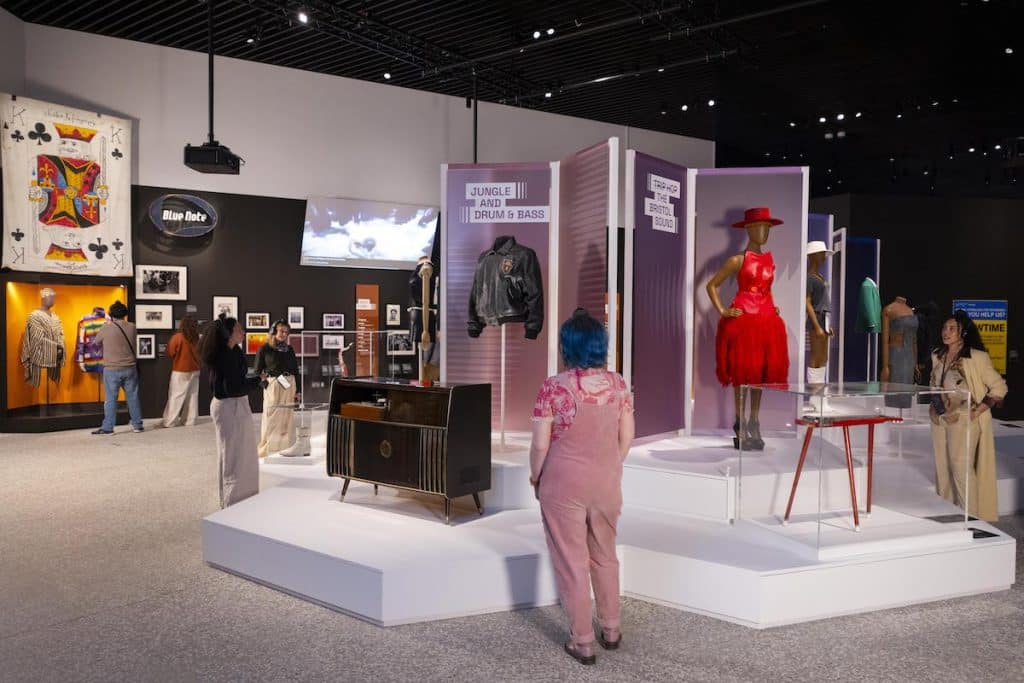
Photo: © David Parry/ V&A
The museum also launches New Work, a twice-yearly programme of commissions responding to East London’s histories and communities. The inaugural edition features newly commissioned works by Tania Bruguera, Turner Prize-nominated Rene Matić, Carrie Mae Weems and others, each taking the theme of Making East London as their starting point. A temporary display, Dispersal, featuring photographs by Marion Davies and Debra Rapp documenting communities displaced by the 2012 Olympic development, adds a note of critical reflection to the opening that feels carefully considered and wholly appropriate.
Museum director Gus Casely-Hayford has described the project as being co-created with young people, east Londoners and those who work and study in the area. That ambition is visible throughout, from the gallery design to the community-produced displays. Whether a museum of this scale and institutional weight can sustain that relationship over time remains to be seen. For now, on the strength of what opens this Saturday, V&A East Museum looks like something the city genuinely needed.
V&A East Museum opens on 18 April. The Music is Black: A British Story is supported by the Ford Foundation.