
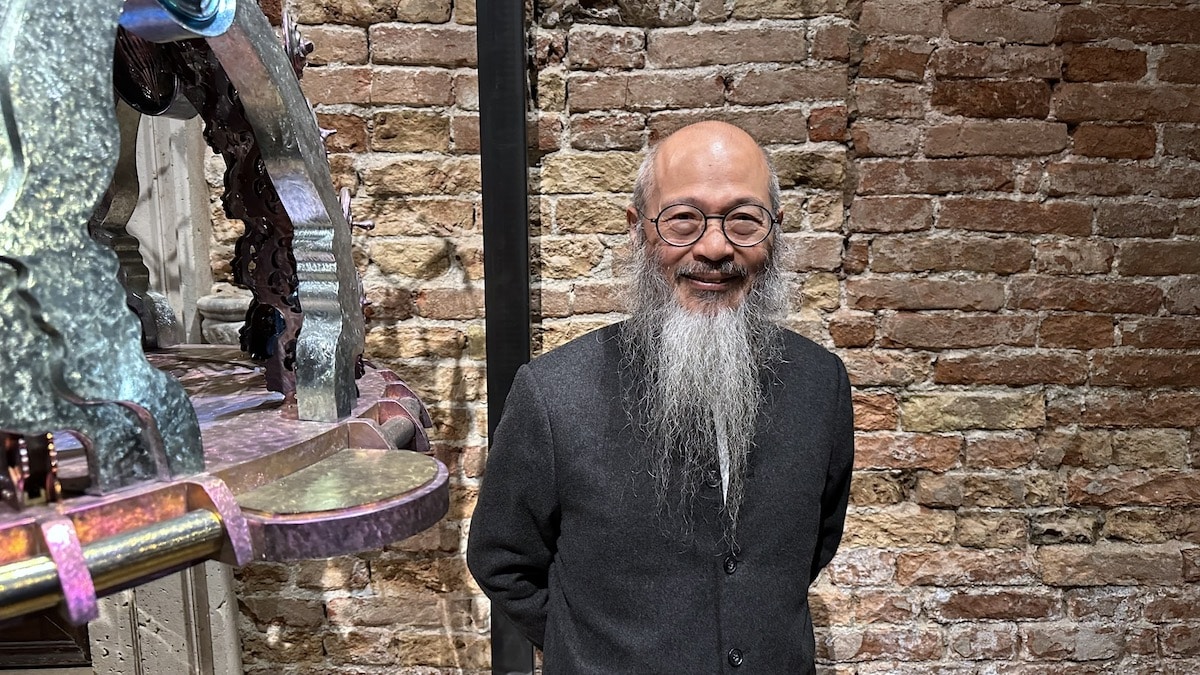
Wallace Chan’s decision to exhibit across two of Venice’s most historically layered buildings sets the scene for an encounter steeped in architectural history with a contemporary art twist. The Chapel of Santa Maria della Pietà, the modest but elegantly frescoed church, is inseparable from Antonio Vivaldi, who taught and composed there for much of his career. It carries its own collected atmosphere and its own claim on anyone who crosses its threshold. Chan’s work sublimely blends this historic context with his unique flair, offering a display full of surprises.
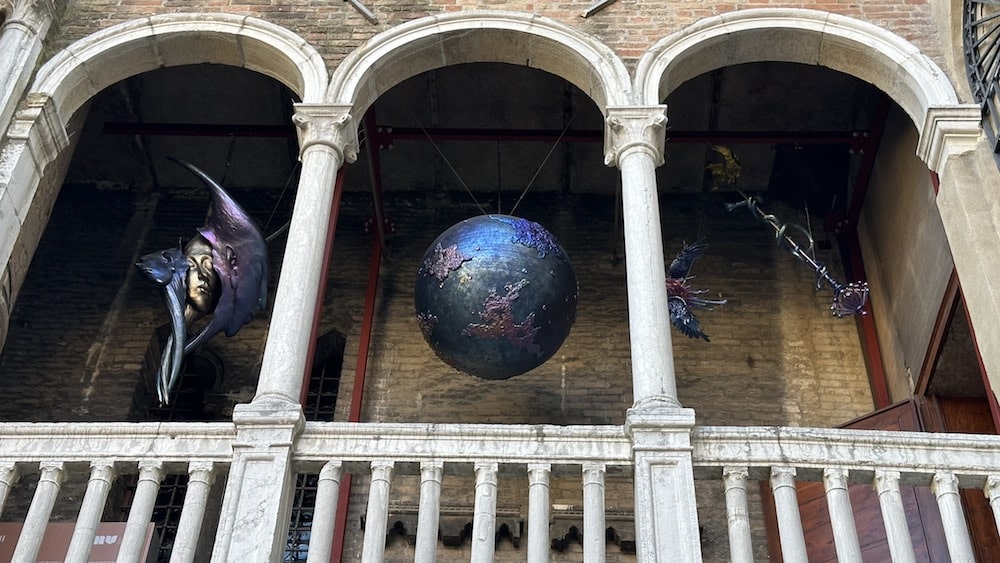
Wallace Chan Vessels of Other Worlds: Scala Contarini del Bovolo, Venice
The second site of the exhibition is of an entirely different character. The Scala Contarini del Bovolo, a late-Gothic and Renaissance exterior staircase tucked into a small courtyard near Campo Manin, is one of the city’s most extraordinary pieces of architecture and one of its least visited. They have a wonderful painting by Tintoretto that interacts with Mr Chan’s contemporary sculpture. The fifteenth-century structure offers panoramic views across Venice’s rooftops. Neither building is a neutral container. Both carry centuries of meaning, and Chan has chosen to work with that weight rather than against it.
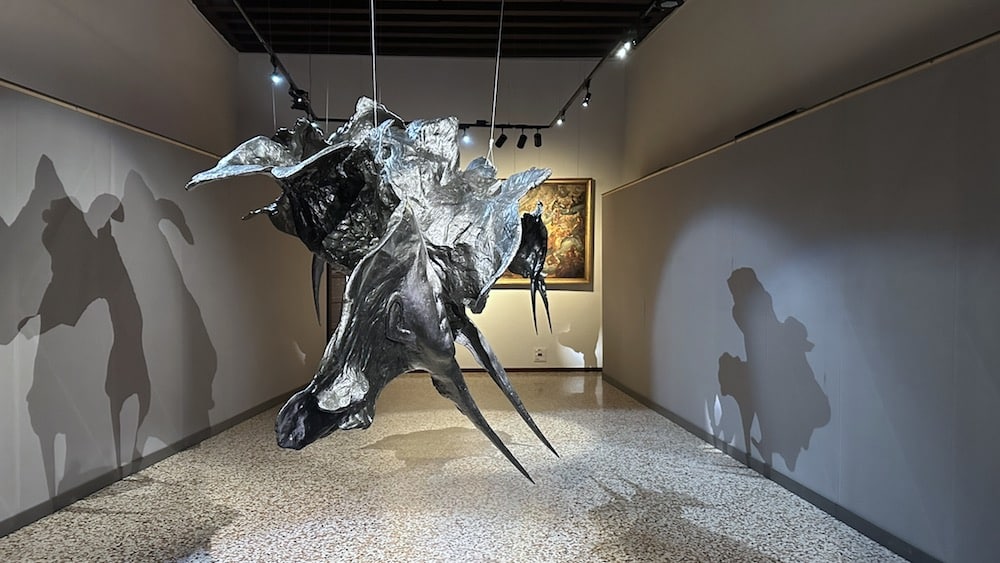
Wallace Chan Scala Contarini del Bovolo with Tintoretto
Wallace Chan was born in Hong Kong in 1956. From the age of sixteen, he trained as a gemstone carver. He has spent five decades developing a practice that resists labels and is known as a pioneer of titanium in jewellery, a development that transformed the field. This has also aided his ability to create sculptures that defy categorisation.
Vessels of Other Worlds is a cross-disciplinary approach to sculpture. It is an ambitious work within a broader art-historical conversation. Chan fully realises he has expanded the field of sculpture and installation.
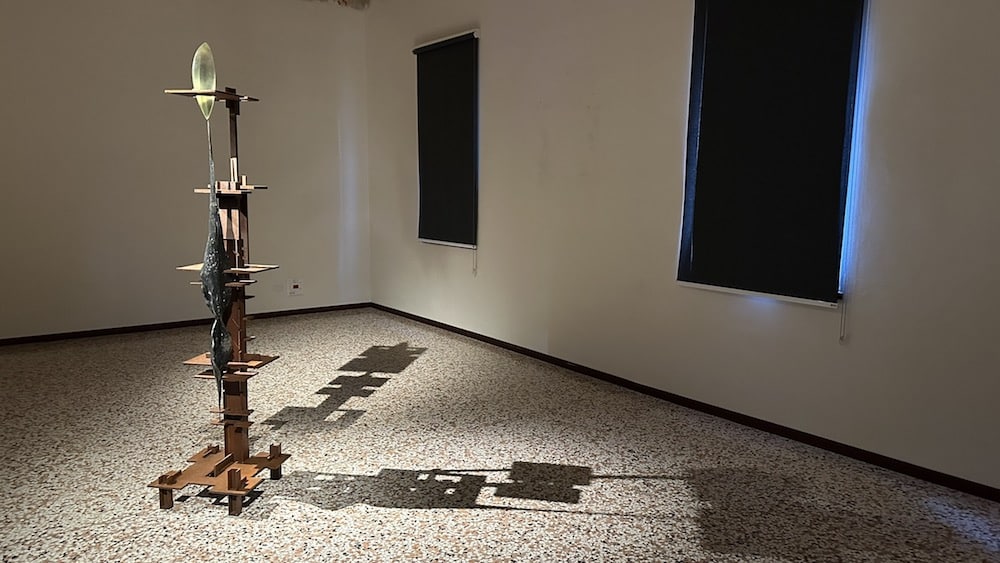
The titanium’s industrial use is warmed by Chan’s handling of the objects, colouring them and transforming them into something that holds light and brings the surface alive with the kind of quiet luminosity that the chapel’s interior seems to both absorb and amplify. The relationship between the sculptures and their architectural context is one of productive tension rather than easy harmony, and it is in this tension that the work is most interesting.
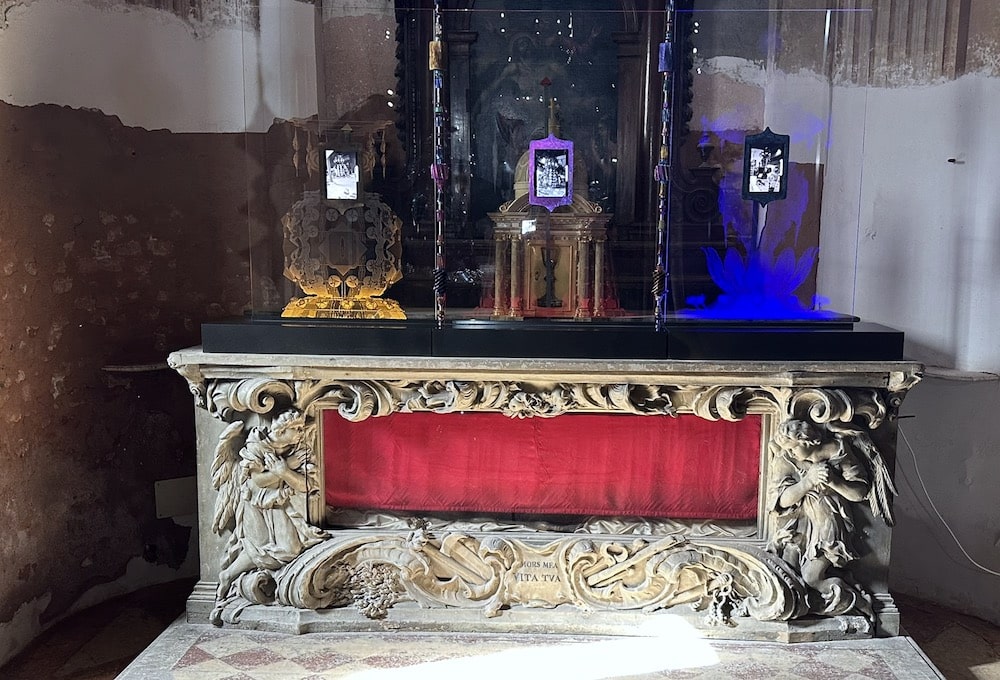
Wallace Chan’s Vessels of Other Worlds:
The three works, positioned on the altar of the Pietà Chapel, are vessels of considerable physical presence. Each draws inspiration from the Olea Sancta, the sacred oils used in Catholic ritual, and each is understood to represent a stage of human life: birth, growth and death.
Chan explains that each vessel is assembled from more than twenty thousand individual screws, a technical footnote you begin to discover on the surfaces when closely examined. This is what a labour of love has produced. Human figures and symbolic motifs are embedded throughout, unfolding gradually as the viewer moves around the work. This is not a sculpture designed to be consumed quickly. It requires the slow, circling attention that the chapel’s intimate scale naturally encourages, and that the exhibition as a whole seems designed to cultivate.
Surrounding the three central works, a constellation of suspended titanium forms evokes droplets caught in motion, distributing a sense of fluidity and suspended energy throughout the upper reaches of the space. The verticality of the chapel’s architecture, which Chan has described as a determining factor in his formal decisions, lends these suspended elements a particular force. They are a physical articulation of the work’s concern with transcendence and transition.
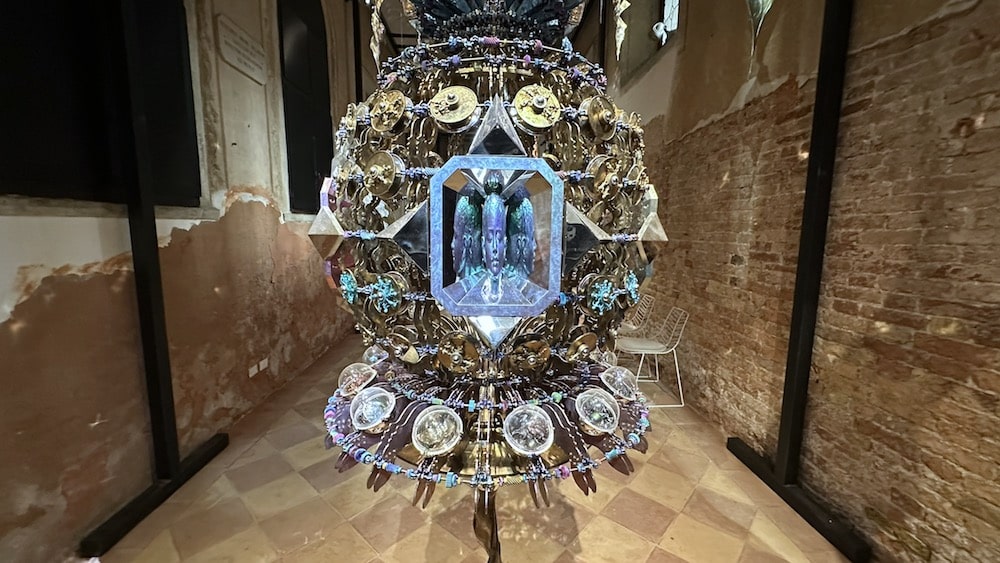
Wallace Chan The Chapel of Santa Maria della Pietà Detail
The exhibition draws on multiple traditions. The inspiration of Hieronymus Bosch’s Garden of Earthly Delights is evident in the density of symbolic imagery embedded in the sculptures’ surfaces. A sense of a world teeming with figures operating at a scale that requires one to look to apprehend fully. At the same time, the work’s engagement with ritual objects and its placement within a functioning ecclesiastical space gives it a devotional quality that is reverential in any sense and genuinely exploratory.
James Putnam’s curatorial sensitivity is evident throughout. The monumental sculptures, reaching up to 10 metres in height, extend the work beyond the chapel’s physical boundaries, creating an immersive experience that explores the relationship between intimacy and grandeur. Venice carries centuries of a layered history, he explained over dinner. The sculptures inhabit both environments differently, making it visible to the viewer in ways that enrich rather than dilute the experience.
Chan’s comment that he tries to respond to the character of a site rather than impose upon it is borne out by what Vessels of Other Worlds achieves. This is not an artist who has presented a body of pre-existing work in a convenient ecclesiastical setting. The chapel’s proportions have shaped the work’s formal decisions at every level, from the verticality of the suspended forms to the restraint that prevents the installation from overwhelming the space it occupies. That restraint is itself a form of ambition, more difficult to achieve and more durable in its effects than spectacle.
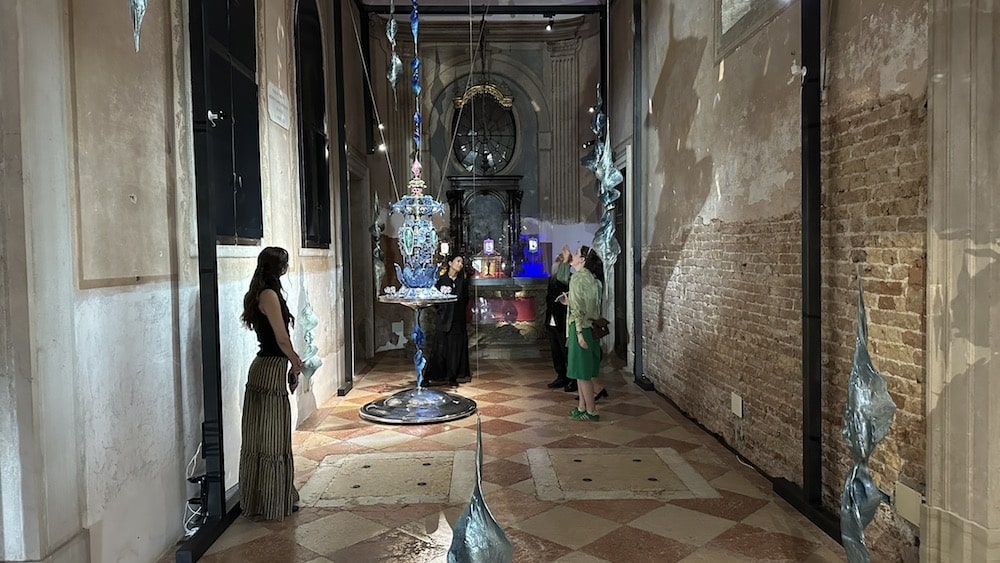
Wallace Chan The Chapel of Santa Maria della Pietà,
The exhibition arrived at a Biennale defined by political crisis, institutional turbulence and the insistent presence of the world’s most pressing conflicts in every corner of the Giardini and Arsenale. Vessels of Other Worlds does not address any of this directly and is a pleasant escape into spirituality. What it offers instead is something that this particular Biennale perhaps needs as much as it needs political urgency: a sustained encounter with craft, materiality, time, and the possibility of meaning that is hard-won rather than declared. Chan has spent fifty years developing the technical and conceptual language deployed here. The locations give it a context equal to its ambition. The result is one of the more quietly compelling experiences available in Venice this summer.
Wallace Chan’s works are held in the permanent collections of the British Museum, the Victoria and Albert Museum, the Museum of Fine Arts in Boston and the Shanghai Museum, among others.
The Shanghai component will open at the Long Museum on 18 July 2026, completing what Chan describes as a dialogue between two cities whose connections to water, in his view, give them a shared essential character.
Words Photos: P C Robinson © Artlyst 2026
Wallace Chan: Vessels of Other Worlds, opened on 8 May and runs until 18 October 2026 as a Collateral Event of the 61st Venice Biennale, responds to its placement in a truly remarkable way.