
Fanciful! Yinka Shonibare examines the metabolism of cultural history with a global grip on race. As a Nigerian-British artist, he has a gentle irreverence for Patterns of Power, hence the show’s title. Among his recent works, African Flower Magic (2025) uses flowers as a starting point to explore the interweaving of nature and culture. Fabric sections and Financial Times FTSE cut-outs feature primitivist image icons with organic designs. The floral fabric cut-outs of African fabrics that originated with Indonesian batik designs appropriated by the Dutch, introduce a multi-layered cultural referencing. As designs, these bring nature and culture together in an intercultural way. Shonibare’s is a playful hyper-synthesising of historical and Post-Pop culture that questions what is the high and what the low of art. Art history is given the appearance of a new facade. Yinka Shonibare chases aesthetics – styles, periods, epochs – as if it were a sheepdog to be caught up with. We see him coalesce it all in the Twins series, where gold leaf is merged with FTSE stock market quotes cut out from the Financial Times. Ah, yes, that strange pot-pourri of funds and art, something we can all comprehend in today’s artworld. In one of the Twin series, everybody is running, the idols and is it stockbrokers or Victorian gents but whatever they are black… foreign primitives or insider traders? Another in the Twins series features elegant all-black Victorian ladies in silhouette, carrying their parasols, and another slew of Financial Times quotes. The aristocrats or the servants – who is zooming who?
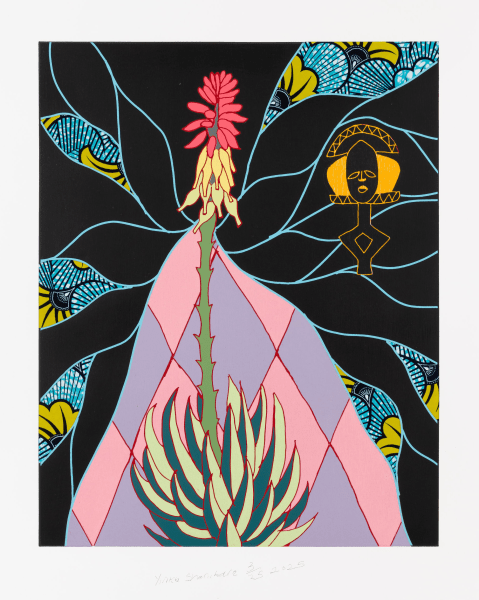
Yinka Shonibare African Flower Magic I, Courtesy Yinka Shonibare and Cristea Roberts Gallery, London © Yinka Shonibare
Cut out of society, immigrants have a hard road to tow as do non-Western outsider artists. It is with great empathy that Yinka makes this New World disorder a soft salad of coloured cut-outs and all worldly sculptures.
Shonibare’s fusion of Western art and literature with African sources raises questions about what identity is or could be in a global context. Is there a centre? Styles, historical or contemporary, scraped and sanded down by the minimalist aesthetic, result in a kind of white-cube conformity about what to touch and what not to touch, ideationally, in art. And often it’s race, class and the awkward interface between African primitivism and European art history. We saw this with Shonibare’s Nelson in a Bottle, commissioned for the 4th Plinth in 2010. This HMS Victory stands within view of Nelson’s Column (1840-43), a triumphal remnant of Empire if ever there was. This Victory has sails made of vivid African fabrics acquired by Shonibare at Brixton Market.
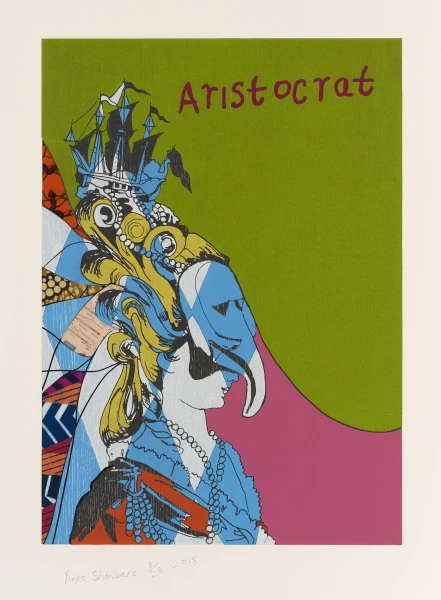
Yinka Shonibare Aristocrat I, 2018, Courtesy Yinka Shonibare and Cristea Roberts Gallery, London © Yinka Shonibare
At Yorkshire Sculpture Park, Shonibare’s large-scale fabric Wind Sculpture used similar African fabric patterns originally made by the Dutch after batik fabric designs in Indonesia, and later exported to Western Africa. As anti-monuments, Shonibare’s public sculptures are not associated with historical personages or events. This has the look of fabric frozen in motion by the wind, that’s all.
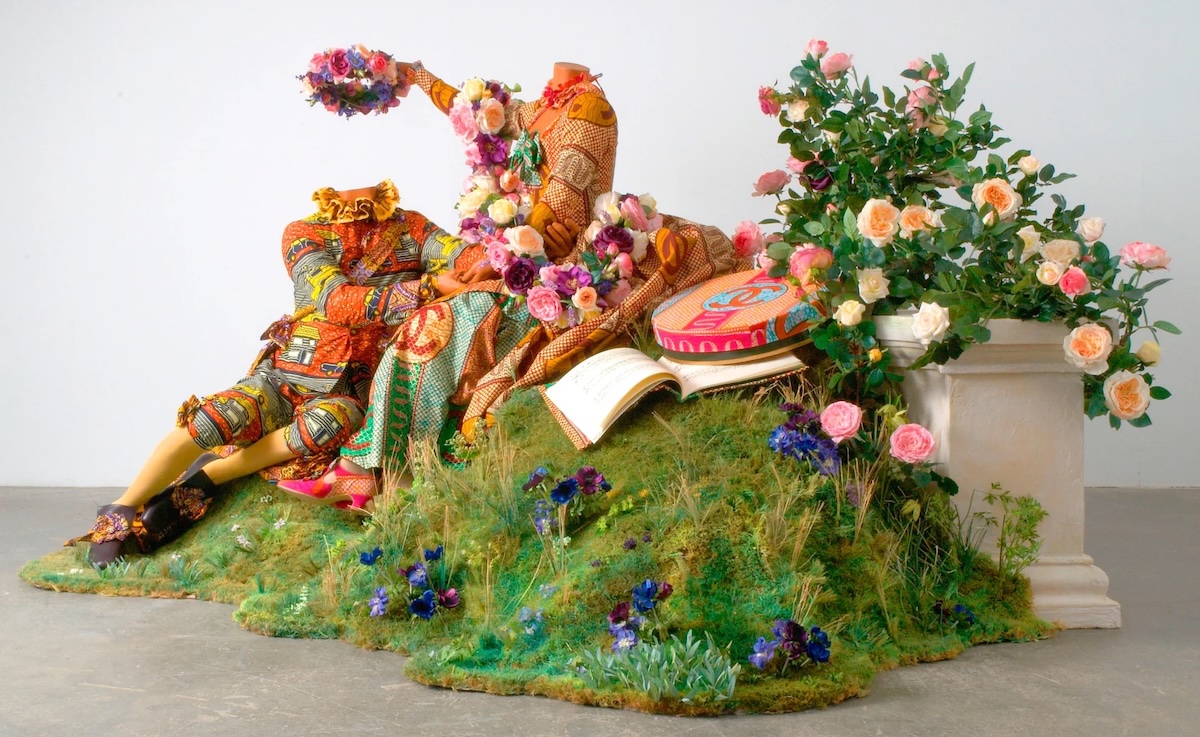
Shonibare’s post-colonial Pop vitality comes out in The Crowning (2007), based on Jean-Honore Fragonard’s painting The Progress of Love: The Lover Crowned (1771-72), a four canvas series consisting of The Pursuit, The Meeting, The Lover Crowned and The Love Letters originally painted for Madame du Barry, Louis XV’s mistress. The Crowning (2007) plays on the absence of vivid colour in much contemporary art and instead dialogues on intercultural communication. These two headless mannequin figures, covered in wax-printed cotton, are a complex reification of the tense contrasts between the aesthetics of the colonised and the empire. The luxurious 18th century costumes here aren’t silk, but replete with Chanel logos, and motor cars… the fabric shift and wrapping of these potential aristocrats brings the workers, labourers to mind who build that wealth – the so-called velvet hand of imperial inequity Noam Chomsky referred to…. The figures are headless, for Shonibare, because their race and background cannot be known – an open reading of ethnic history.
Smaller sculptures, presented like fetish objects in a glass vitrine, recall Western art’s multiple appropriations of foreign cultural sources. They include African Roots of Modernism (Mbundu Ngulu) (2023) and Bété Mask (2023). These hand-painted patterns and colours on miniature mask-like forms call to mind the Pompidou’s Les Magiciens de la Terre (1989) show, where appropriation of art from Zaire, China, Madagascar, Pakistan, Mexico, Tibet and South Africa was demonstrated by example. So-called primitivism had no representation but was finally recognised as an ongoing source for what we call Western art, one example being Picasso’s appropriation and reconfiguration of African mask sources as “modern art”.
As Shonibare makes clear, “My work deconstructs the grand narratives, rooted in the history of power and empire. I aim to look at those traditional icons and dismantle that power.” Like Kent Monkman and Brian Jungen, Yinka Shonibare exposes the gaps and missing links, the power imbalance in the lineage of Western art history. One hierarchy’s demise, may unfortunately leads to the creation of another… Shonibare presents a mirror to us all, so we can see that with a respect for cultural identity (our own included), we are all part of a global culture. He makes it happen with such a sublime sense of humour!
Yinka Shonibare CBE RA: Patterns of Power, The Arc, Winchester, 14 February – 3 June, 2026
Visit Here
Lead image: Yinka Shonibare CBE RA, The Crowning 2007, Arts Council Collection, Southbank Centre, London. Acquired in honour of Sir Peter Bazalgette, 2017. © Yinka Shonibare CBE. All Rights Reserved, DACS 2020