

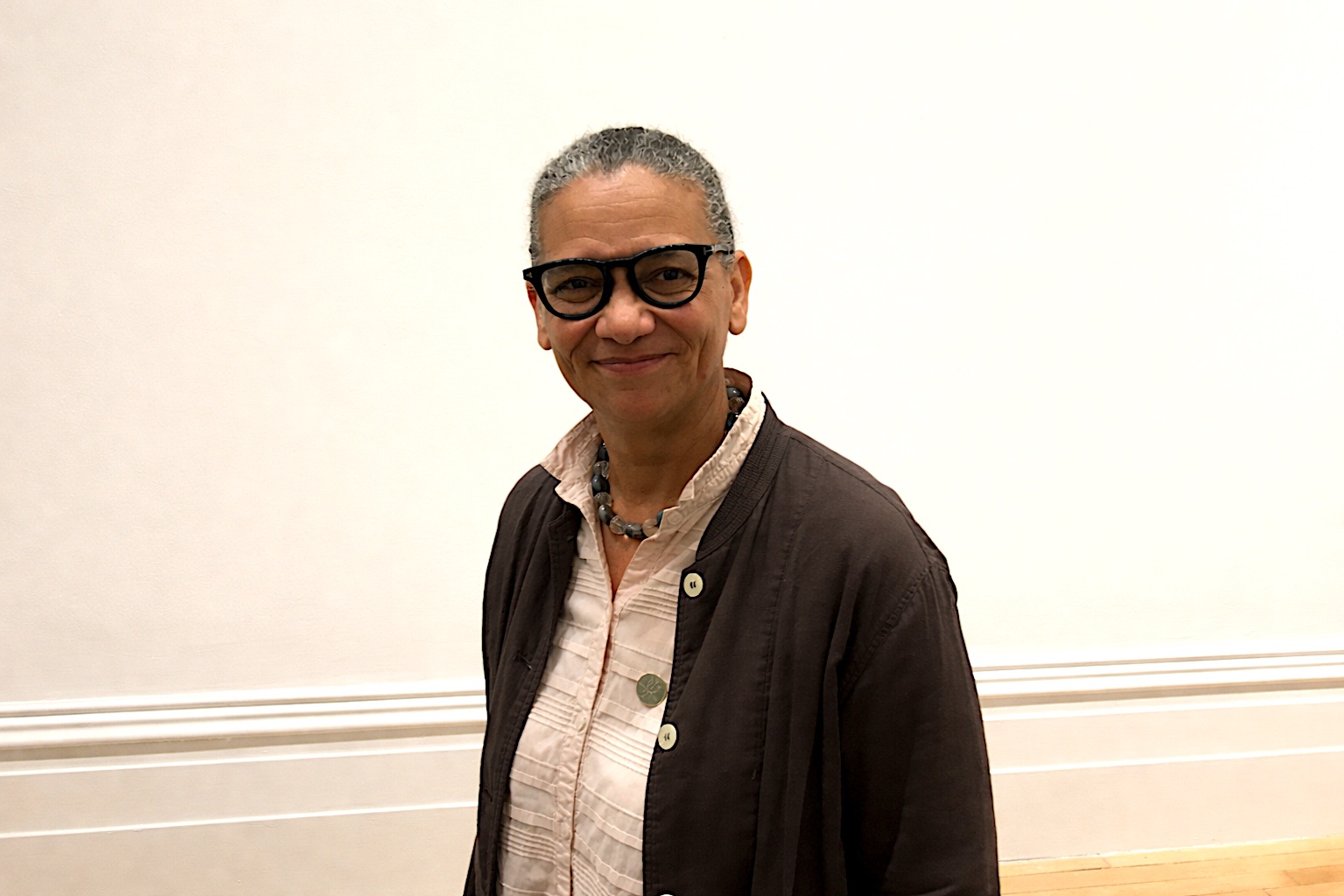
The British Council has released further details of Lubaina Himid’s forthcoming commission for the British Pavilion at the Venice Biennale. It will be a substantial solo presentation of new work titled Predicting History: Testing Translation. The exhibition unfolds as a meditation on belonging, on how one settles, adapts, and remakes the idea of home in unfamiliar terrain.
The pavilion traces the experience of navigating life away from one’s origins, describing a process shaped as much by uncertainty as by discovery. As the title implies, history resists prediction, and translation — whether cultural, personal, or linguistic remains forever provisional.
At its centre is a new body of large-scale, multi-panel paintings, saturated with colour and charged with dreamlike imagery. These scenes, poised somewhere between the theatrical and the uncanny, extend Himid’s long-standing interest in narrative and staging. Here, she operates simultaneously as a storyteller and director, constructing characters and dialogue while orchestrating the conditions in which they unfold.
Working with artist Magda Stawarska, she also introduces an immersive sound element that heightens the sense of dislocation and the tension that quietly runs through the installation. Together, image and sound give form to the subtle frictions, often unspoken, that shape the experience of belonging.
The exhibition responds directly to the British Pavilion itself. Its neoclassical architecture becomes part of the work’s language, reframed by Himid as a space of openness and possibility. Yet beneath this apparent welcome lies a subtle unease. Sound, text and imagery introduce dissonant notes, complicating any easy reading of Britain as a place of uncomplicated refuge.
Himid, born in Zanzibar in 1954, has long been recognised as a pivotal figure in British contemporary art. Her work engages with race, feminism, cultural memory and the politics of representation, often drawing on archival research and storytelling to challenge dominant Eurocentric narratives. Across her work, overlooked histories and marginalised voices return to visibility, unsettling established accounts of the past.
Reflecting on the project, Himid describes the complex emotional terrain that underpins the exhibition. She speaks of the ways private spaces are filled with memories, both real and imagined, and with objects, recipes and music that offer reassurance in unfamiliar surroundings, even as they remind us that the past cannot be erased. “This is that place,” she says. “We cannot leave it. These are the plans; we continue to make them.”
Emma Dexter, Director of Visual Arts at the British Council Collection and commissioner of the British Pavilion, frames the exhibition as an immersive environment shaped by colour, sound and narrative. She describes the project as a reflection on the UK as a site of both possibility and tension open yet complex, and defined by a multiplicity of voices and histories.
Ese Onojeruo, Shane Akeroyd, Associate Curator of the British Pavilion, notes the collaborative nature of the project’s development in the lead-up to the 61st International Art Exhibition of La Biennale di Venezia. He highlights the role of dialogue and care within Himid’s practice, describing the process of supporting the work in Venice as both an honour and a formative experience.
Ruth Mackenzie, Director of Arts at the British Council, situates the commission within the organisation’s broader ambitions to foster new perspectives through art and architecture. She emphasises Himid’s ability to intertwine personal narratives with broader global histories, raising questions about migration, memory, and shared experience.
Support for the commission comes from the Art Fund, which will also help facilitate a UK tour following the exhibition’s presentation in Venice. Additional partners include Frieze and the Henry Moore Foundation, as well as private donors and the British Council’s Ambassador Circle and Global Circle.
Himid’s career spans several decades and is closely tied to the emergence of the Black British Art Movement. During the 1980s and 1990s, she curated several landmark exhibitions, including Five Black Women (1983) at the Africa Centre in London and The Thin Black Line (1985) at the Institute of Contemporary Arts. Both projects foregrounded Black women artists at a moment when their work was largely absent from mainstream institutional spaces. In 2025, she revisited The Thin Black Line at the ICA, expanding its scope and renewing conversations around representation and artistic practice.
Historical inquiry also informs the Le Rodeur series (2016–17), which takes its name from a nineteenth-century French slave ship associated with a notorious atrocity in 1819. Figures in these paintings occupy ambiguous temporal settings, hovering between past and present, their presence insisting on the continuing relevance of historical trauma.
More recent works address related concerns in different ways. The ongoing Men in Drawers series transforms found wooden drawers into intimate spaces of reflection, their concealed interiors revealing painted portraits of Black figures. The Aunties (2023) series, composed of sixty-four painted and collaged planks, honours the often unacknowledged women who shape extended networks of care and kinship. In the Strategy Paintings (2023), groups gather around tables to debate, deliberate and problem-solve, accompanied by symbolic objects — lemons, teeth, gondolas that complicate interpretation and suggest the ambiguities of decision-making.
Himid lives and works in Preston, where she is Emeritus Professor of Contemporary Art at the University of Central Lancashire. Her achievements include the Turner Prize in 2017, the Maria Lassnig Prize in 2023 and the Suzanne Deal Booth | Flag Art Foundation Prize in 2024. She is represented by Hollybush Gardens in London and Greene Naftali in New York. Her work continues to resonate internationally, alerting us to the unfinished business of history.
Photo: P C Robinson © Artlyst 2026